
Sir Keir Starmer pledges to 'fight' social media companies to keep children away from phones

Prime Minister Sir Keir Starmer has promised a “fight” with social media firms over efforts to keep children away from mobile phone, tablet and TV screens.
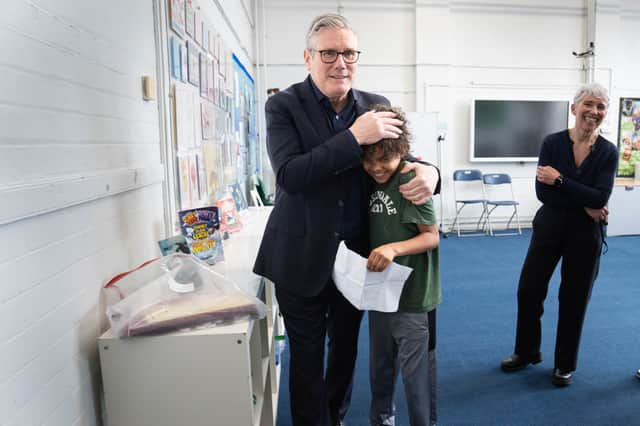
Parents have been searching for what is appropriate screen time and social media use for their children without any help, Sir Keir said as he visited a school yesterday.
The Government has now issued guidance that advises parents of younger children to limit screen time for two to five-year-olds to an hour a day, and less if possible.
For children under two, screen time should be avoided unless for shared activities that encourage children to interact with others, parents have also been advised.
The Prime Minister said: “When there’s a lot going on, when children are having a tantrum, trying to find something to distract them is an obvious thing and I don’t think parents and carers have had any guidance at all yet about what would be appropriate, what might be best.”
The guidance to parents on screen time for two to five-year-olds will advise them to “try to keep it to one hour a day. Less is possible”.
For the screen time that two to five-year-olds do have, families will be advised to avoid fast-paced social media-style videos and toys or tools that use artificial intelligence (AI).
Bedtimes and mealtimes should be screen-free, with families advised to instead try background music, table games, bedtime stories, and colouring.
Watching screens with children and talking and asking questions about the content is also better for a child’s cognitive development than letting them use them alone, the guidance will say.
Shared screen activities could include video calling friends and family or looking through photos together, parents will be advised.

Around 98% of children are watching screens on a daily basis by the age of two, the Government has previously said, and those with the highest screen time see an impact on their language.
The guidance was developed by a panel led by children’s commissioner Dame Rachel de Souza and children’s health expert Professor Russell Viner.
Prof Viner, a paediatrician and professor at University College London, said he would next like to see the Government issue more specific advice to parents on what is actually good content for their children to see.
He said: “What we have suggested to the Government is better guidance from educationalists on what’s good content and actually what isn’t, because there’s a lot of educational content out there making all sorts of claims that can be confusing for parents.”
Prof Viner said long periods of watching screens without interactive engagement “crowd out” important things for young children’s development like sleep and physical activity.
Appearing on ITV’s Good Morning Britain, Education Minister Josh MacAlister said there has been “a complete rewiring of childhood” over the last decade due to social media and screen time.
“For parents of really small children, we’re trying to help create some new social norms,” he said.
“There’s no judgment. It’s much easier to say these things than it is to do them, I appreciate.”
The Government is also currently consulting on how to protect children under the age of 16 online, which could include an Australia-style social media ban or measures like time limits and curfews.
Sir Keir added: “Some of this will require a fight. If we’re going to do more to protect children, we’re going to have to fight some of the platforms that are putting the material up there because they’re putting this addictive stuff up there for a reason.
“They want more children to spend more time online and we’ve got to fight them and be clear whose side we’re on here.”
The Prime Minister told reporters on Thursday he was very keen to tackle addictive features on social media.
Prof Viner added that evidence from Australia and from a trial on different restrictions, will help the UK to make decisions on how to protect young people.
“We absolutely need to do something to limit the exposure of adolescents to harmful content, as that’s the real issue,” he said.
“I absolutely support thinking about how we get social media companies to design things that are pro-development by design.”
A jury ruled on Wednesday in Los Angeles that Google, owner of YouTube, and Meta, which runs Facebook, Instagram and WhatsApp, built platforms to hook young users without regard for their wellbeing.
In a 2020 internal exchange revealed in the trial, Meta employees described their own platform as “a drug” and themselves as “basically pushers”, comparing social media’s hold on users to gambling.
Experts have said this is a landmark ruling that could change the way social media addictiveness is enforced in the US.
Leanda Barrington-Leach, executive director at charity 5Rights, said: “The tide is turning on the attention economy.
“Governments around the world are stepping up to set clear rules for how technology is designed, and the courts are beginning to hold companies to account.
“The message is clear: taking on tech is possible; a better digital world for children is possible.”