
Amar Latif: 'I lost my sight at 18 but it hasn't stopped me seeing the world'
Adventurer Amar Latif lost his sight aged 18 – but it hasn’t stopped him seeing the world. He has been skydiving in Cuba, surfing in Hawaii, ice-skating in Canada and scaled Kilimanjaro – and he set up a travel company to help thousands of blind travellers see the world.

His latest project is fronting the BBC Radio 4 Appeal for Rafiki Thabo Foundation, a charity which helps disadvantaged children and young people in communities in Eastern Africa to access education and which this year celebrates its 20th anniversary.
Amar, 51, who lives in Leeds, was diagnosed with a rare genetic condition called retinitis pigmentosa when he was four. “When I was at school and gradually losing my sight, my desk was moved to the front of the class and I was so self-conscious,” he says. “I wasn’t confident as it was hard to know what was happening around me.”
His life changed forever when, aged 18, he lost his sight completely. “One day, I went to bed as normal and the last thing I saw before I went to sleep was the poster of Madonna at the end of my bed. But when I woke up, I couldn’t see it. At first I thought it was morning fuzz but I realised I couldn’t see my desk or chair. I thought: Is this it?

“It was complete whiteness. I felt claustrophobic and couldn’t breathe. I kept closing my eyes and opening them hoping I would see my Madonna poster. I kept bumping into things and when I went downstairs I couldn’t see the faces of my friends and family. I didn’t want to believe it was real.”
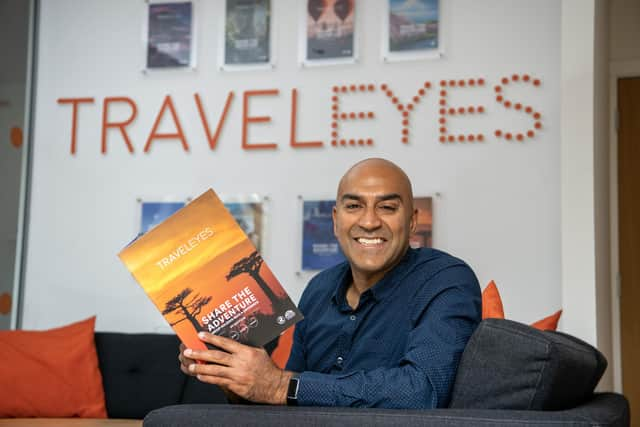
Amar was determined to go to university as planned and kept up with his studies by listening to his classmates’ notes recorded onto tape. In his third year, he studied in Canada, exploring New York and Vancouver and experiencing everything through the descriptions of friends. It was this which inspired him to set up Traveleyes, which takes groups of blind and fully sighted travellers all around the world - from tea-tasting in Sri Lanka, to dancing in Cuba, and rainforest walks in Costa Rica.
A sighted traveller is partnered with a different visually impaired person each day and in return for ‘being their eyes’, they get to travel for a significant reduction in price. Amar, originally from Glasgow, says: “I might be blind but I have seen the world...I want others to experience that too as it can be life-changing.”
The entrepreneur, who was awarded an OBE in 2023, says his success is thanks to his education, something which his work at Rafiki Thabo Foundation has highlighted. “I heard about a young girl called Praise who was abandoned by her father at eight years old because she was suddenly blind,” he says. “She was stigmatised, terrified, and hungry, and her dreams of an education and a better future seemed impossible but she became a scholar, supported by Rafiki Thabo Foundation and is now on her way to realising her dream of becoming a lawyer.”
The foundation provides a scholarship programme and school meals, improves school facilities, and works to reduce barriers to education faced by children with disabilities for children in Kenya, Lesotho and Uganda. In 2023, Amar joined a trek up Mount Kilimanjaro for the charity. As he battled altitude sickness and the 59,000 metre-high climb, he struck up a friendship with a man called Ayiesa, who had grown up in a village in Western Kenya.
He lived in poverty and suffered malnutrition and there was no money for school fees. But Ayiesa was determined to get an education. Unable to attend school, he studied at home, alone. From a young age, he mended shoes, collected firewood, and scavenged plastic from rubbish tips to pay to sit the end of school exams. When he was 25 he got a scholarship through Rafiki Thabo to go to university and he now has a government job, pays for his four children – and two others - to go to school and mentors 10 young people to help them get the most out of their education. He also helps run a centre for children living with developmental disabilities.
Amar says: “Ayiesa’s story was very inspiring and in some ways life-changing. It made me aware of how different my life could have been if I had been born in Pakistan where my parents are originally from and where views towards disability are very different. My blindness could have meant I ended up begging on the streets. Having access to education has given me opportunities and so I want to pay that forward to help others.”
To donate, visit rafiki-foundation.org.uk