
Artificial Intelligence in the NHS: How AI is helping to detect health conditions
In December last year, John Pengelly’s story made local and national news. The former army captain, of Bradford, was an example of how a new AI algorithm could help to identify a hidden heart condition that increases a patient’s risk of having a potentially fatal or life-changing stroke.

The retired grandfather was diagnosed with Atrial Fibrillation (AF) in summer 2024 after taking part in a trial investigating the algorithm called FIND-AF.
Developed using machine learning, the technology searches people’s GP records to identify red flags that suggest they are at risk of developing AF in the next six months - and these people are then offered further testing to confirm a diagnosis.
“I didn’t have any symptoms,” John, then 74, told news outlets. “I’d occasionally get a bit breathless when I’m out and about, but that’s because there’s so many hills around us and some of them are really steep.”

It is estimated that AF is a contributing factor in around 20,000 strokes each year in the UK. Whilst there is treatment for those with AF who are at high risk of stroke, some people miss out because they don’t know they are living with the threat to their health.
Chris Gale is a Professor of Cardiovascular Medicine at the University of Leeds and led the trial.
“The fundamental problem is that often when we identify AF it’s when someone presents with a stroke or presents with one of the other complications of AF such as heart failure or rapid palpitations or heart attack,” he says. “Arguably, that’s too late. The AF has been there and it’s caused a problem…One of the missions here is to see if we can identify AF before any of this happens, or in people that have got it and don’t know about it.”
The FIND-AF algorithm was developed by scientists and clinicians at both the university and Leeds Teaching Hospitals NHS Trust, with funding from the British Heart Foundation. Using the anonymised electronic health records of over 2.1 million people, the team trained the algorithm to find warning signs that suggest that people are at high risk of developing AF in the next six months.
Prof Gale, who is also an honorary consultant cardiologist in Leeds, says: “If the score says you’re unlikely to have AF, you’re very very unlikely to have it, which is a good rule out test…It doesn’t detect everyone but it detects AF that hasn’t already been detected or diagnosed at a much higher rate than other studies.”
The team are now looking to partner with the NHS to roll out the algorithm, which Prof Gale says could also detect other potentially modifiable cardiac diseases.
In its ten year plan for the health service, the Government pledges to “make the NHS the most artificial intelligence-enabled care system in the world”, noting how its uses can include liberating frontline staff from admin, supporting the interpretation of genomic data, and enhancing the effectiveness of diagnostics.
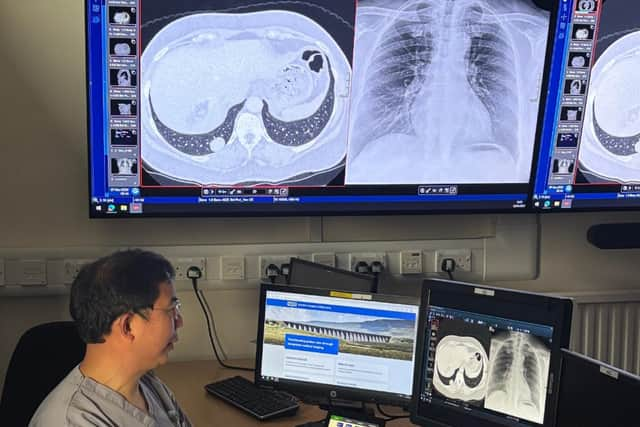
In hospitals up and down the country, AI tools are already being implemented to help read and interpret imaging of the body, including x-rays and scans of organs such as the heart and kidneys.
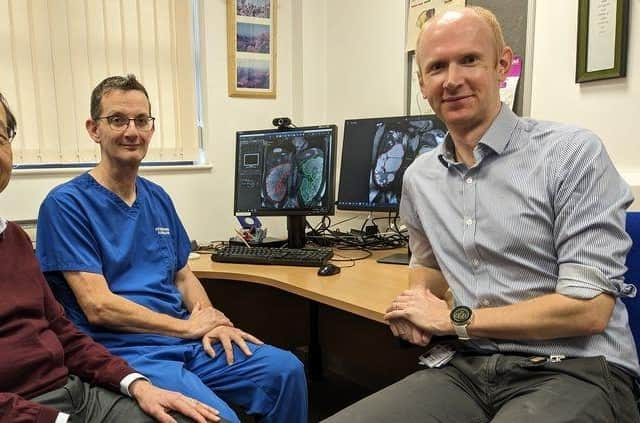
In Sheffield, for example, kidney doctors and clinical scientists at the University of Sheffield and Sheffield Teaching Hospitals NHS Foundation Trust are using artificial intelligence to better predict when a person’s kidneys might fail, using data from MRI scans.
Professor Albert Ong, Consultant Nephrologist and Clinical Lead for Genetics at the trust, has been using the tool in his specialist kidney clinic, and says the software is six times faster than manual processes.
The tool provides an accurate and quick analysis of total kidney volume, a measurement used to assess future kidney lifespan in patients with a common inherited condition known as ADPKD.
Another AI tool developed by the trust and university featured on BBC’s Panorama earlier this year. That software aims to speed up heart disease diagnosis, providing a quick analysis of images and scans of the heart, and performing complex measurements of its function within minutes.
Without the AI, these would otherwise have to be calculated by radiographers or doctors painstakingly drawing around images of the heart’s chambers on multiple images.
Elsewhere in Yorkshire, The Doncaster and Bassetlaw Teaching Hospitals Trust is one of several in the country that uses AI in its radiology services, to support the reading of chest x-rays and non-contrast CT brain scans.
The technology assists clinicians with their triage work by detecting a range of findings and flagging and prioritising cases based on different urgency levels.
Meanwhile, the Yorkshire Imaging Collaborative (YIC) - the collective name for six NHS trust radiology departments working together in the region - has implemented AI to help with diagnosing diseases more quickly.
Every year, approximately 400,000 chest X-rays are taken across the trusts, which require interpretation by specialist radiologists or reporting radiographers. The software acts like a second pair of eyes for clinicians, allowing them to prioritise the review of the chest X-rays identified as suspicious or requiring further investigation. The aim is to help to identify serious conditions, such as lung cancer, earlier so that patients can begin treatment sooner.
Dr Daniel Fascia, Consultant Musculoskeletal Radiologist and Clinical Lead for YIC, says the technology is also helping to reduce backlogs and supporting staff outside the radiology team to get patients on the right care pathways sooner.
“As radiologists we are really good and very highly trained at looking at all these but we are a workforce in super short supply,” he says. “Where this is really adding value is empowering people who are not as trained (in this area) as we are to pick things up earlier - for example, a junior doctor working in acute medicine on the wards at night or a nurse practitioner in a minor injury unit or emergency department. The AI software highlights to them a very important finding like a potential cancer and they can act on it at that first meeting of the patient to start directing them towards the right care.”
According to the NHS’s AI and Digital Healthcare Technologies Capability Framework, AI is being piloted in healthcare for faster and more accurate diagnoses and for assisting with or automating repetitive tasks, with the aim of supporting the reduction of errors caused by human fatigue, decreasing costs, and reducing mortality rates.
It is, however, not without its challenges including AI algorithms being dependent on the data used to train them, maintaining privacy, “ethical and regulatory issues around accountability, fairness, transparency and trustworthiness” and the need for the health and social care workforce to have a working understanding of the technology.
To help understand patient and staff attitudes towards the use of AI in health care, the Health Foundation charity commissioned a survey, conducted in June and July 2024, of over 7,000 members of the public and 1,200 NHS workers.
Reporting its analysis, the charity said that more than half of the UK public (54 per cent) and three-quarters of NHS staff surveyed (76 per cent) said they support the use of AI for patient care, and an even greater proportion said they support the use of AI for administrative purposes (61 per cent and 81 per cent respectively).
However, concerns highlighted included AI’s potential impact on the social and relational aspects of healthcare (patients and staff feeling more distance from one another) and the potential impact of AI on decision-making accuracy, with 30 per cent of the public believing the main disadvantage of AI will be that healthcare staff will not question the outputs of AI systems, and so may miss errors.
Summarising key points from the research last year, the charity said: “These results suggest that AI technologies will need to be designed and used in ways that protect or even enhance the human dimension of care…The public are also much more likely to support the involvement of AI in decision making where AI outputs are checked by a human. These results suggest the public strongly value keeping a human in the loop for many uses of AI in healthcare.”