
Dentistry in crisis: 'It’s easier to access dentistry in a warzone than it is in Yorkshire'
“It sounds like something out of a horror story, but it’s actually happening,” Ashley Green, the chief executive of Healthwatch North Yorkshire, tells me, as he discusses the county’s dentistry crisis.
Mr Green explains that one person came to his organisation, which collects patients’ experiences of the NHS to improve services, after having pulled out of their own teeth.
“They can’t register, they can’t get an appointment with an NHS dentist,” he says.
“They’re having to turn to private care if they can afford it.”
Those that can’t, Mr Green says, on occasion “resort to self extraction”.
“People are too scared to go out of the house because they’re so self-conscious about the state of their teeth,” he adds.
Tragically, shocking stories like this are not uncommon as access to NHS dentistry across the region is almost non-existent.
According to the British Dental Association’s survey 97 per cent of people who try and access NHS dental services across Yorkshire and the North East fail.
Experts say that while some practices state they carry out NHS work, many are actually not taking on any patients and lengthy waiting lists effectively prohibit procedures.
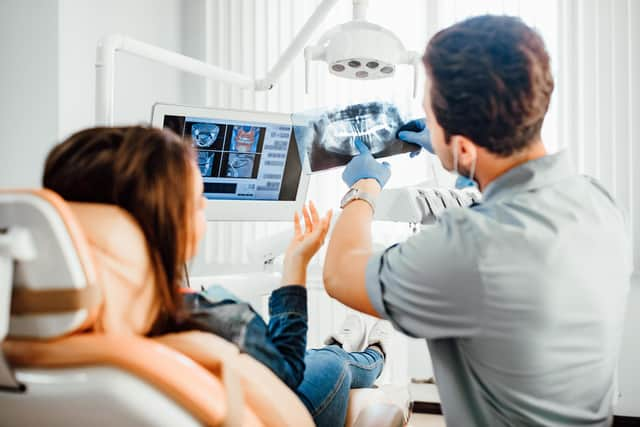

Others only agree to take on children if their parents choose to use the dentists on a private basis, a practice which is illegal but sadly far too common.
A recent Health and Social Care Select Committee report found that four of five integrated care board areas with the lowest number of dentists doing NHS work in the country were in Yorkshire and Lincolnshire.
This leads to situations where Ukrainians in York, who have fled the war, are heading back to their home country to have dental work.
Healthwatch York manager Sian Balsom explains: “We’ve heard more than once of people going back to Ukraine for dental treatment, because it’s easier to access dentistry in a warzone than it is in Yorkshire.
“They couldn’t get credit to pay for private treatment and they couldn’t find anywhere in the NHS.
“‘What am I supposed to do other than going back to Ukraine?’ they said. It felt like the only way they could access that support.”
Another person told Healthwatch York they fly back to Spain every time they need dental treatment as it’s far cheaper.
In one case, Ms Balsom explains, a York resident lost their dentist because they were stuck in Egypt during the country’s revolution in 2011.

“That’s 14 years ago - they still haven’t been able to find an NHS dentist,” she explains.
The overwhelming message from patients, Ms Balsom says, is “what do I do?”
Be it, the person with multiple sclerosis who couldn’t find a single NHS dentist after suffering a fall, or the grandmothers who can’t eat properly because they have lost their dentures. The only option, it seems, is to pay to go private.
“In York, we’ve seen a number of dental practices go private and the regional commissioners have worked really hard to bring further provision into the city,” Ms Balsom says
“It’s not enough, it’s nowhere near enough, it hasn’t even replaced what we’ve lost, but they’re working really hard with what we’ve got.”
Both Ms Balsom and Mr Green say issues with dentistry are one of the top subjects that people get in touch with Healthwatch about.
Earlier in the year, Care Minister Stephen Kinnock announced that 80,000 additional urgent NHS dental appointments will be available in Yorkshire for patients with infections, abscesses and cracked or broken teeth.
At the time, he told The Yorkshire Post that he had heard “heartbreaking stories of people having to remove their own teeth with a pair of pliers”.
“We inherited an NHS dentistry system that is on its knees,” he said.
“A staggering one in four people across England can’t get an NHS dental appointment, and the biggest cause of children, between five and nine, being admitted to hospital is to have their rotten teeth removed, is, frankly, a disgraceful state of affairs.”
The Government has also just recently rolled out its controversial supervised school tooth brushing scheme for three to five-year-olds in deprived areas.
However, the British Dental Association has questioned why the Government took so long to take action on NHS dentistry.
Shiv Pabary, chair of the BDA’s General Dental Practice Committee, said: “It’s progress, but government could have fired the starting gun on commissioning urgent care last summer.
“Action here will translate into just two extra slots a month for each NHS dentist.
“NHS dentistry had ceased to exist for families across Yorkshire long before Covid struck.
“Ministers must now confront the failed contract that’s left millions with no options.”
Mr Kinnock said he recognised “that there’s a bigger piece of work to be done about routine dental treatment and about prevention, and we need to renegotiate the NHS dentistry contract to make it more appealing”.
However, there has been little update as to when this will happen.
Ms Balsom tells me: “We need a solution that gives proper access to good oral hygiene, and the contract, we’ve said it so many times, the contract needs ripping up and a new one designed about maintaining the oral health of the practiced population.
“People need to have a right to be registered with a dentist like you are with a GP, you need to be on that patient list and they need to be responsible for your oral health.”
Mr Green adds: “We need permanent registration for patients, similar to how people register for GPs, to ensure care is more consistent.
“Because if you don’t, people are going to resort to pulling their teeth out and presenting at accident and emergency in severe pain.
“If there’s that investment now, it’s going to prevent that further down the line.”
An earlier version of this article incorrectly stated that House of Commons Library research found that just 11 per cent of all dental practices across the North East and Yorkshire are open for NHS activity. In actual fact, it found that practices spend 89 per cent of their time on NHS services and 11 per cent of their time on non-NHS services.