
'I'm here and I'm loving life' - Yorkshire cancer patients among inspiration behind new Simon Armitage poem for World Cancer Day
Yorkshire-based Poet Laureate Simon Armitage has written a new piece for World Cancer Day, inspired by the experiences of people in the region. Laura Reid hears some of their stories.

It’s not lost on Nicky Tschumi-Leake that she’s in her fifties, well and cancer-free. Her mum died at 56, her grandmother at 44. “I’ve lost other women in my family around this age too,” Nicky says. “Our whole female line was practically wiped out due to breast and ovarian cancers.”
For Nicky, thanks to cancer research and advancements in medical science, that risk is vastly reduced.
“Look at me, I’m here and I’m loving life,” the 52-year-old enthuses. “I’m a very lucky person, extremely lucky. I shout it from the rooftops.”

Nicky, from Doncaster, lost her mother in 2006. Despite her family’s history with cancer, the diagnostic tests needed to identify a genetic link were not widely available at the time and it wasn’t until more than a decade later that Nicky discovered she had inherited a faulty BRCA1 gene - and a very high risk of developing cancer alongside it.
It was January 2018 when she got the results and by May that year, she was under the knife, opting for an operation to remove her breasts, and then another that December to remove her ovaries.
“It was weird to see the diagnosis in writing,” Nicky reflects. “The red flags were there. It’s not that I wasn’t worried, because I was with all the family history but to see it confirmed was still a bit of a shock.
“With finding out, you need to act on it. If you don’t know, you leave it to fate almost but when you know (you’re at risk), you need to take action. That was a little scary.”
Nicky says she was told by medics she had an 89 per cent chance of developing either breast or ovarian cancer. She opted for surgery over regular screening.
“I wouldn’t board a plane that had an 89 per cent chance of crashing and that was the attitude I took,” she says. “I have a daughter, I have family, I saw what my mum went through and it wasn’t at all pretty and I was just thinking I really don’t want this.”
Nicky is one of an estimated 1 in 400 people in the UK carrying a faulty BRCA gene, a genetic change that significantly increases a person’s chances of getting certain types of cancer, like breast, ovarian, prostate and pancreatic cancer.
She is also one of the voices from across Yorkshire who have inspired new work by Yorkshire-based Poet Laureate Simon Armitage to mark World Cancer Day today (February 4).
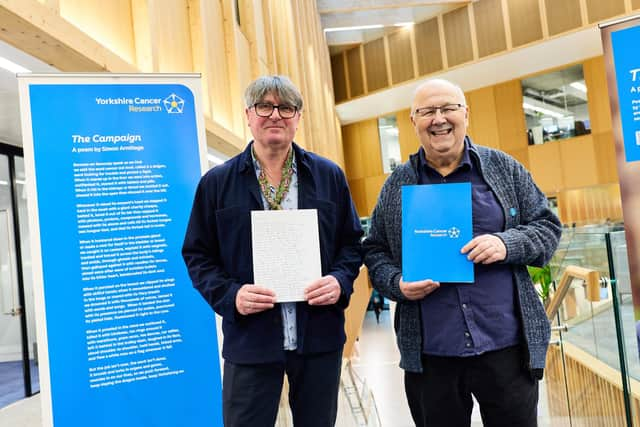
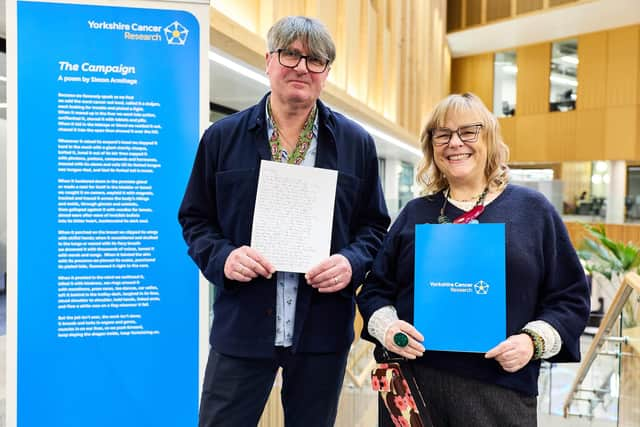
Commissioned by the charity Yorkshire Cancer Research (YCR), the poem, entitled The Campaign, pays tribute to a century of progress in prevention, diagnosis and treatment, while highlighting the work still needed to create a future free from cancer in this region and beyond.
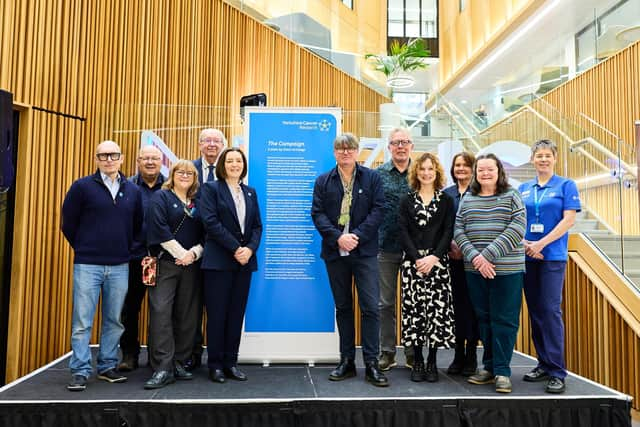
Every 17 minutes, someone in Yorkshire is told they have cancer, and before writing the poem, Simon visited the YCR centre in Harrogate to hear from 17 people affected by cancer in some way.
These included researchers who are instrumental in pioneering new discoveries, as well as fundraisers dedicated to saving lives, families who have lost loved ones, and those living with cancer.
Former headteacher Gary Lovelace is among the latter. The 68-year-old, who lives in Leeds, has advanced kidney cancer. Gary’s diagnosis came in 2021, after he slipped in the bath and discovered a lump in his side. He underwent surgery to remove the cancer, but later scans revealed it had spread to other parts of his body and it was deemed to be incurable.
Gary now receives ongoing treatment to help slow its progression and has turned his attention to fundraising to support the work of YCR, which last year marked its 100th anniversary.
“Part of me feels lucky because if I had got this disease 10 or 15 years ago, these treatments I’m benefitting from now wouldn’t be around,” he says. “Most of the time, I live a full life, I’m busy, I’m involved in football, I go to lots of gigs, and spend time with my family.”
He’s responding well to medication and hopeful for more time to come “but you can’t help having all sorts of different thoughts,” he says. “I get on with my life a lot of the time but you can’t help thinking what’s it going to be like when I’m not around, with my wife, my family, my grandchildren. It can be difficult.”
“People talk about the fact that we’re all going to die but it’s a bit more pertinent when you know you have an incurable, inoperable disease,” he adds.
Gary has taken part in a number of fundraising initiatives for YCR, including raising thousands of pounds by “laughing at death” in a bet with an old school friend, who was a war reporter in Ukraine, over who would die first.
“Lots of people hear the word ‘incurable’ and assume that your life is over. If I can, I want to show people in my position that’s not necessarily so,” he says.
Sharing his experience with Simon was “humbling, inspiring and powerful”, Gary says. “We all shared our different experiences and perspectives of this dreadful disease with admiration and positivity; the atmosphere in the room was palpable.”
Simon was also inspired by a defining moment in the charity’s history - its first public fundraising appeal 100 years ago. In January 1926, at the Queen’s Hotel in Leeds, the organisation’s first Honorary Secretary, Sir Harold Mackintosh, issued a rallying call across Yorkshire to “deliver the attack upon cancer, the great enemy of mankind, and become the new Saint George in the work of slaying the dragon.”
His words sparked an extraordinary wave of generosity, raising £140,000 (the equivalent to more than £7 million today) for cancer research in Yorkshire.
“I ran with the idea of cancer as an ‘enemy’ that must be tackled through ingenuity, decades of research and painstaking discovery,” Simon says. “Cancer is also a dragon in the mind, demanding a certain bloody-mindedness - a true Yorkshire characteristic – to overcome this shadow and threat to our daily lives.”
Dr Kathryn Scott, Chief Executive at YCR says the poem was a “poignant and lasting” way to mark the charity’s centenary, capturing the spirit of Yorkshire and the region’s resilience, generosity and determination.
She was moved to tears on her first read. “There’s a lot of emotion in cancer research when you’re talking to patients and their families,” she says. “And people seek comfort and reassurance in all sorts of places including in poetry and the arts generally. It’s not all about the hard science, the drugs, the surgery. You need some light in a dark place and for some people, poetry really can do that. This poem is really accessible. It’s written with the Yorkshire dialect in mind and about the experiences of Yorkshire people.”
For Nicky, it was the word ‘hope’ that stood out in the conversations that she and others had with Simon.
People don’t always consider a genetic link with cancer and she hopes to get across the message that there’s testing out there and options regardless of the result.
Reflecting on her surgeries, she says: “Unlike a cancer survivor, you’re walking in perfectly fine and healthy and you come out a different person in more ways than one. I was in a lot of pain, a level I didn’t anticipate.”
“I felt a bit guilty,” she continues. “I called it the coward’s way out when there’s so many brave souls fighting cancer. It was a bit like imposter syndrome when I met cancer survivors because my place wasn’t there, I’d cheated what potentially would have been my destiny as it were. It’s taken a long time to get to the point now where I’m here talking about it, not hiding behind it, wanting to raise awareness.”
Nicky now campaigns for improvements in genetic testing and treatment, so she can help to shape a better future for her 21-year-old daughter.
She is backing seven leading cancer charities, including YCR, in calling for new early-stage studies and clinical trials into whether PARP inhibitors – drugs already used to treat cancer – could one day be used to reduce the risk of cancer for people at high genetic risk.
“More cancer prevention research means my daughter could have choices I didn’t,” Nicky says. “The more options she has, the better her future could be. Developing pioneering cancer prevention treatments like PARP inhibitors could mean my daughter won’t have to worry about cancer like I have.”
For more about the voices who inspired Simon’s poem The Campaign, visit www.yorkshirecancerresearch.org.uk/the-campaign-simon-armitage