
'I'm one of first in world to try new therapy for incurable muscle disorder FSHD - and I can do so in Sheffield'
When Lauren Clarke was 14, she was diagnosed with a rare, incurable muscle-weakening disorder. Ten years on, she has become one of the first patients in the world to take part in a pioneering research study, exploring whether the disease’s progression can be disrupted.

Lauren, aged 24, has facioscapulohumeral muscular dystrophy (FSHD), a muscle-wasting condition caused by a genetic mutation, which activates a gene that shouldn’t normally be switched on. The gene increases the toxic build-up of the DUX4 protein in muscle cells, resulting in loss of strength in the face, shoulders, arms, legs and hands. There are currently no approved drug treatments to help.
Lauren, who lives in York, can no longer stand for prolonged periods of time and struggles with simple daily activities such as washing her hair. She is one of only a relatively small number of patients across the world to take part in the new trial, known as FORTITUDE, through Sheffield Teaching Hospitals NHS Foundation Trust.
The therapy, developed by Avidity Biosciences Ltd, USA, is the first to target the gene. By silencing it, researchers believe that the disease’s progression can be disrupted, improving outcomes for patients. Lauren was initially apprehensive about signing up to the first-in-human trial. But she says it offers hope for the future, both for herself and others.
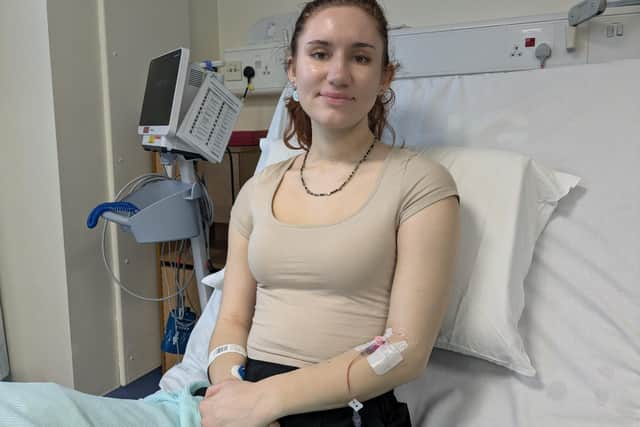

"With the stage I’m at, with it affecting my walking so much, if there’s a chance to stop progression, now would be the time. I thought I need to take the chance. I’m still a bit nervous but I do feel very lucky to be taking part as not everyone is suitable. If it improves strength that’s incredible but if it slows down the disease even just a little bit, that’s massive too.”
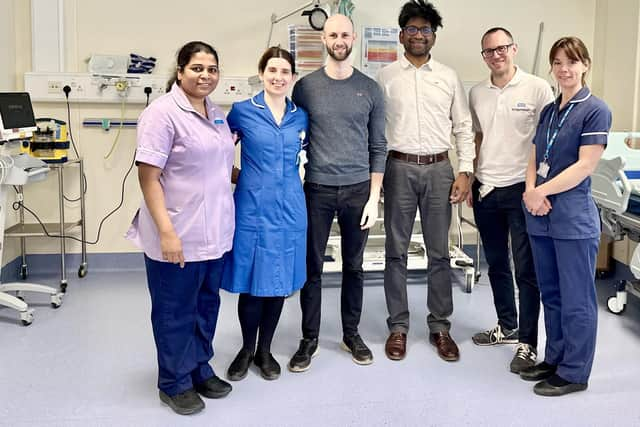
Dr Channa Hewamadduma is a principal investigator for the trial and a Neuromuscular Consultant Neurologist in Sheffield. He says this novel treatment could suppress the active gene which causes muscle wastage. If muscles are already dead, the damage is irreversible, he says, but where muscles are affected and in a stunned state of neither being dead nor functioning properly, they’re potentially recoverable.
“If you’re recovering stunned muscles to become good muscles then probably you’re gaining some function,” Dr Hewamadduma explains. The therapy could also help to stop ‘good’ muscles from being affected. “If you’re preventing good muscles becoming stunned muscles, that means you are preventing further deterioration.”
Any improvement or stability would be welcomed by Lauren, whose condition has progressively worsened since diagnosis in 2015. She sought medical attention after her mum spotted her struggling to tie up her hair, noticing she was only able to do so when leaning against the wall with her arm. “I couldn't raise my arm properly,” she says. “It sounds a bit weird looking back, but it had been such a gradual deterioration, I almost didn’t notice or think too much about it.”
In November 2015, after a series of tests, she was given a formal diagnosis. “You look back and see different signs. When I was younger I couldn’t use a straw and I couldn’t do a sit up but you don’t take your daughter to the doctors for that...I remember looking up FSHD on the internet and thinking is this going to be me? I had a really hard time, almost like a mourning period, coming to terms with it.”
Lauren, who does laboratory work for the NHS, says she’s slow to walk now. “It’s hard to go up stairs and there’s a lot of overcompensation and funkier movements. When I go out to late-night bars people think I’m intoxicated because I walk funny. It’s an invisible illness.”
Lauren is one of up to 100 FSHD patients set to take part in the FORTITUDE study across the world, with patients randomly assigned to receive the therapy or the placebo. In Sheffield the study is being supported by the Sheffield National Institute for Health and Care (NIHR) Clinical Research Facility. It is one of only two non-American centres in the world – and the only UK site in the North of England – to be recruiting eligible patients into the trial.
Dr Hewamadduma says he and his team have been working to establish Sheffield as a key site for research into rare genetic neuromuscular disorders, with clinical trials offering patients in the region the chance to access cutting-edge treatments before they are rolled out in the NHS.