
Infected blood scandal relative: 'It doesn't feel like we've got any justice'
The compensation scheme for the infected blood scandal has “perpetuated” the harm of victims with key decisions about the scheme made “behind closed doors”, according to a report.

The Infected Blood Inquiry warned that there has been a “repetition of the mistakes of the past” and that people have been “harmed yet further” since the scheme was established.
Sir Brian Langstaff, chairman of the probe, said that the number of people who have been compensated to date is “profoundly unsatisfactory” as he called for “faster and fairer” compensation for victims.
Campaign group Tainted Blood has estimated that at least 100 people have died while waiting for compensation since the main report was published last year.
Writing in the 210-page report, Sir Brian said: “Trust has not yet been regained but instead has been further damaged and that people have been harmed yet further by the way in which they have been treated.”
Speaking to people impacted by the scandal at an event in central London yesterday, Sir Brian said that “delay creates an injustice all of its own”.
He described how one man spent his dying days applying for compensation but died before he received it.
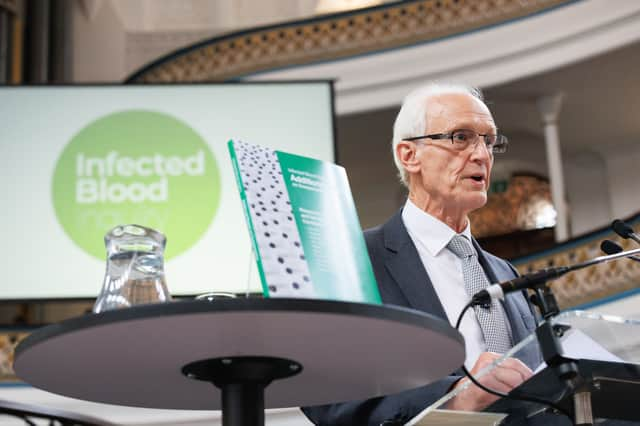

“One man spent his last days applying for compensation but died before the process was complete.
“His family do not know when they will receive the recognition that should have been his.
“A mother in her 80s, whose two sons and husband were infected at the same hospital, died before she was even allowed to start the process.”
“People are still dying, they’re still dying now - some died while they were waiting for the government to get their fingers out.”
Louise Edwards, from Churwell in Leeds, was just 12 when she lost her dad Jack, after his haemophilia treatment was tainted with hepatitis C and HIV.
She was in Westminster to coincide with the publication of the latest report, and thanked Sir Brian for his work.
The 51-year-old told The Yorkshire Post: “It is so frustrating - we just want it done.

“It will be 40 years since my dad died, and it still doesn’t feel like we have got any justice.
“Compensation will never bring him back, but that’s a recognition that somebody has done something wrong.”
Last year, Sir Brian published the Inquiry’s final report on the scandal, which found it “could largely have been avoided” and there was a “pervasive” cover-up to hide the truth.
He was then asked to complete another report on the compensation process after complaints.
NHS patients were injected with blood and plasma from the USA, which had been donated by criminals and drug users, from the 1970s to 1990s.
More than 30,000 people contracted HIV, hepatitis or other deadly diseases as a result and are still living with the consequences to this day.

People continued to be given infected blood, even after the risks were known, and in some cases children were not even told they had contracted HIV.
September will mark 40 years since her father Jack died, aged 47, and Ms Edwards said it still hasn’t “officially been recognised what happened to us as children”.
“We lost our father, our family was basically torn apart through no fault of our own. Nobody’s acknowledged what we’ve lost.”
She said Mr Edwards, a foreman at the former John Collier clothing warehouse on Kirkstall Road, would “have loved it so much” to see his grandchildren.
Ms Edwards and her family may have to wait until 2029 to receive compensation for his death.
A Government spokesperson said: “Over £300m has been paid to victims since the compensation scheme opened last October and we are taking action to enable a quicker compensation process.”