
'It seemed difficult to believe things would get easier' - Yorkshire mum of son with SMA1 says heart goes out to Jesy Nelson
A Yorkshire mum whose son has rare genetic disorder SMA1 says her heart goes out to former Little Mix star Jesy Nelson after the singer’s twin babies were also diagnosed with the condition.

Kayleigh Steel was told her boy Oscar had the spinal muscular atrophy just ten days after his birth. He was treated with a £1.8m single dose of gene therapy Zolgensma – reportedly the most expensive drug in the world – aged 24 days.
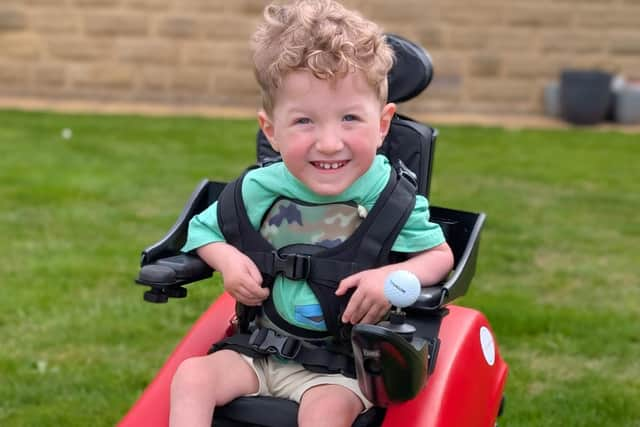
Now, Oscar, who lives in Holmfirth, West Yorkshire, is three-years-old and “whizzing around in his wheelchair”.
In 2021, Zolgensma was made available on the NHS, as a way of preventing paralysis and prolonging the lives of children with SMA.

The health service said at the time that untreated SMA was the leading genetic cause of death for children, and that gene therapy could give babies the ability to sit, crawl and walk.
Reflecting on her family’s journey, Kayleigh, 38, an independent reviewing officer, says: “My heart goes out to Jesy. It is a huge shock when your child is diagnosed, and all your hopes and expectations for them and your life with them change in an instant.
‘I initially felt very low as my life became a whirlwind of scheduling appointments, advocating for Oscar’s needs and feeling isolated by the sheer number of tasks and limited support in managing this, while also dealing with the emotions of being told that your child has a life-limiting condition.
“And at first I didn’t want to be told it would get easier – it seemed difficult to believe. But as Oscar’s personality started to develop, everything changed. There will always be challenges of course and he will always have disabilities, but he loves his mainstream nursery and whizzing around in his wheelchair.

“Oscar is a lovely, smiley and happy little boy despite his devastating condition and tough start to life...As Oscar’s parents we’re determined to give him the best quality of life possible. He is a joy to be around, he loves cars, Lightning McQueen, singing, playing with his sister Edie and new little brother Finn, and Paw Patrol.”
Oscar has a feeding tube and various other equipment to support his breathing and lung function and undergoes specialist physiotherapy. As he gets older, Kayleigh says the family home will need adaptations to help him be more independent.
The Steels are being supported by children’s charity Tree of Hope, which helps families raise money for medical treatments, equipment and healthcare services not freely available to them through the NHS and social care.
As well as fundraising, the family is working to raise awareness of the condition and push for newborn screening to test for it.
“It’s a non-invasive and inexpensive test, and almost all children who are treated at birth have a higher chance of leading typical, independent lives and to achieve their motor milestones,” says Kayleigh, who has recently run 5k per day for 31 days for her latest fundraising challenge Oscar’s Jingle Jog.
On social media, 34-year-old Jesy, who gave birth to twins Ocean Jade and Story Monroe Nelson-Foster prematurely in May with fiance Zion Foster, said she will also be campaigning for SMA1 screening at birth. She wants screening for the condition to be added to the newborn heel prick test and says she is “determined to make this happen”.
Last week, Health Secretary Wes Streeting said he backed Jesy’s move to challenge the screening process for the rare genetic condition, and said she was “right to challenge and criticise how long it takes to get a diagnosis”.
The Cabinet minister said he was “determined to look not just at screening for SMA, but to make much better use of genomic medicine”.
According to the NHS, SMA can cause muscle weakness, movement problems, issues with breathing or swallowing, tremors, and bone and joint problems.
Newborn screening for SMA is not available in the UK, but Scotland has announced it will screen babies from the spring. The UK National Screening Committee does not recommend screening but has commissioned work to reassess this due to developments in treatment.
Without treatment, which focuses on the altered genes that cause SMA, babies tend to live for less than two years.