
'It's not fit for purpose' - How a change in NHS contracts led to Yorkshire becoming a dentistry desert
The Yorkshire Post’s Westminster Correspondent Ralph Blackburn takes a look at how a contract change in 2006 had a cataclysmic effect on dentistry in Yorkshire.
In 1997, Dr Mark Green was walking the streets of the sleepy North Yorkshire village of Thornton-le-Dale desperately trying to find NHS dental patients.
He had resorted to dropping off leaflets door-to-door as he was “sitting in my practice twiddling my thumbs”.
“At the time I was thinking I must be the most qualified leaflet dropper in North Yorkshire,” he tells The Yorkshire Post.
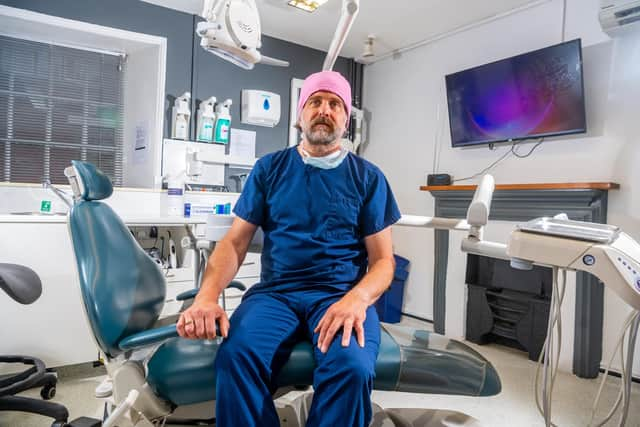

Now he jokes: “Thirty years later if I was doing the same I would be mugged - there would be a queue of a thousand.”
In the meantime, Dr Green was forced to sell his practice in Whitby as he could not find staff to work at an NHS dental practice.
“It’s complete role reversal,” he says, “now you certainly don’t need to advertise even if you are taking new patients on.”
Currently, the North East and Yorkshire have the lowest proportion of dental practices doing NHS work in the country.
So what has happened in the intervening period? How have we gotten to the point where people are pulling out their own teeth?
Dr Green, a British Dental Association rep, has a simple answer - a change of the NHS contract by New Labour in 2006.
“Before that, every dentist had an individual contract with the Government,” he explains. “Since 2009, it’s widely been deemed unfit for practice.”
Dr Julian Perry, clinical lead at dentist legal adviser Densura, agrees: “The contract is not fit for purpose - it just doesn’t work. If the patient needs 25 fillings the dental practice literally goes bust.
“And for nearly 20 years there’s been no change in the fee structure. Over that time there’s been a huge change in inflation."
“The NHS dental system is very weak and has got weaker over time,” according to chief medical officer, Dr Chris Whitty.
“The last time I think most people in the country would consider that NHS dentistry was operating as they would anticipate it should do was probably in the early 1990s and the changes since then have all tended to either do nothing or make things worse,” he recently told MPs.
“It’s been the inability of any Government to grasp the nettle and get it sorted,” Dr Green explains. “We were promised great new things with Labour but then they realised the cupboard was bare.”
Care Minister Stephen Kinnock has promised that the current government will rewrite the dental contract.
However, in almost a year since the election there has been little detail on what this will look like.
Any changes would likely require primary legislation, and have not featured on the Government’s Parliamentary agenda yet.
“We struggled on the coast and I just couldn’t recruit,” Dr Green explains, saying he sold his own practice in Whitby in 2018. “I could see myself being left with a five-surgeon practice that I can’t do on my own.
“I still wanted to work on the NHS but I couldn’t get anyone to work with me. We had thousands and thousands of patients.”
Dr Green now works in Kirkbymoorside for another practice, still with NHS patients.
However, that makes him a rarity in the North East and Yorkshire, according to House of Commons Library data.
He takes on new NHS patients - including children - through a scheme organised by the Integrated Care Board.
“It’s amazing how much tooth decay we’re still seeing in this day and age,” he says. “We’ve not turned a corner with dental health in my last 30 years of practice.”
“My message to the Government would be - get a move on,” he adds. “They’ve admitted this contract is unfit for practice.
“This was a top five issue for politicians at the last election, and if they don’t get their finger out it will be a big issue on the doorstep next time round.”