
Maternity in crisis: Sheffield mum speaks out over birth trauma after forceps delivery
Giving birth for the first time is a leap into the unknown. Expectant mothers may diligently write birth plans, often hoping for a low-intervention and low pain-relief experience, and to return home with their new babies as soon as possible following their delivery.

The reality is that many labouring mothers will need unplanned assisted deliveries, Caesarean sections and intense post-natal care to bring their children safely into the world.
Expecting the unexpected is part and parcel of having a child, but when things seriously don’t go to plan, a traumatic birth can be an incredibly difficult thing to live with.
According to research from the Birth Trauma Association, up to five per cent of women develop post-traumatic stress disorder symptoms after giving birth to their child - in the UK.
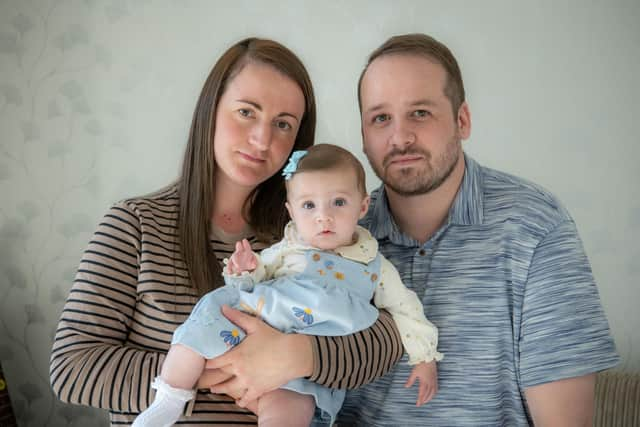

No one knows the strain of a traumatic delivery better than Charlotte Dale, a 32-year-old nurse from Sheffield.
While heavily pregnant with her first daughter, Daisy, earlier this year, Charlotte was told that due to the projected size of her baby, she would need to be induced. Oxytocin inductions - where hormones replicating those produced by the body in labour are pumped into women via an IV drip - have a higher risk of forceps or Caesarean sections being needed.
Assisted deliveries with forceps are associated with higher risks of birthing injuries including tears, and later issues with continence in mothers. In the UK, around one in eight births will end up needing forceps or ventouse.
“I wanted a water birth ideally,” remembered Ms Dale, “And obviously that went straight out of the window.
“It’s very dated at Jessops. I’ve not got very nice memories of when we walked in.
“I had a midwife who told us ‘it’s years since I was on a labour suite.’”
That midwife failed to break Ms Dale’s waters properly, meaning that she was given the drip against clinical guidelines. Her body went into labour, but after over 24 hours it was decided the safest way for her to deliver her baby was via forceps.
It’s clearly difficult for Ms Dale to recount what happened next. “Next minute, there was a registrar at the bottom of the bed with forceps in her hand.
“She said ‘you’re going to push, I’m going to pull.
“She went to do an episiotomy [cut to the vaginal wall to make delivering a baby easier] and she ignored shouts about where the ligdocaine [local anaesthetic] was, and cut me without any ligdocaine.
“I could feel everything she was cutting. She yanked Daisy out - and then I had a major haemorrhage.
“I don’t think they realised how bad it was. I was shouting ‘am I going to die?’ and everyone came running in to find the source of the bleed.”
Ms Dale lost 1.7 litres of blood, and needed a week-long stay in hospital following her labour. She is now living with continence issues directly caused by the delivery, and says her post-partum care in the hospital did not take this into account.
In addition, she has yet to receive NHS physiotheraphy for her pelvic issues and has been forced to pay for private healthcare.
Ms Dale has put a formal complaint into Sheffield Teaching Hospitals about her care on the Jessop Wing, which at its last CQC inspection was told it requires improvement.
“I think your brain just puts a defence in and tries to forget what’s happened,” she says reflecting on her trauma. “The registrar wanted to come say sorry to me, but the last thing I wanted was the person who’d caused it at the end of my bed.
“My mental health is okay, considering - but I’m still having to deal with incontinence.”
Ms Dale is now hoping to raise awareness of postnatal issues around assisted deliveries.
“You just think in your head it’s going to be vaginal or c-section. If you have a forceps birth, you can have all sorts of damage.”
Dr Jennifer Hill, Chief Medical Officer, Sheffield Teaching Hospitals NHS Foundation Trust said: “We sincerely apologise that we did not meet Ms Dale’s expectations for her pregnancy journey and for the distress this has caused.
“Our teams are committed to ensuring all women and birthing people receive high quality maternity care, and we are disappointed not to have achieved this for Ms Dale.
“We can confirm that Ms Dale was given local anaesthetic prior to her episiotomy being performed. An initial review indicates that in relation to the continence issues, additional tests were performed, and support was provided. We are in the process of reviewing the entire pathway of her care with the aim of providing a full response to all the concerns Ms Dale has raised.
“We apologise that this has taken longer than expected due to the complexity of the interventions she required but can assure Ms Dale that learning has already been shared with staff. If necessary, additional training will also be introduced to address any issues identified.
“We would welcome the opportunity to meet with Ms Dale and her partner to discuss her care and some of the learning that has arisen as a result of her feedback.”
Preventing traumatic births is the focus of Kim Thomas, the chief executive of the Birth Trauma Association. Last year Ms Thomas delivered a landmark parliamentary report into birth trauma and how it can be prevented, with calls for the Government to recruit a dedicated Maternity Commissioner.
“There’s an issue, I think, of not listening to women. Doing things without properly seeking consent - like performing sweeps. There’s a lot of failure by midwives to escalate to obstetricians when there’s a problem,” said Ms Thomas.
“Generally, there’s a dismissive attitude towards women, that their cares and concerns don’t really matter.
“With forceps, for example, we heard a lot of stories in the inquiry about really brutal births that resulted in physical injuries mothers can live with for years.
“It can have a really devastating impact in terms of incontinence, pain and sexual function.
“It’s not talked about enough, how many injuries we end up with. We do have high rates of forceps births in this country. You have to look at other European countries that have very low forceps rates, because they use the ventouse instead and generally it’s a safer procedure.”
Ms Thomas warned that recruiting more maternity staff would not be the only solution to preventing traumatic births.
“You can recruit more staff all you like,” she said, “But actually changing an entrenched culture is very, very difficult.
“One thing we believe very strongly is that if you don’t support women who have been through birth trauma, then that has a massive knock on effect elsewhere.
“A lot of these women don’t go back to work. Their relationships break up and they have difficulties bonding with their babies. There’s this really widespread economic knock on effect that doesn’t get reflected anywhere.
Ms Thomas is now concerned that the new Labour Government won’t implement the recommendations of the birth trauma report, after the general election was called just nine days after it was delivered to MPs.
“It’s frustrating because everything they [the previous Government] was planning to implement, they didn’t have time to do.”