
Meet the trainers preparing guide dogs in Leeds for a future making a life-changing difference
Ellis the Labrador is playful, cuddly, and loves a treat. In many ways, he is just like any other two-year-old dog. However, Ellis has a very important future ahead of him: he is training to become a guide dog.
At the Guide Dogs training centre in Thorner, Leeds, Ellis is one of 12 dogs learning the vital skills needed to support someone with a visual impairment. His role will be to help provide safety, mobility, and independence to his owner.
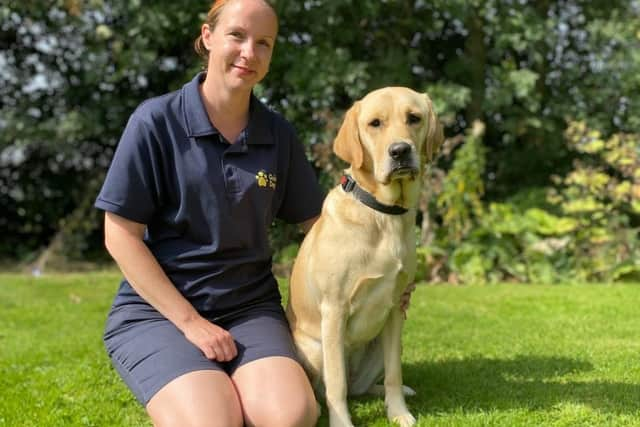
Elysha McBride, a guide dog trainer, has been working at Guide Dogs for the past four years, looking after dogs in their early stages of training. "I used to have a Saturday job in Specsavers and I used to see Guide Dog owners and puppies so I’ve always admired what guide dogs do,” she says. “When I went to university for animal behaviour, training was something I always loved and so this work combines two things that I really enjoyed.”
Her colleague Hannah Watts has been working at Guide Dogs for the past 18 years. In her role as a guide dog mobility specialist, she supports dogs during the later parts of their training, alongside co-ordinating matches between dogs and owners. “I used to compete with dogs, so I knew I wanted a job that would involve dog training and I also love working with people so I just wanted to combine those two things,” she says. “I knew at school this was the job I wanted so I went for it.”
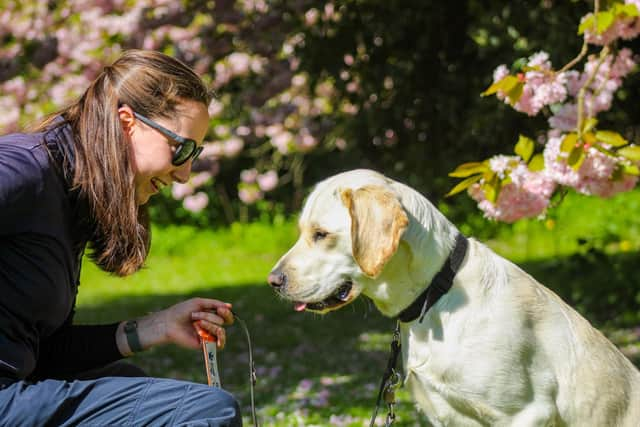

Elysha and Hannah affectionately refer to the Guide Dog training centre as “school” for trainee guide dogs as they arrive for short bursts of focused training sessions. But it’s not their first training destination. From eight weeks old, they are cared for by volunteer puppy raisers, who introduce them to different experiences and environments and begin training.
When the trainee guide dog is around 14 months old, they then arrive at their local guide dog training centre for specialised training, which typically lasts six to nine months. “They’re usually very giddy, very silly young puppies when they first come,” Elysha says. “They’re often very overexcited - everything's brand new, it's a lot of playfulness. We then try and mould and filter that energy and happiness into the work.”
Elysha and Hannah play an essential role in training guide dogs, however, it is support from volunteers which makes their job possible. “All of our training dogs live with volunteers outside of working hours,” Hannah explains. “They have them at evenings and weekends and help out massively. Without those volunteers we wouldn’t be able to have the dogs and do what we do.”
When training the dogs, Elysha and Hannah use a positive-reinforcement system focused on repetition and rewards. They are learning behaviours that will prepare them for their working life. In an outdoor space, for example, guide dogs play a vital role in helping a visually impaired person to travel safely. Their capabilities are limited however, with Hannah pointing out that some people wrongly assume they are trained to independently cross roads, memorise routes, and understand traffic lights. “We get people who think they can read bus numbers, and find milk in a supermarket, but they’re not robots!” she says.
A walk relies on a partnership between the guide dog and their owner, who both have important roles to ensure their journey is safe. Elysha warned that distractions can cause danger. Petting a guide dog while they are working can break their concentration, and grabbing a visually impaired person to direct them, while well-intentioned, can create confusion. An offer for help can be well appreciated, Elysha says, but the approach taken is crucial. “You need to ask for permission and respect the answer. Acknowledge the guide dog owner too as so many people just talk to the dog.”
In 2024-2025, Guide Dogs Leeds supported 26 different partnerships between guide dogs and owners. For Elysha it is always an emotional moment when a guide dog leaves the centre to start their new life.
“Obviously I’m thrilled they’ve made it but it's always this lump in the throat day when they go because you do spend everyday with them,” she says. “You get to know them so well.” Hannah agrees, but both know a dog’s departure means they will soon change someone’s life for the better.Hannah says: “For me that's the best part of the job, not that the dog’s leaving me but the fact that the dog has fulfilled what we hoped it would and it has actually partnered with somebody.”
- Visit guidedogs.org.uk