
Professor Myles Gibson obituary: The pioneering neurosurgeon who spent most of his career in Yorkshire
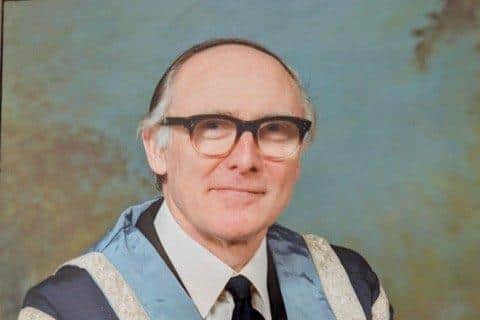
Robert Myles Gibson, who has died at 99, was a respected neurosurgeon who helped pioneer the development of modern pre-hospital care in the UK.

Born in Dunragit, south-west Scotland in May 1927, he spent the greater part of his career in Yorkshire, as a consultant neurosurgeon at Leeds General Infirmary from 1960 to 1992.
The son of Robert Gibson and Mary (née Harvey) he grew up with his three sisters in what he usually described as an idyllic Scots childhood, the war notwithstanding.
When his father became stationmaster at Oban on the west coast, the young Myles began riding the footplate, and thus began a lifelong love of steam engines.

He went to Sheuchan School in Stranraer, followed by Kilmarnock Academy before gaining a place to study medicine at Glasgow, from where he graduated in 1949.
He had an interest in politics during his undergraduate days and campaigned for the future Liberal democrat leader Menzies Campbell. Myles himself stood for parliament, unsuccessfully, as a Liberal in the Highlands.
He was also part of the Glasgow University student cohort which helped to plan the famous 1950 Christmas Day heist of the Stone of Scone from Westminster Abbey.
The aim was to promote Scottish devolution and national identity by reclaiming the coronation stone taken by Edward I in 1296, and Myles’ role was to help make a replica out of plaster of paris from suitable medical supplies.
His main focus, however, was on becoming a neurosurgeon, and to that end he obtained a scholarship to McGill University in Montreal, where he studied under the world famous neurologist Professor Wilder Penfield. Myles received his MsC in 1951.
He played football throughout his school and university days, starting at Kilbirnie Lakeside Juniors and then Queen’s Park, the leading Scottish amateur club, based at Hampden Park.
In Canada he played for the Montreal Hakoah club, which organised a testimonial for him when he decided to return to the UK.
Myles had hoped to be a footballer and a neurosurgeon but accepted his father’s advice that to do both might risk him being unable to do either properly.
So he chose neurosurgery and became House Surgeon at Glasgow Royal Infirmary and then Senior Registrar in Neurosurgery at Edinburgh Royal Infirmary under Professor Norman Dott, before accepting the appointment in Leeds, where he remained until retiring from the NHS in 1992.
But he never really retired from medicine and commitment to research led to the development of the Glasgow Coma Scale, now used internationally, and he was instrumental in the International ‘Save a Limb, Save a Life’ initiative.
He was particularly proud of the work he and his team at LGI did in training overseas doctors who could then use their expertise to improve medical services in their own countries.
He became an advisor in neurosurgery to university and government medical services in Saudi Arabia, Malaysia, Hong Kong and Singapore, and visited Zimbabwe regularly as part of the college examining team.
Myles also had a long association with St John’s Ambulance and even in his latter years continued to help arrange and present workshops at their training and examination conferences.
Outside his clinical practice and throughout his career he served as a Major in the Royal Army Medical Corps, with spells in Korea and the Rhineland.
He was part of the team that undertook psychological and neurological assessment of Nazi prisoners at Spandau, including Albert Speer and Rudolf Hess, and was joint author of the Field Surgical Pocket Book.
He would often at short notice attend injured servicemen in the Middle East, Kenya and was said to have been consulted following the assassination of President John F Kennedy.
His love of football never left him and in 1972 he became honorary consultant advisor to the FA, a role in which he initiated courses for the treatment of injuries and developed the medical examination of young players with special emphasis on the development of screening.
He published guidelines on management of head injuries in football and chaired the working party on medical aspects of safety at sports grounds, authoring the Gibson Report which laid down the guidelines and requirements for club doctors at football stadiums.
He was appointed honorary medical director for the 1996 European Championships, having previously become Treasurer to the General Medical Council.
A longstanding Fellow of the Royal College of Surgeons Edinburgh, he was awarded the The Society of British Neurological Surgeons medal in 2023 for his contribution to British neurosurgery.
He also used his medical expertise to help advise governments on the resourcing and financing of the NHS and co-authored the Health Service Financing Report with Lord Geoffrey Howe.
Myles was awarded the OBE in 1992.
He is survived by Ena, his wife of 66 years; their children Stroma and Alastair and five grandchildren.