
Songs That Move: Ryedale Festival to showcase Bibi Heal's pioneering music and exercise programme designed to help people with neurological conditions
When soprano Bibi Heal appears at Ryedale Festival this month, she will be showcasing a pioneering initiative that links music with exercises designed to benefit those facing neurological challenges.

Heal and her team will be presenting their Songs That Move programme, which aims to support people with Parkinson’s, stroke and similar conditions with movements informed by healthcare professionals.
"Art doesn’t have to be a service but I love that our art form can be,” says Heal, who is based in Skipton. “The songs exist for their own sake but the idea that it can completely change someone’s day or physicality or make their life easier is so rewarding and very important.”
The Songs That Move project aims to harness the power of classical songs and their stories, and to combine them with movement to exercise both the body and the brain. Heal has been working with pianist Stephen Barlow and choreographer William Tuckett on the scheme, in collaboration with clinical professionals including Neuro Heroes specialist physiotherapists, and with support from Parkinson’s UK.

They’re also working to develop the programme with input from those behind the Movers and Shakers podcast about the realities of life with Parkinson’s, including Leeds-born former broadcaster and journalist Jeremy Paxman, who announced his diagnosis in 2021.
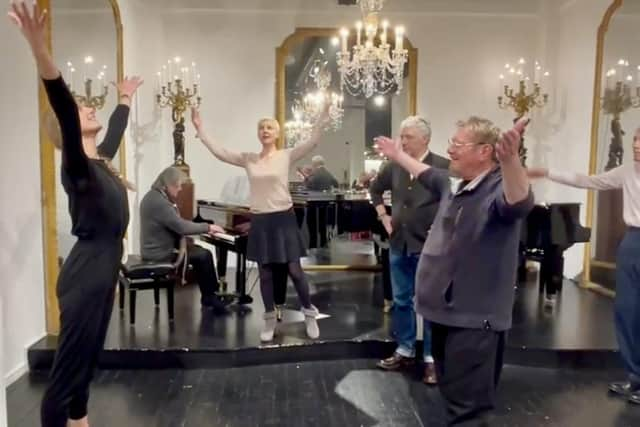
So far, the initiative has involved live performances; the song is introduced and brought to life with natural gesture, performed by Heal and Barlow, before a dancer brings to life specific exercise movements, inspired by the words and designed to meet a range of physical needs.
That’s what will be happening at the Ryedale Festival, with dancer Helen Gould, who was last year awarded an MBE for her services to people with Parkinson's, taking to the stage. Anyone who wants to join in with the movements is welcome to do so.
Next for the Songs That Move team is developing a series of videos to reach people digitally through an app, with feedback from people living with the condition. Work will begin on this in autumn, after more than £10,000 was raised to support the development. A pilot library of 10 films is set to be introduced first, but the overall aim is to create a library of songs and exercises catering for a range of neurological conditions.

The idea began five years ago. Heal explains: “I’ve always done a lot of song recitals and I was looking for ways of making classical songs really resonate with audiences more than they traditionally do. It’s often seen as quite high brow or niche. But the songs deal with everything everyone deals with in life and has done over the centuries.”
Heal explored using songs within social prescribing, before becoming focused on the gestural aspect of classical music, with singers often using gesture to express the story of the songs, particularly if the lyrics are written in a foreign language.
“We realised that it feeds into a form of movement that can be used by somebody using the song for a therapeutic purpose. A little bit like doing physio, using the song and the story as the inspiration to move,” she says.
“It’s particularly effective for Parkinson's and neurological conditions…If you can tax your brain, really use your brain whilst using your body, then you get a far better result and it helps to improve neuroplasticity which slows the progression of the condition.”
Parkinson’s, a disease in which parts of the brain become progressively damaged over time, is recognised as the fastest growing neurological condition in the world.
Those behind the Songs That Move project say: “It is proven that exercise plays a universally vital role in easing the progression of symptoms, whether tremor, stiffness, cramp, insomnia. If the brain is simultaneously challenged by other stimuli, this improves neuroplasticity and the outcome is even more positive. That’s the inspiration behind our innovative programme.”
Heal hopes the appearance at Ryedale Festival will help to spread the word about the project and will offer and opportunity to get direct feedback from those who have a neurological condition or their carers, partners and companions.
Songs That Move is at Helmsley Arts Centre on the afternoon of July 18 and the National Centre for Early Music in York that evening.