
Support Dogs Sheffield: How a new headquarters in Hillsborough will help charity to change lives
Support Dogs has been changing lives since 1992 and now funds are needed for its new centre of excellence in Sheffield.

It never ceases to amaze Lynn Ratcliffe that her dog can, pretty much, predict the future.
Barnby is an assistance dog and with an insistent look is able to tell Lynn that in 29 minutes she will have a seizure.
That’s exactly what happened when the Sheffield-based national charity Support Dogs welcomed media to its new headquarters in Hillsborough last month.
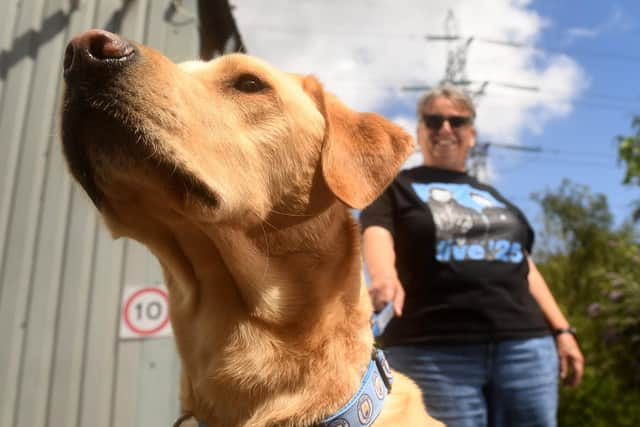

“He’s done it here today,” says Lynn, who has epilepsy. “I thought, oh, is he alerting? I gave the treat bag to somebody because I thought he might be just after a treat. He looked where the bag went but then he was focused totally on me again and was definitely alerting, so I knew I had 29 minutes. So I carried on normally for a bit then took myself off somewhere private, had the seizure, had a sleep and then rejoined everybody.”
Lynn, from Stockport, was diagnosed with epilepsy in 1998, in her late 30s, after suffering a head injury.
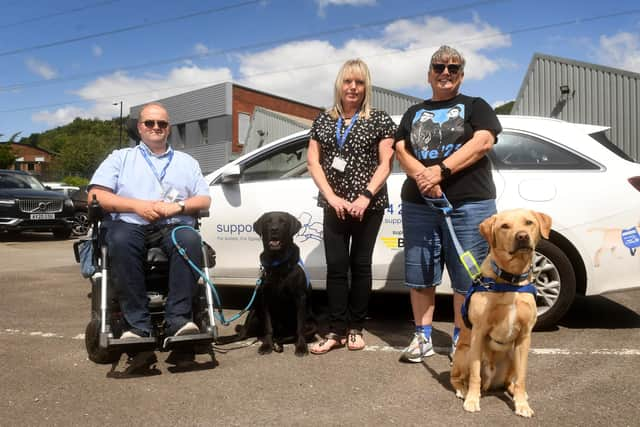
Barnby, a Labrador, is her third seizure alert dog after she went into training with him about a year ago. Her first assistance dog, Dougal, retired in late 2014, and Golden Retriever cross, Simba, took over. Now that Barnby is Lynn’s loyal companion, he rarely leaves her side - and, like his owner, will be watching Manchester City at most home matches.
“Barnby’s a good boy. I’ve got his predecessor, Simba, at home and he’s a mischief,” she says.
Although research has so far been limited, it is thought that the dogs pick up on physiological changes in their epileptic owner - pupils dilating, increased heart rate, breathing changes or potentially even a scent that’s released - which allow them to alert before a seizure with a signal such as a specific bark or nudge.
Lynn went 10 years with epilepsy without an alert dog. “I could be in quite dangerous situations. I could be in the bath, could be cooking, could be crossing a road. I could get myself into all sorts of scrapes. I ended up at hospital a few times,” she says.
Support Dogs was founded in 1992 but has outgrown its small office unit by a huge measure. While it relies entirely on donations and fundraising, it also estimates that it saves the NHS more than £35m a year through its work providing people with epilepsy seizure alert dogs (still the only UK charity training these), autism assistance dogs and disability assistance dogs.
Meanwhile, dog wellbeing is paramount too: about a quarter of the animals that the charity has trained have come from rescue centres or homes that are no longer able to care for them.
There is huge demand for these services. More than 29,000 families and individuals accessed the charity’s application pages in 2024, and around 4,000 people request support each year.
So the new headquarters at Elsworth House is not just any old space - it is a new national specialist centre for the training of dogs. After acquiring the new building, they want to create a new Community Heartspace - delivering education and welfare sessions but also for the wider use of other community groups - refurbish the roof and existing building spaces to improve accessibility and integrate its team into the premises. After that, they would create specialist client areas for those affected by epilepsy, autism and disability, as well as a puppy training arena, sensory enrichment areas, puppy snooze pods and dog welfare rooms.
They even plan to create a small ‘city’ environment with mock shops and the like, so that the dogs and clients can simulate real world circumstances when training.
The project is costing £4.2m - around half of which is still needed, so an appeal is under way to raise the remaining funds of more than £2m.
Danny Anderson, fundraising manager, talked to the press in early July when the Government’s planned changes to Universal Credit and Personal Independence Payments were hitting headlines.
“Every solution you’re hearing today and yesterday is about either cutting costs or increasing taxes and some people are not getting the benefits they need. But there is another solution,” he says. “That solution is about innovation and creativity. And this incredible charity which started here in Sheffield 33 years ago has come up with something, this really new idea, which is a mere, I don’t know, 100,000 years old? It’s called a dog.”
The charity’s work, he says, improves mental health, increases mobility and confidence, provides care in the home and physical activity, and reduces dependency on family members. The dogs prevent emergency calls, hospital stays, GP appointments and the needs for medication, says the charity.
“It enables the people we support to have a much better, wider, fulsome and healthier life,” says Danny.
Chris Beddoes is one such person. He used to be a senior staff member at Worcestershire Royal Hospital’s medical assessment unit, but his life changed suddenly in August, 2015.
“I was making an A&E trolley and I woke up on that trolley and I haven’t walked again since,” says Chris.
The dad-of-two was left with chronic back pain and eventually diagnosed with muscular-skeletal disease, which is inoperable and effectively causing his spine to crumble away.
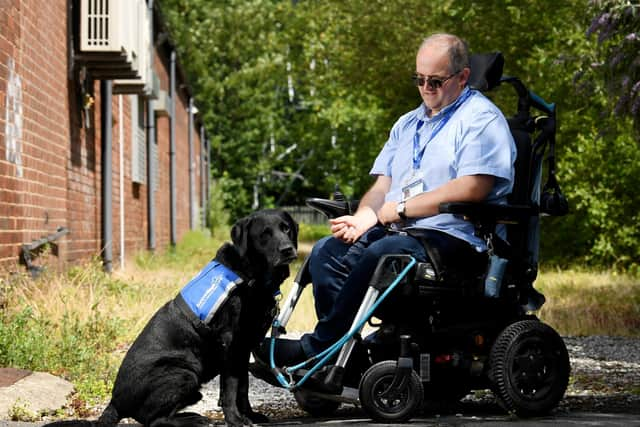
He began using a wheelchair in 2016 and couldn’t go anywhere on his own. “I felt like I was a prisoner in my own home, initially,” he says.
That was until he got Charlie, his black Labrador, who underwent his six-week training in May 2022, followed by the family having two weeks of training.
It is the effect that Charlie is having on Chris’s family for which he is perhaps most grateful - particularly when it comes to his sons Jack and Daniel.
“My eldest is now at university and my youngest is hoping to go to university in September. They wouldn’t have been able to do that if it wasn’t for Support Dogs.
“They have said to me several times, with Charlie, they know that I’m safe. With Charlie and my wife, they know that I’m safe and I’m able to go and do stuff. Before that, they were actually saying they would have stopped at home instead of moving into halls of residence at uni.
“Now I can go out independently. Charlie will do everything for me from helping me to get dressed and undressed. He even pays using my debit card. He will open and close doors. He will pick up anything I've dropped, even a flat debit card on the floor, he will pick it up for me.
“The first time I went out with Charlie on my own, I went and bought a shirt. He helped me to try it on in the dressing room. When we went home my wife said: ‘Ooh we’ve got to take that back because it won’t fit you’. Because she was really surprised we’d been able to try it on.
“He helps me such a lot.”
Danny believes that part of the reason dogs are not taken more seriously as a cost-saving health aid is that they are cute and fluffy - funding would come much more easily, he reckons, if Charlie was invented by Elon Musk.
Chris, who is 44 this year, adds: “When I’ve gone into hospital he’s gone with me. He’s stopped there overnight, and everything, the entire stay, and he’s done work which a care assistant would have had to have done. But he’s done that for them so that it has freed up them to go and deal with other people.”
The dogs have also been life-changing for the charity’s autistic clients.
Sheffield boy Sam Mills, who is 15 this month, is the son of Emma and Steve, and brother to Ellie.
He was diagnosed with autism at the age of five and his dog Willow, who Sam got when he was six, is now settling into retirement, but Emma tells of the amazing benefits she provided after they got her in 2017.
“Sam didn’t leave the house. The whole world was a barrier,” she says. Leaving the house was, she says, like “a Squid Game and he (felt like he) might die, that’s how extreme it was for Sam”.
When Sam was young, his family couldn’t touch him because it was too physically painful. “Willow could touch him, Willow could comfort him when I couldn’t,” says Emma.
She was trained to lay across him and apply deep pressure support, which helps calm the nervous system.
“Where every other service couldn’t help him, where schools couldn’t help him and where we couldn’t help him as parents, Willow could.”
Now, Sam can walk independently between different places, which was unthinkable eight years ago.
It was that kind of care that helped Sam eventually make some brilliant family memories.
Emma says: “We went from being just in our living room - we couldn’t have people come to the house, Sam couldn’t cope with visitors - to being able to go to Disneyland, to do lots of family holidays, to go to the cinema, things like that.”
And when it came to social situations and crowds, where he once struggled, having a dog made it easier.
“Willow changed all that because people would come up and they’d ask about his dog, and he knew they were going to ask about his dog, so the pressure wasn’t on him.”
Basically, says Emma, “she turned everything into being fun and not scary anymore”.
Last year the charity supported 154 families who have a Support Dog living with them and, crucially, it hopes that the new centre will allow them to increase their partnerships so that more people can access the care that has changed the lives of people like Lynn, Chris and Sam.
Rita Howson has seen what these dogs can do over the decades. She started as a Support Dogs volunteer but worked her way up in the charity to chief executive over the decades.
“I loved seeing the difference the dogs made to someone’s life. I think you get a little snapshot of somebody’s challenges, somebody’s struggles, then you see what happens,” she says.
“There’s so many stories of the difference and the impact the dogs make that has just really kept that passion here.”
Find out more about the various ways to donate or contribute to the appeal at: www.supportdogs.org.uk/national-centre-appeal