
'There's nothing like being at home': Virtual ward technology bringing care to patients
One of the cornerstones of the NHS ten-year plan is a shift from hospital care to community care – and it’s already happening in Yorkshire and beyond. That’s why ‘bringing care closer to home’ was one of the key themes at the latest South Yorkshire Research and Innovation Expo held last month.

The event showcased research and innovation happening across South Yorkshire and explored how it can improve health, reduce inequalities and support economic growth in the region.
Among the projects that were highlighted were a virtual ward programme, which is enabling children to be monitored at home, and an AI-enabled wound care pilot, which is supporting the work of district nurses in caring for patients in the community.
Under the latter scheme, community nurses at Sheffield Teaching Hospitals NHS Foundation Trust began using a digital wound assessment app last year to create accurate, trackable records of wounds over time. Now, its sister version, for patient use, is being rolled out to members of the community so they can help keep track of their own wound healing.
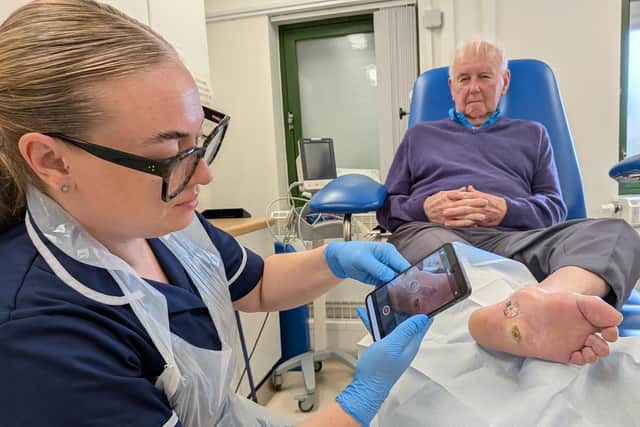

Saul Hill, The Minuteful for Wound app project lead, said: “It’s all about having increased visibility on a patient’s wound so we can improve our reaction time if anything is going wrong. The technology operates in so much minute detail, measuring really minor changes in the wound size that we wouldn’t be able to pick up manually.”
The app uses smartphone imaging and AI to capture consistent, objective wound measurements and detailed photos in seconds. Stored on a digital portal, they enable clinicians to have full visibility of a series of images showing the wound’s healing and characteristics over time without necessarily the need for a visit to the patient’s home. As well as reducing variation in assessment, the app is designed to support earlier intervention when wounds are deteriorating, potentially leading to better patient outcomes.
Want more stories like this? Subscribe to our newsletter here.
Saul Hill said: “Wounds can have a devastating impact on patients’ quality of life and healing them quickly is a top priority. This is a fantastic example of the difference technology, delivered by NHS teams who are focused on what matters most, can make to patients and their care. If successful, the outcomes of the pilot could lead to the app being rolled out more widely across the Trust.”
Meanwhile, virtual wards are in operation within Sheffield Children's NHS Foundation Trust and The Rotherham NHS Foundation Trust. The programme is part of a project initially funded by the South Yorkshire and Bassetlaw NHS Acute Federation, which aims to improve patient experience, enhance clinical outcomes, and reduce the need for hospital admissions.
The virtual wards scheme at Sheffield Children’s allows children and young people under haematology and oncology departments to receive care from the comfort of their own home, whilst in Rotherham, a community paediatric nursing team is running a virtual ward for children. Young people and their families are given a kit of equipment to help monitor things like temperature and those details are then inputted into a virtual ward app for a team of healthcare professionals to review.
Children’s nurse Clair Scaife, one of the speakers at the South Yorkshire Expo and a clinical lead involved with the virtual wards programme at Sheffield Children’s, said: “You've got the technology but you've also got the human side as well, that clinical expertise. What it offers families is an alternative to hospital bedded care - providing that level of acute care within their home if that is the clinically safe thing to do.”
In a 1 2month pilot period, more than 200 children were able to be cared for at home and Jamie Shepherd, the project lead for paediatrics at the South Yorkshire and Bassetlaw Acute Federation, said more than 300 hospital attendances were avoided.
She said: “For this particular project, the big measure has been the response from the families and the children in terms of how they've benefited from the model and avoided having to come to hospital. It’s a difficult time for families. It’s got a cost for them. They have to travel. They may not be able to attend work. And it can be scary for children, even though we try and make it as pleasant as we can. There’s nothing like being at home, for a family and a child.”