
'They help us do surgery better': How NHS robot revolution is transforming lives
It might sound futuristic, but it’s happening now. At hospitals across Yorkshire, robots are assisting surgeons to carry out procedures and under “radical” plans to cut NHS waiting times, millions more patients are set to be treated with the support of the technology.

In 2023/24, some 70,000 robotic-assisted surgeries were carried out in the NHS in England, but the number is expected to rise to around half a million over the next decade.
Earlier this year, NHS officials said that by 2035, it is expected that nine in 10 of all keyhole surgeries, such as the removal of certain organs affected by cancer, will be delivered with robot assistance – up from one in five at present.
In this region, the use of robotic-assisted surgery has already expanded dramatically in the last decade.
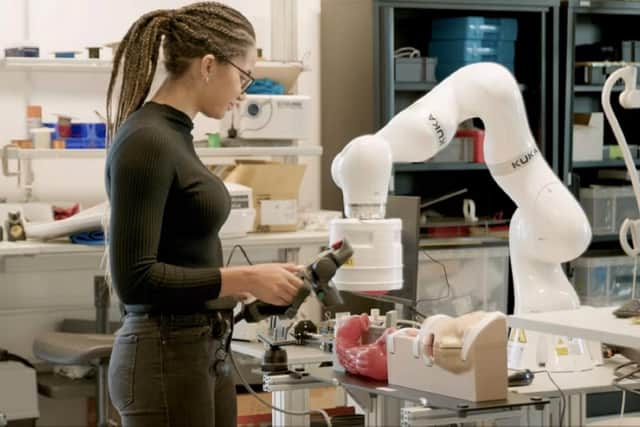

At Hull University Teaching Hospitals, for example, around 750 procedures each year are now performed using the technique.
It was first used by the trust’s urology department in 2015, when a Da Vinci robot assisted with a prostatectomy - the surgical removal of the prostate gland.
Now, the trust now has two robots in a dedicated suite at Castle Hill Hospital, used by surgeons carrying out urological, gynecological, colorectal, thoracic, gastrointestinal and ear, nose and throat procedures.
In robotic-assisted surgery, instruments are controlled by a surgeon at a console using a 3D camera, with experts saying the technology therefore allows for greater dexterity. It also has the potential to reduce strain on surgical teams, allowing a greater number of complex surgeries to be carried out each day, and therefore helping to reduce waiting times.

NHS England says that patients who have robotic assisted-surgery also tend to recover quicker and are able to leave hospital sooner.
Matt Simms is a urology consultant in Hull, focused on pelvic cancers. He says there are many advantages of robotic surgery over keyhole surgery in his field. For the patient, “it’s a much better operation,” he says. “With the dexterity and the vision that the robot gives you, it’s more sophisticated and that is reflected in the outcomes, which are better with robotic surgery...These operations are major operations with risks of side effects, particularly incontinence and erectile dysfunction which massively affect quality of life. The incidences are much lower with robotic surgery because it’s a more precise technique.”
For the surgeon, the technology allows for better ergonomics and less fatigue, Matt says. “Robotics enables surgeons to do more work and feel less tired. They may feel like they’re able to operate for longer and retire later because there’s less physical strain from doing the operations.”
Jonathan Cowley, a consultant colorectal surgeon at Calderdale and Huddersfield NHS Foundation Trust also speaks of such benefits.
“The surgeons that use the technology find it comfortable - they’re sat down rather than being stood at a patient’s bedside,” he says. “Nobody has been using it long enough to know whether that means people can work into their mid-70s rather than mid-60s but theoretically there should be less orthopedic neck problems with time, so it’s better from a quality of life perspective.”
David Jayne, a Professor of Surgery at the University of Leeds, believes there’s scope for the technology to go even further.
“If you’re controlling everything from a console that is remote from the theatre table, that console doesn’t necessarily have to be in the same operating room,” explains Prof Jayne, who is also an Honorary Consultant Surgeon at Leeds Teaching Hospitals NHS Trust. “There have already been instances where operations have been done in different countries - with the surgeon in one country and the patient in another. That’s an uncommon practice at the moment, however, mainly limited by data delays…The speed of the communication is perhaps not quite good enough to fully realise that robotic potential.”
Prof Jayne, who specialises in robotic and minimally invasive surgery for colorectal cancer and pelvic floor dysfunction, also believes that in the next couple of decades, some robotic operations will be semi-automated.
Already, the NHS says, in some orthopaedic procedures, robots are programmed to perform elements themselves.
“But we are a long way from autonomous robotics,” Matt maintains. “We’re still in this master slave model where we control the robots and they help us to do the surgery better.”
Earlier this year, Health Secretary Wes Streeting, who had robotic-assisted surgery when he had treatment for kidney cancer, said that innovative technologies would “transform the NHS”. Robotics is part of the government’s 10 Year Health Plan for England, identified as one of five technologies “that will personalise care, improve outcomes, increase productivity and boost economic growth”.
Robotic-assisted surgery is just part of the picture, with research suggesting that robotics can also play a part in diagnosis too, reducing the need for hospital-based diagnostics like endoscopy or colonoscopy.
A team led by engineers from the University of Leeds, for example, has developed a tiny magnetic robot, which can take 3D scans from deep in the gut and could “revolutionise” early cancer detection.
It paves the way to a transformation of the diagnosis and treatment of several forms of cancer by enabling ‘virtual biopsies’ — non-invasive scans that provide immediate data to allow doctors to detect, stage, and potentially treat lesions in a single procedure.
Postgraduate researcher Nikita Greenidge, a member of Leeds’ STORM (Science and Technologies Of Robotics in Medicine) Lab, worked on the study and says this could eliminate a wait between diagnosis and intervention.
“This not only makes the process more comfortable for patients but also reduces waiting times, minimises repeat procedures, and alleviates the anxiety of waiting for potential cancer results,” she says.
A minimally invasive technology, it is also likely to be easier to establish in settings outside of hospital. “That helps with bringing it closer to communities, increasing access and getting people screened faster,” Nikita says. “The earlier we can detect colorectal cancer, the more treatable it is and that has great effects for the patient themselves and also for the NHS…you have both life and cost saving.”
Robotics technologies like these are ones that have direct contact with patients. Yet robots are also taking on other roles within the health service, from supporting the cleaning of clinics to transporting waste, linen, food and supplies around hospital buildings.
Then, there’s pharmacy robots - automated systems that scan, sort, manage and find medications for dispensing.
Leeds Teaching Hospitals NHS Trust has three and has been using the technology for over a decade. When a prescription request is made from a ward, pharmacy staff can ask a machine to find the medication in its storage system and transport it along a conveyor belt and down a chute onto their desk.
As well as freeing up staff to focus on providing the instructions on the label of the medication and assembling the final product for the patient, the system also boosts efficiency by operating 24 hours a day and supporting at least ten dispensing stations at a time.
When there are no requests from staff for medications to be outputted, the machines focus on housekeeping. That could be loading medications into the system after deliveries are placed on the input conveyor belt, organising products based on their size and how often they are used, or checking expiry dates and flagging when supplies are running low.
“The first main benefit is storage density,” says Ric Bowers, lead clinician for medicines procurement and supply at the trust. “The robot measures the size of the box of something and figures out the best place to put it. We would need a dispensary twice the size as we have if we were to fit it out with shelves and operate manually.
“The second and probably the most important benefit is safety. The robot doesn’t replace people, it mitigates the risk of specific human errors, notably picking errors, which is where a human being might go to select one drug but pick another because it looks very similar or it’s on the same shelf. Because the robot picks by barcode, it gives you exactly what you’ve asked for.”
Supporting precision like this, and in surgery, is why the Government has placed emphasis on robotics in its ten-year plan for the NHS. “Robotics have transformed surgery in recent decades,” it says. “In the future, they will also transform patient care and support - from continuous monitoring, to rehabilitation, to prosthetic limbs to support recovery from neurological or musculoskeletal injuries.”