
'They're making a remarkable difference': Wearable technology and augmented reality in Yorkshire's health clinics
When Professor Rory O’Connor first heard about the potential to use XR technology in neurorehabilitation, he knew he wanted it in his clinic. “I wanted to be able to use this for people I see,” he says, proudly showing The Yorkshire Post a video of an augmented reality (AR) headset being used by a man with Parkinson’s disease.

“He came in using his wheelchair, he uses a walking frame to get around everywhere. But he was able to walk just holding onto his wife’s hand by the end of one treatment session.”
For around three years now, Prof O’Connor, Lead Clinician for Rehabilitation at Leeds Teaching Hospitals NHS Trust and a Professor of Rehabilitation Medicine at the University of Leeds, has been working with Stroll, an organisation that develops digital therapeutic software for AR glasses to support movement therapy for people with neurological conditions.
He and his team now have around 20 headsets available, which overlay digital cues onto a patient’s physical environment in real-time to help them improve mobility. The technology, currently implemented in Leeds primarily for people with Parkinson’s, can also be used for rehabilitation exercises - as a “fun way of getting up and moving” - and can be taken home by patients over a number of weeks.
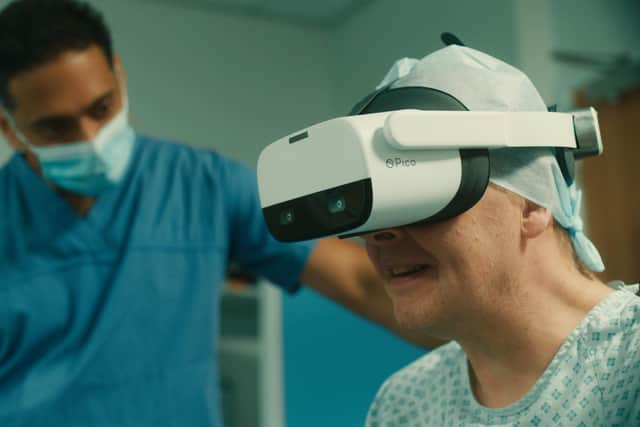

A trial is now taking place to measure the benefits and see how long the effect of a series of treatment sessions with the technology could last for patients.
“For an individual it means they keep moving, they keep mobile, they keep active and they can use this in their own homes,” Prof O’Connor says.
“The advantage for us is that we can see remotely and help someone if they’re struggling with the technology. We can also prescribe the exercises remotely - if someone is improving we can make the exercises more difficult so that they continue to get better but not so challenging that it gets demotivating.
“So the rehabilitation team can work much more effectively and in a way, we are delegating to the AI system the supporting of someone’s recovery. Then we can use our people to do the hard thinking, the treatment planning and so on, for patients, and the delivery of other treatments we offer as well.”
Prof O’Connor’s focus in rehabilitation has also seen him and his colleagues work with a 3D-printing business in Leeds to develop new kinds of braces, splints and supports for patients, bespoke to their bodies.
“We take a scan of the hand (or other body part), the support is printed and then we can post it out,” Prof O’Connor says. “I’ve not come across anything like this before in my career, it’s fantastic. If it gets lost or broken, we can just press print and have another one sent out the next day.”
It’s just one example of how technologies are bringing new potential to the NHS. Wearable technology is also increasingly being used, with smartwatches and other devices presenting opportunities for the monitoring of patients remotely, outside of medical settings.
The idea is that people can manage their health at home, with healthcare staff receiving the data.
Earlier this year, the cancer team at Airedale NHS Foundation Trust began rolling out an app called Careology to help people being treated for cancer to access support and manage their condition.
It works with their healthcare teams to help self-manage aspects of their treatment including medication, side effects and symptoms, with staff able to intervene should someone need additional care.
Elsewhere in Yorkshire, Leeds Teaching Hospitals NHS Trust, for example, has a remote monitoring virtual ward service, covering a range of specialities including cardiology and oncology.
The technology, developed with Yorkshire digital health company Inhealthcare, means patients or their caregivers can take regular measurements such as blood pressure, respiration rate and oxygen saturation, securely transmitting readings to care teams.
Lead consultant Dr Muzahir Tayebjee said earlier this year that “while virtual wards won’t solve all our capacity challenges, they’re making a remarkable difference”.
“In our cardiac valve pathway, patients who would previously have been stuck in hospital waiting for investigations can now be at home with their families. They maintain their priority status for treatment while avoiding the risks of lengthy hospital stays.
“One of my colleagues recently observed that by freeing up beds more quickly for critically ill patients, this service could potentially help save lives.”