
Yorkshire academic becomes first woman to climb Everest with stage four cancer

It’s a mission which would test anyone but a Leeds academic has conquered one of the world’s most famous peaks.
Dr Shaunna Burke has become the first woman with stage four incurable cancer to summit Mount Everest.
As an exercise psychologist at the University of Leeds, Dr Burke has dedicated her career to researching how exercise can be used in cancer treatment.
Determined to push herself further after completing the Everest Marathon last year, Dr Burke set out to summit the world’s tallest mountain in aid of Macmillan Cancer Support – all while dealing with the long-term effects of her incurable breast cancer and chemotherapy treatment.
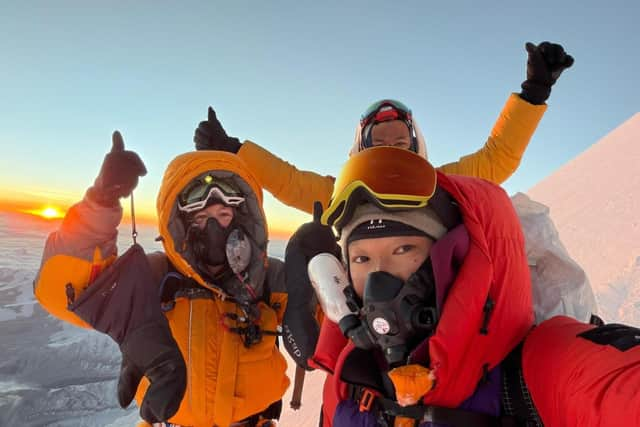

The awe-inspiring challenge is also a research project in collaboration with Leeds Beckett University, and the subject of an independent film titled Dying to Climb.
Dr Burke said: “Reaching the top was one of the most meaningful moments of my life, and I could not have done it without the unwavering support of my two incredible climbing Sherpas, Lopsang and Khangdo. Their strength, experience, and encouragement carried me every step of the way.
“Thank you to my sponsors, and to all my friends, family, and followers for your incredible support throughout this journey.
"Your belief in me kept me going even in the toughest moments.”
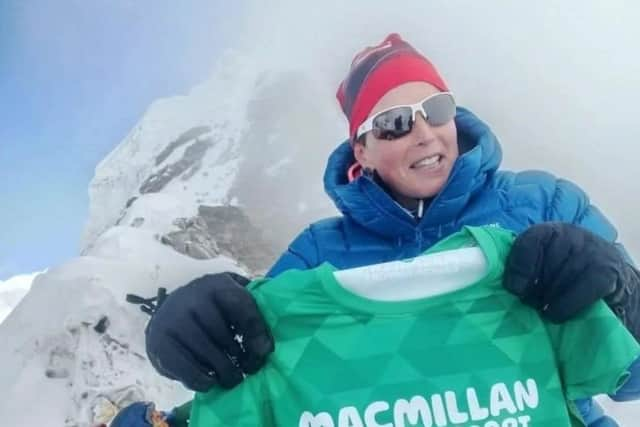
Dr Burke, who works in the School of Biomedical Sciences at Leeds, created a personalised diet and exercise plan for herself after being diagnosed with incurable breast cancer in 2024.
She ran to chemotherapy and radiotherapy appointments to maintain her fitness and mental health during cancer treatment.
In preparation for the climb, Dr Burke trained in the altitude chamber at Leeds Beckett University’s (LBU) Carnegie School of Sport, walking on a treadmill with a weighted rucksack to simulate the demands of climbing above 4,000 metres.
Monitored by Dr Barney Wainwright, an Applied Sports Scientist at LBU, the training helped to prepare her for the exertions of the challenge as well as providing data on how her body adapted to low oxygen levels.
On Dr Burke’s team for the first part of the climb were anaesthetist and high-altitude expert Dr Patrycja Jonetzko, who has provided medical support for a number of mountain expeditions, as well as camera operator and director Ben Ayers from Rainshadow Films, the makers of the Dying to Climb documentary.
The expedition with the team’s ascent of Mera Peak, a 6,400-metre mountain where the research testing was conducted.
This stage allowed Dr Burke to be closely monitored as she acclimatised to high altitude and very low temperatures.
She progressed to Everest Base Camp at 5,364 metres with her climbing Sherpas.
Dr Burke became the second Canadian woman to summit Everest’s peak, at 8,849m above sea level, in 2005. This is her second time reaching the highest point on earth.
So far, Dr Burke has raised more than £30,000 for Macmillan Cancer Support through this project alone.