
'Your mind seems to forget you have Parkinson's' - The transformative impact of augmented reality headsets
An augmented reality project is showing transformative results for people living with Parkinson’s in the region, with some who walked with a stick now able to take steps unaided after taking part in the scheme.

Laura Wright, a neurological physiotherapist at Sheffield-based Hallamshire Physiotherapy, has been delivering a programme using Stroll AR technology to try to improve movement in people with the progressive neurological condition.
Those who took part in sessions in Chesterfield earlier this year walked further and faster, balanced better and felt more confident by the end of the scheme – and now people in Barnsley are seeing similar improvements as a result of their augmented reality sessions too.
Laura is running the programme for six members of the Barnsley and District branch of Parkinson’s UK, partially funded by the national charity.
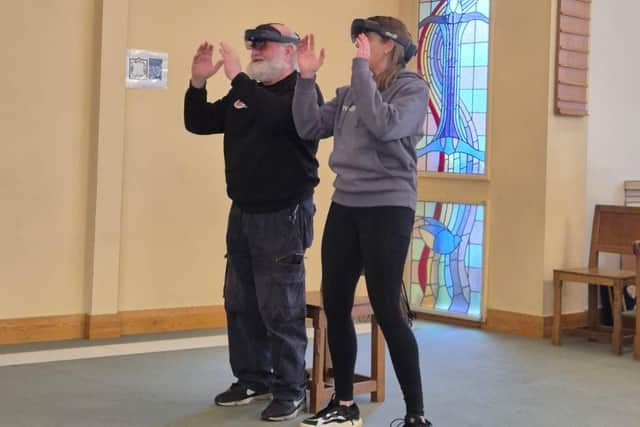

She works with the individuals, who put on augmented reality headsets, overlaying games, tasks and prompts onto their environment to help them with balance, strength, coordination and mobility, as well as with cognition and problem-solving.
The technology can also be used in neurological rehabilitation for stroke and multiple sclerosis.
“This technology is brilliant,” Laura says. “It’s those little stories of people who can barely get out of their wheelchair and walk then all of a sudden they’re striding and walking how they would have done years previously that make it so rewarding.
“I’ve been doing these sorts of exercises with people for years - sitting to standing ten times in a row for example, and they’ll look at me and roll their eyes. They’re doing it here without even realising. The technology has made it more fun.”
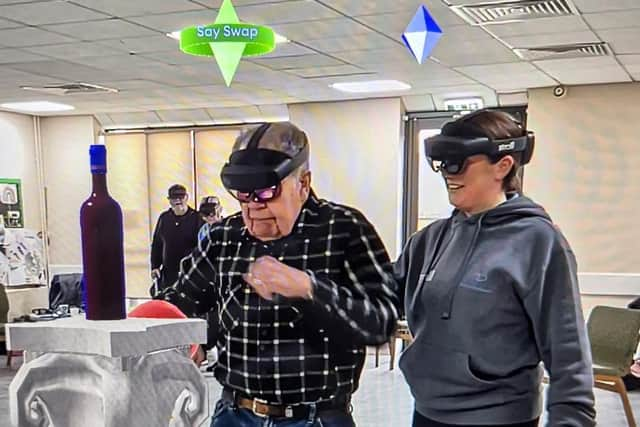
“It brings out that inner child within anybody and you want to try and beat yourself week on week,” she adds. “Therefore your legs get stronger, you get more balanced, you get more confident.
“And if you’re more confident and have less fear of falling, you are more likely to go out and do things which keeps you more active and also means that you’re doing more of the things you want to do.”
There are more than 40 symptoms of Parkinson’s but common ones include a tremor (shaking), slowness of movement and rigidity (muscle stiffness), which typically get worse over time.
“Evidence suggests exercise is the only thing that can slow down the progression,” says Laura, who worked in the NHS for 17 years. “Using the headsets is one version of getting people to exercise.”
In Barnsley, sessions with augmented reality have been delivered for six weeks, with measurements taken on the first and last week. After a short break, another four weeks of sessions will take place, with further measurements.
Results so far are promising. Branch chairman Terry Kendall, who lost his wife to Parkinson’s five years ago, put together a funding proposal for the programme after a “remarkable” taster session with the technology. “In ten minutes, two people were walking in a much better way than they previously had,” he says.
After six sessions with Stroll AR, guided by Laura, improvements have been observed in mobility, gait speed, strength, balance and falls confidence. Three participants have moved from walking with a stick to walking unaided and two who were largely unable to move prior to the scheme have been able to do so in some way.
Laura explains that encouraging people to move with visual prompts whilst the augmented reality headsets are on helps to rewire pathways in the brain, fostering neural connections that reinforce mobility, stability and coordination.
That means that improvements are likely to be seen even once the glasses are off, particularly if people feel empowered by their achievements with the glasses on, which can boost morale and confidence.
Barrie Cooper, who was diagnosed with Parkinson’s around five years ago, is one of those who has been involved in the Barnsley project.
“It’s been very helpful. It’s helping me to walk better. For a couple of days after I take the augmented reality glasses off, I’m wanting to go. I’m definitely getting more confident,” the 74-year-old says.
He’s been doing rehabilitation exercises every week for some time. “But if I could wear these all the time, I’d prefer it,” he says. “It gets you motivated. Your mind seems to forget you have Parkinson’s.”