
Adwick-le-Street: The Yorkshire village which has a unique link to George Washington
Many Yorkshire villages have unique histories. One of them, Adwick-le-Street, situated a few miles north-west of Doncaster, even has an association with George Washington, the first American president.
The original village of Adwick, centred on Village Street, was mentioned in the Domesday Book of 1086.
John Magilton (1977) states: ‘The village name and present street pattern point to an especially interesting past, the name suggesting a Saxon origin to the settlement.’
J. Morgan Jones in Adwick-le-Street A Short History of the Parish Church [1962] states that it is difficult to establish a definite date for the present St Lawrence’s Parish Church.
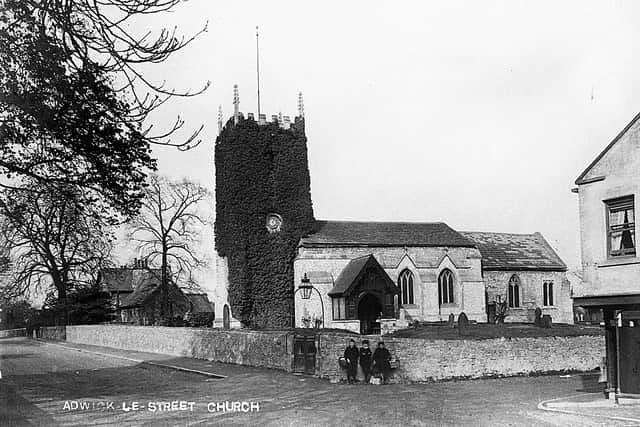

But 1150-1200 seems a reasonable estimate for it was probably developed from an early aisleless Norman nave and chancel, the first addition being the north chapel in the thirteenth century.
He adds: ‘Of the original fabric, there still remains the South doorway and a built-up semi-circular headed window visible on the South wall of the Chancel. It is possible that the semi-circular sedilia are also part of the original church.’
The church was restored in in 1862 and the chancel partially restored in 1895. A new organ was provided at the same time and in 1904 a reredos and altar were erected.
In an article from December 5, 1946, it is claimed that the most interesting thing about Adwick-le-Street is its association with the Washington family and America’s first president.
A branch of the family lived at Adwick Hall and many villagers were proud of the link with the famous statesman. The church registers show they were there from 1562 until two years after the birth, in Virginia, of the future president.
They bought Adwick-le-Street in 1560 and the head of the village was the village squire.
The article said: “Their arms – stars and bars – from which the national flag of the United States was derived, are sculptured on the family tomb, which is rich in decorative sculpture and decorative writing.”
Adwick Hall was formerly situated opposite the church, on the west side of Village Street. A print exists of the Hall which is alleged to have been built in the 16th century. After the Civil War, it was confiscated and only recovered with some difficulty.
It was later run as a ladies’ boarding school by a Miss Simpson.
The building’s demise is aptly described by C.W. Hatfield (1866): “Adwick Hall is a mass of ruins…a scene of desolation has overtaken the revered home of the late Dr Inchbald. The garden with its flowers is no more.
"The pump alone remains an abiding relic of a time-honoured mansion. The hall is dismantled and a portion of the materials used in the erection of farm premises at Pigburn.”
According to a booklet published around 1955, Adwick-le-Street Rectory dates from the reign of King Charles the Second, and it adds: “One Albrede de Lisureo gave the “glebe” of St Lawrence’s church to the Nunnery at Hampole, but after the dissolution of that Order, a Mrs Anne Saville of Methley purchased it at a cost of £900 and “settled” it upon the Church forever.”
The Reverend Joshua Brook, being the incumbent built, at his own cost in 1682, the parsonage house. Adwick-le-Street Rectory was purchased in 1952 by Adwick-le-Street UDC.
An undated manuscript states that following a search no firm date for the construction of Adwick Mill could be found. And, while the datestone of the house reads 1786, analysis of the land tax records for Adwick-le-Street revealed that the building was occupied in 1784.
The land tax, which began in 1784, named the owner of each property together with the name of the occupier, who was not necessarily the same person. Hence for Adwick Mill from 1784 until 1789, the owner is given as Charles Duncombe and the occupier as William Boulton.
As the Duncombe family seem to have been the chief landlord in the Adwick area, it has been suggested that they instigated the building of the mill, put up the funds for its initial construction and organised the engineering of the mill dyke.
The 19th century was marked by a number of developments in Adwick-le-Street. An inn with the name of Forrester’s Arms can be traced back to at least 1855, but between 1822 and 1838 it may have been called the Plough. At one time the Forrester’s Lodge of Oddfellows used to meet on the premises.
Also, the Adwick Bowls Club had its headquarters in the pub. Rebuilding took place to the designs of Henry Beck, c. 1909.
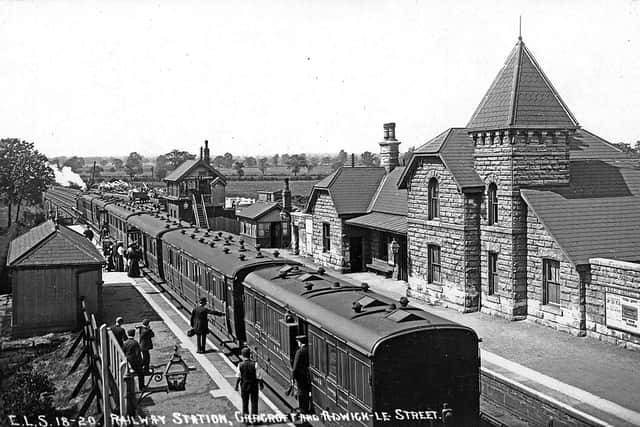
The West Riding & Grimsby Railway was a project undertaken by the GN, MS&L, and SY railways to join Wakefield to the port of Grimsby.
A connection was made between the MS&L near Stainforth, whilst a branch was formed from the GN main line north of Doncaster station and joined the new railway just north of Adwick. Here, the only station on the branch was opened on March 1, 1866. It was built with limestone walls and a Welsh slate roof.
The station was initially called Adwick, then in January 1867 changing to Adwick & Carcroft, before Adwick-le-Street & Carcroft in March of that year. During 1880, the latter place was given prominence and placed first in the title.
This remained the case until the station closed to goods traffic in June 1965 and to passengers on November 6, 1967. The building subsequently became a house, but a new station was opened just to the south of the original on October 3, 1993.
The Methodist Times of February 10, 1887 said that a new and handsome Gothic chapel, to accommodate 140 people, erected at a cost of £400, had been opened in the village of Adwick-le-Street. The site was generously given by P. Thelluson, of Brodsworth.
The 20th century saw significant changes to Adwick. Whilst having a population of just over 300 at the turn of the 19th century, this increased into the thousands.
The opening of the Brodsworth and Bullcroft collieries, 1908 and 1910 respectively, brought an industrial era that entirely altered the character of the district. Miners and their families from Nottinghamshire, Derbyshire and older coalfields, flocked to the area.
A report from June 7, 1912 stated that the first police station at Adwick-le-Street was fast approaching completion. Provision was made for the ‘lodging’ of prisoners, with five cells. There would also be a house for a resident police officer.
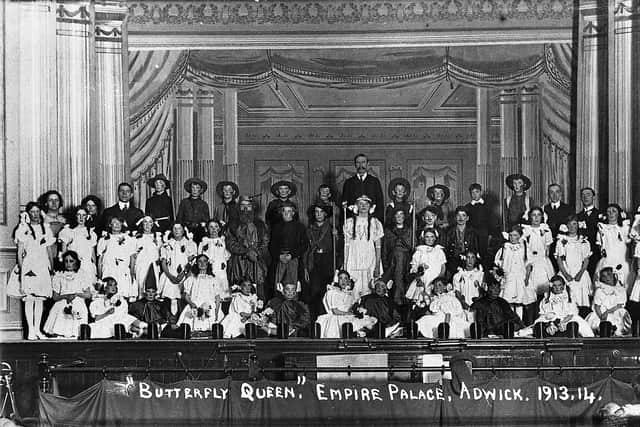
The Northern Counties Cinema Company opened the New Empire Palace Cinema during December 1912. A sale notice from August, 1933 gave the following details: ‘Auditorium 71ft by 57ft. Accommodation 885; Stage and 2 dressing boxes.’ The New Empire Palace, latterly owned by Intimate Cinemas (Adwick) Ltd, closed in May 1958. The building still survives.
A Trade Directory of 1921 mentions: ‘The Adwick-le-Street Urban District Council was formed in 1915. There are four wards as follows: Adwick, Woodlands, Carcroft, Highfields.’
A new road from the Carcroft and Adwick railway station to Windmill Balk Lane was completed in 1927. The cost of the new road, including the compulsory purchase of the land, was about £7,000.
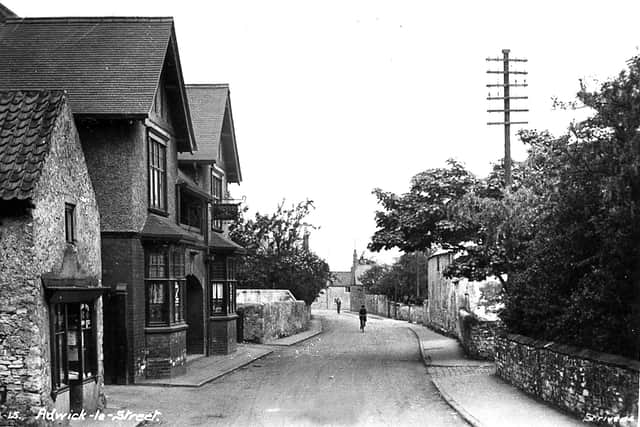
In the years following the Second World War, several old Adwick-le-Street properties were demolished as a result of Clearance Orders and redevelopment has taken place. John Magilton (1977) summed up the present situation in the area when he said: ‘The village has suffered greatly from redevelopment throughout [the 20th century], although some interesting structures remain and are worth preserving.’