
Ampleforth Abbey: The historic Yorkshire abbey home to one of the largest known Mouseman collections
Robert Thompson has always had a close working relationship with the Church. Sally Clifford visits Ampleforth Abbey in North Yorkshire – home to one of the largest known ‘Mouseman’ collections.
It was during his bus journey from Kilburn to Cleakheton where his father sent him to be an apprentice engineer, a 15-year-old Robert Thompson took a particular interest in Ripon Cathedral.
He’d stop off to change buses and would sketch the fifteenth-century woodcarvings and interiors.
He later speaks of this period as his inspiration to “bring back to life the spirit of medieval oak work, which had been dead for so many long years”.


The wood carvings and interiors within inspired his work when he joined the family joinery business in Kilburn some five years later when his father John became ill.
Many of us know Robert Thompson for his trademark mouse on furniture and chopping boards but, of course, Mouseman’s reach extended beyond suburban streets and country retreats to many ecclesiastical settings such as the beautiful Ampleforth Abbey.
Nestled in 1,200 acres, the abbey, and neighbouring Catholic private and independent boarding school, Ampleforth College, are home to one of the largest known Mouseman collections.
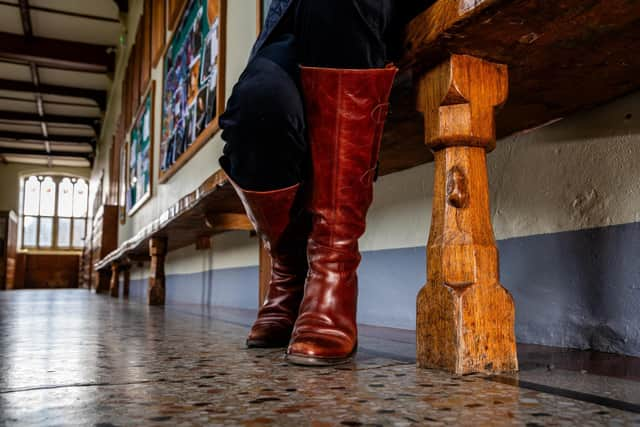
The abbey’s quire was Robert Thompson’s first major commission and the choir stalls, pews and lecterns were all carved by Thompson.
A visual snapshot of the chiselling of the mouse moniker and the rippled surfaces achieved with an adze, a traditional tool similar to an axe, are played out in four minutes of film footage taken in Robert Thompson’s workshop and shown within the abbey’s visitor centre where Mouseman furniture from the prep school at Gilling Castle occupy the adjoining tearoom.
Father Chad, one of 39 Benedictine monks living at Ampleforth Abbey, explains the film, dating back to 1948, was discovered within the abbey’s archive.
It gives an intriguing insight into the process of Thompson’s productions, from the carrying by hand of large pieces of old English oak to their subsequent carving into what we now see on the furniture.
Leading the way to the abbey church, Fr Chad explains the relationship forged through craftsmanship between Robert and the architect, Sir Giles Gilbert Scott, the designer of Liverpool’s Anglican Cathedral who would employ Thompson’s services for much of the ornate wooden interiors within the abbey church and the college.
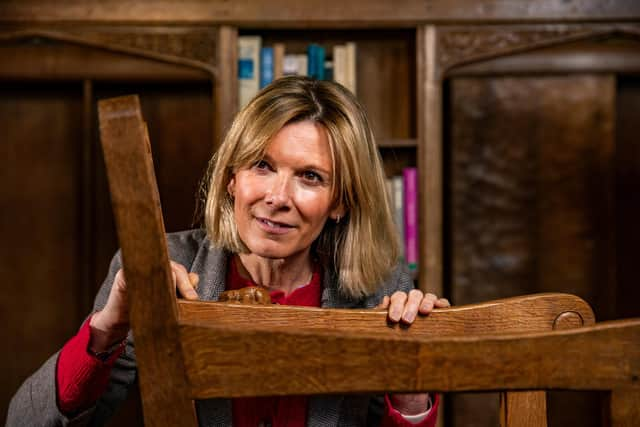
Fr Chad, who arrived at Ampleforth 35 years ago, explains Scott and Thompson, along with Fr Paul Nevill, the first monk to commission Thompson, were born, and died, within six years of each other.
“Their lives are interwoven,” he says.
Stepping inside the Abbey Church the extent of Thompson’s craftsmanship becomes apparent.
The heavily detailed abbot’s stall is a work of wooden art.
Running his hand under a surface, Fr Chad explains the hidden inscription to the craftsman and architect – created by Thompson and bearing his name alongside that of Scott, who was apparently keen to use his own craftsmen when he initially came to Ampleforth. Thompson’s craftsmanship persuading him otherwise.
“Oak is such an English thing and when this monastery was developed here the community was very keen to establish that we are English.
"I think oak represents something that was local, long-lasting and there is something of our vow of stability, about praying in these oak stalls for the rest of your life.
"They are extremely solid things and somehow the monastery is embedded and set in this locality,” says the monk.
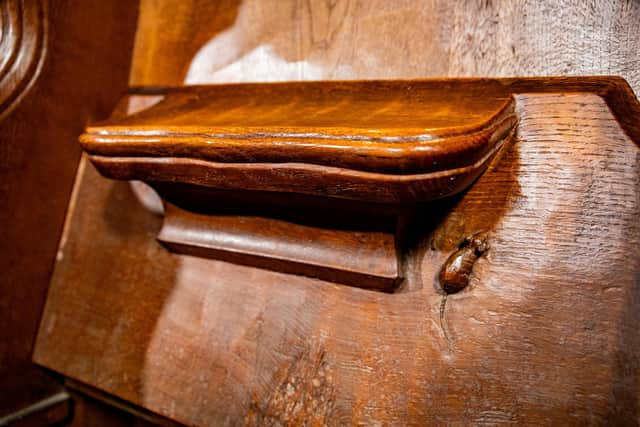
Thompson made his mark all over the abbey church from the lectern, where lessons and readings are delivered, to the misericords (mercy seats) in the choir stalls – featuring a hinged wooden ledge under a folding seat for the monks to perch.
“I think of our presence here for 225 years in this valley, to be able to come and pray here is a great privilege and these oak stalls are not going to disappear and will stand the test of time,” says Fr Chad.
Thompson’s introduction to Ampleforth came in 1919 when he was asked by Fr Paul Nevill, who became headmaster at Ampleforth College, to create a large wooden cross for the cemetery in Ampleforth village.
Standing in the silence, and absorbing the beauty of Thompson’s work, Fr Chad talks about another theory to Thompson’s mouse moniker being “a symbol of industry in quiet places”.
This theory certainly fits with the industrious craftsman whose association is stamped around the church, and the college, where continuing our journey into Thompson’s craftsmanship, we see the doors to the Big Study with inscriptions in honour of all the Old Amplefordians who fell in the First World War.
Along the Big Passage, decorated with Thompson’s honours boards, we arrive at the library passing through the doors Thompson crafted in honour of Fr Paul.
“Fr Paul Nevill said he wanted Thompson to build the library because he wanted the boys to know what beauty was about.
"Anthony Gormley was here as a boy and I’m sure he was influenced by seeing a lot of the beautiful sculpture about the school,” says Fr Chad.
Memorials and inscriptions – testimony to the people of importance associated with the abbey and the college who have since passed – can be found in portraits on the walls and carvings.
Emma Craig, the college’s head of development, explains the portrait of former scholar Hugh Dormer who was killed in action during the Second World War.
His family kindly donated the proceeds from his war diaries for the Upper Library’s completion. His memorial inscription is beautifully carved into the side of one of the Mouseman bookshelves.
Perhaps the most impressive feature of Thompson’s work within these walls are the 22 carrels lining each side of the room previously known as the Junior Library.
The crests featured on each pay homage to the important Catholic families connected with this significant place of study and worship.
Flanking either side of a Mouseman desk – with chessboard atop – a pair of monks’ chairs feature the ornately carved Grid Iron, paying homage to St Laurence, the principal patron of Ampleforth Abbey.
The few visible signs of wear on the leather lattice seats are indicative of the students’ respect for the hard work put in to producing such beautiful yet practical pieces for everyday use.
“To be surrounded by this amazing craftsmanship really instils a sense of stewardship in the children and a bit of awe,” says Emma.
While much of Thompson’s pieces date back through the ages, Emma explains there are more recent commissions such as the Amplemouse box, which raises money for the Ampleforth College bursary fund, and the Mouseman gifts given to those associated with the abbey and college for service and special occasions.
“It is not a museum, it is a living collection, she adds.
Catherine Hodgson, head of marketing, communications and development at Ampleforth Abbey, says: “In this anniversary year, we are reminded not only of Thompson’s remarkable legacy, but also of our role as stewards of this very precious collection of furniture, which reflects Thompson’s unique creativity, craftsmanship and typically Yorkshire sense of humour.”
To commemorate the anniversary of Thompson’s birth, Ampleforth Abbey is hosting a free Mouseman Trail, with family-friendly activities inspired by his work, on Saturday, May 2, Sunday, May 3, Monday, May 4, Saturday, May 9 and Sunday, May 10. Booking isn’t required for the trail.