
Amy Johnson statue: The trailblazing female pilot standing over Hull for 50 years
The list of trailblazing female pilots that left a mark on aviation history is headed by Amelia Earhart, the first woman to make a solo flight across the Atlantic, and Raymonde de Larouche, first of her gender to receive a pilot’s license.
Among this exalted company stands Hull’s Amy Johnson (1903-1941), the first woman to fly solo from London to Australia, who also set a record for the flight from Britain to South Africa.
Born into a family of fish merchants, she was educated at the municipal secondary school in East Hull then studied economics at Sheffield University.
While working in London as a legal secretary she took up flying as a hobby and received her pilot’s license in 1929.

The money to purchase her first aircraft - a second-hand de Havilland DH.60 Gipsy Moth - was provided jointly by her father and Lord Wakefield, founder of the Castrol lubricants company.
In 1930 she achieved worldwide fame after completing a 11,000 solo flight from Croydon Airport in Surrey to Darwin in Australia’s Northern Territory.
Her next major flight came a year later when, with a co-pilot this time, she made the first one-day flight from London to Moscow.
Another notable achievement soon followed: a flight from South Wales to the USA with her husband, Scottish pilot Jim Mollison.
After crash-landing in Connecticut and escaping with just superficial injuries they received a ticker tape parade on New York’s Wall Street.
Her final flight was on 5th January 1941 when she was seen parachuting out of her aircraft over the Thames Estuary. Her body was never found.
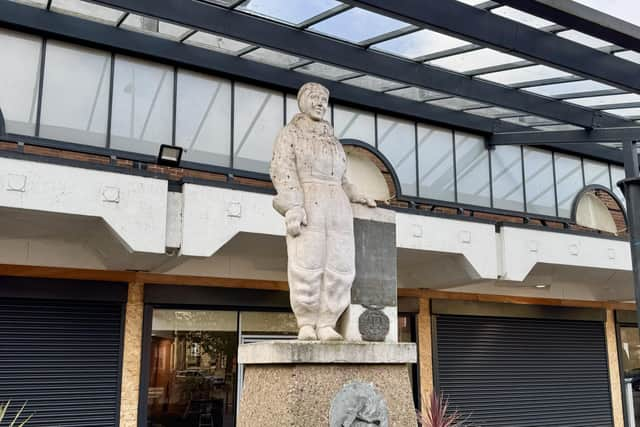
A statue of Amy Johnson sculpted in Portland stone by Harry Ibbetson was unveiled on 18th July 1974 outside Hull’s Prospect Centre by the aviator Sheila Scott, who herself broke over 100 long-distance flying records.