
Bentley: The Yorkshire community devastated by two colliery tragedies
The warm, tightly-knit, mining community at Bentley, South Yorkshire, experienced not one but two tragic accidents during the colliery’s lifetime. These occurred in 1931 and 1978.
Barber, Walker & Co. began sinking two shafts at Bentley in 1906 and the Barnsley Seam was reached in both during 1908 at a depth of 624 yards.
Later, the shafts were deepened to the Dunsil Seam at 642 yards. Initially, movement of coal was in tubs hauled by ponies, then by rope haulages, and by belt conveyors.
Diesel locomotives were used from around 1939 for the movement of men and in 1945 for coal haulage and supplies.
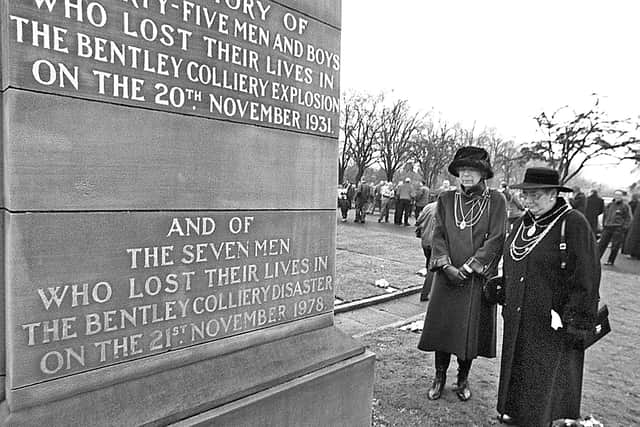

An explosion took place in Bentley colliery’s North-East District, Barnsley Seam, at 5.45 pm on Friday November 20, 1931 resulting in the death of 45 men and boys. The youngest of the victims was 17.
On the pit top a massive crowd of men and women watched a continual procession of ambulances and stretcher bearers.
"The roof and the walls came down like a thunderclap,” explained one survivor. At the time of the blast there were about 1,000 miners in the pit.
Many were in other parts of the mine and were brought to the surface.
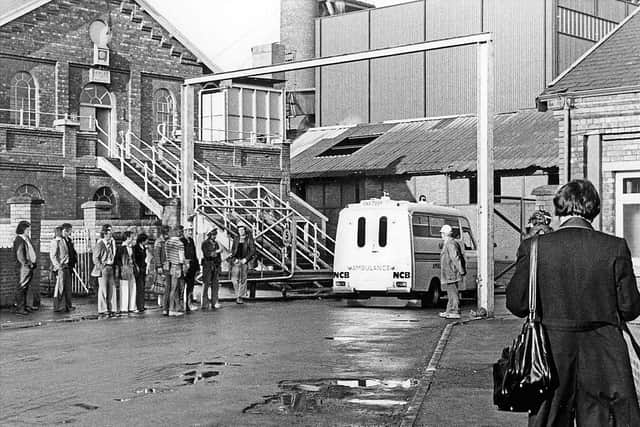
Working in extremely dangerous conditions, three members of the rescue teams were severely burned by a second blast and a third occurred a little later.
The Secretary for Mines, Isaac Foot, said three days later in the House of Commons, that after a third explosion it was decided, owing to fire and the imminent danger of still further incidents, that the affected area should be completely sealed off.
Thompson’s Weekly News on November 28, 1931 reported that 89 children were robbed of their fathers as a result of the disaster.
A Relief Fund was opened and the King and Queen subscribed £1,000 and £50 respectively.
The newspaper added: "Salvation Army Officers, Parsons in their shirt sleeves, all lent a hand and special praise must be given to three St John’s Ambulance Brigade women who, with infinite tenderness helped to bandage the wounded and ease their sufferings.”
They were later identified as Elsie Wadsworth, Elizabeth Oma and a Mrs Jones.
One widow, a Mrs Grain and mother of seven said: "Some of my children do not yet know what has happened. They are too young.
"My youngest child is only 4 and my eldest 12. 2 of the six girls are twins and there is only one boy, so you can have some idea of the plight I am in.
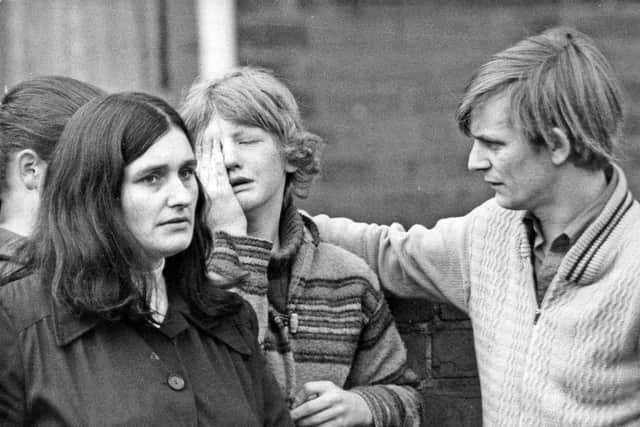
"None of them will be able to go to work for long enough and my husband was the only one who brought in an income. How I shall manage I do not know – I scarcely dare think.”
A Mrs Atkinson commented: “When I learned that my husband had been seriously injured, I hurried to the infirmary.”
"’It is like new wine to see you again lass’, was the remark with my husband greeted me and when I asked him how he was feeling he replied: “I shall get better, I have the guts’.”
Most of the victims of the colliery disaster were buried together in a mass grave at Arksey cemetery on Wednesday November 25, 1931.
Businesses closed for the day and countless houses had their curtains closed as a mark of respect.
Hundreds of relatives of the victims figured in a procession, stretching about two miles long to the cemetery.
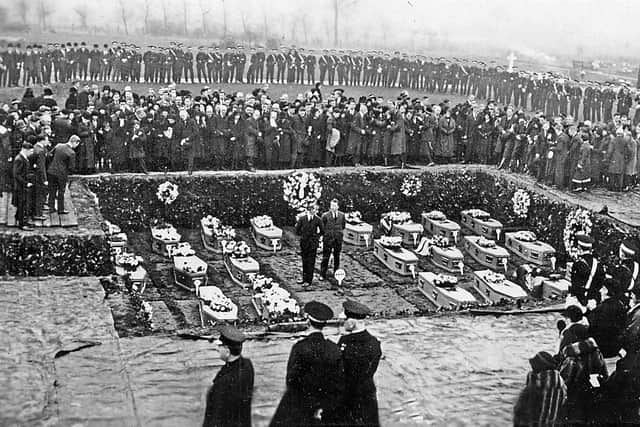
They had been preceded by clergy and a choir from churches in the district of all denominations.
Motor lorries draped in purple carried the bodies of the dead men from several churches to the grave yard.
More lorries were stacked high with wreaths arranged on wooden racks.
John Church (1991) states that some coffins were brought from nearby houses making 31 in all and other victims died later or were buried elsewhere.
He adds the huge grave was divided into 32 plots, the one in the centre being labelled ‘Not found’ and commemorated those five men entombed in the pit.
A special body of police controlled the traffic arrangements and it was estimated that 30,000 individuals attended the funeral.
An official inquiry into the Bentley Colliery explosion was conducted by Sir Henry Walker, Chief Inspector of Mines, for the Mines Department.
An inquest was held at the colliery on December 14, 1931 and Coroner W.H. Carlile presided over the deaths of 45 men in total.
After careful consideration and hearing witness evidence, he thought that they had heard enough evidence to confirm the men were killed by the explosion and that the explosion was an accident.
The jury after a short retirement returned a verdict of ‘Accidental Death’ on the men who had died.
Eight men were awarded the Edward Medal for their bravery in undertaking rescue operations in hazardous underground conditions.
This occurred on February 16, 1933 at a Buckingham Palace ceremony in the presence of His Majesty King George V.
On Sunday November 20, 1932 – a year after the disaster – a memorial stone obelisk in the centre of the big grave was unveiled at Arksey cemetery.
This was in the presence of widows, mothers and children and hundreds more of the general public. The brown obelisk is 10ft 6ins high and plain except for a brief explanatory inscription.
It was designed by G.D. Walton, of the colliery staff, and carried out under the direction of A. Stafford the colliery engineer and a Mr Woodhall.
One report said many sad scenes were witnessed as little groups slowly approached “and laid wreaths on the small inscribed flat stones which marked the last resting place of their loved ones".
The unveiling ceremony was performed by D. McGregor, agent of the colliery, and W.J. Ballam represented the men.
At the time of the Bentley colliery ‘man-rider accident’ of November 21, 1978 there were 920 men employed underground with 280 on the surface.
The pit’s output was 14,000 tons per week of saleable coal. This was gained from three mechanised faces in the Dunsil Seam.
Miners were transported to these sections by diesel locomotives hauling Wickham man-riding carriages. A fleet of 12 locomotives manufactured by Hunslet Limited were used at Bentley.
Seven moved only materials the remainder man-riding. Two speed gearboxes were fitted to all the locomotives having a top speed of 4.42mph and 9.15mph.
They operated on a single-track system with a rail gauge of two feet three and a half inches. The man-riding locomotives were equipped with a system of radio communication.
The Wickham man-riding carriages were divided into four compartments holding five making a maximum capacity of 20 men per carriage.
Rules stipulated a maximum train of four carriages each containing 20 men.
On the Monday night shift of November 20, 1978, 152 men descended the pit to begin work at 10.15.
At approximately 5.40am on the next day, three carriages of a diesel-hauled man-riding train were derailed below ground.
Seven men were killed and 19 others injured when they were thrown from the wooden seats and pinned between the careering carriages and the roadside.
This accident occurred forty-seven years almost to the day after the 1931 tragedy.
The injured men were taken to hospital for further attention. Forty were treated for shock at the colliery medical centre. Those who died were brought to the service by 9am.
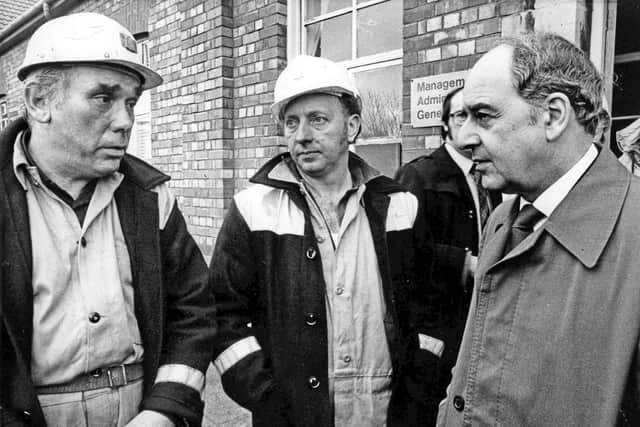
Their ages ranged from 18 to 55. An investigation was started and one of the first at the scene was Arthur Scargill, the President of the Yorkshire NUM.
The official conclusion about the disaster stated that no single individual could be blamed but instead a combination of mechanical failure, operational errors, and a breakdown in safety reporting ultimately led to the unfortunate incident.
On November 16, 1993 British Coal’s announcement to shut down Bentley Colliery was met with an air of sad inevitability within its community.
Each year, since the tragedies of 1931 and 1978, an annual memorial service (apart from a brief interruption by the Covid pandemic) has been held in Arksey Cemetery.