
Bowes Museum: How the early railways brought fashion and holidays to ordinary people
From swimwear and holidays to shopping the latest Paris collections, the style legacy of the early railways is the focus of an exhibition at the Bowes Museum exploring the impact of train travel on fashion. Yorkshire Post Fashion Editor Stephanie Smith reports.

Steam trains still have the power to fascinate and beguile, an instant fix of nostalgia and romance, so no wonder they are often used to evocative effect in period films and TV dramas, from Brief Encounter in 1945 right through to the upcoming new season of All Creatures Great and Small on Channel 5.
Perhaps this is because they still signify to us possibilities, adventure and change. The coming of the railways brought not just ease of travel and fresh vistas to ordinary folk; it also brought new fashions and style - and this was especially true for those living in the North of England.
“What struck me was how important the railway was to this corner of the country,” says Rachel Whitworth, curator of Fashion & Textiles at the Bowes Museum near Barnard Castle.
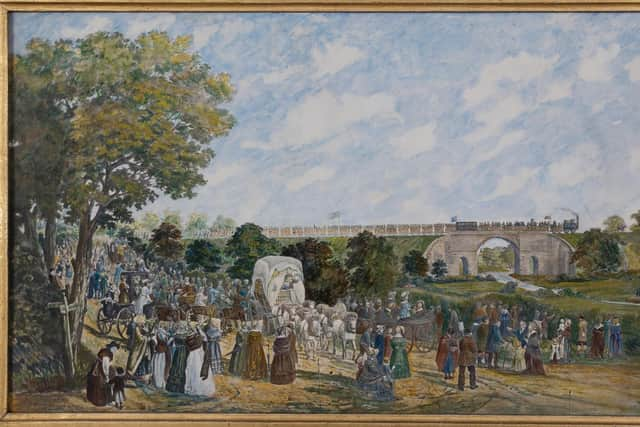

“They could go on holiday. They could get further than they had gone before. They could go into town to get to the shops. You could buy things in London and have them shipped up, so they made lots of things possible that hadn’t been possible before.
“Fenwick in Newcastle has been selling French fashion since the mid-1880s, because John James Fenwick, who founded the store, would go over to Paris, buy stuff and bring it back to Newcastle, where he would sell those original pieces, but he would also get his in-house tailor to copy them.”
“Fenwick, in the brochures that they produced advertising their sales, would publish a railway timetable, from York up to Alnmouth, for trains to Newcastle, to get you to the shop, to do your shopping, and then get you home again.”
Rachel has curated a new exhibition at the Bowes Museum called Dressed for Departure: Fashion in the Age of Rail, which opens on September 27 to mark the bicentenary of the Stockton and Darlington Railway, the world’s first public railway to use steam locomotives. The exhibition explores the transformational impact of rail on everyday lives and styles, from the early 19th century to the end of the 20th century.
“The railways were instrumental in making the seaside holiday such a huge thing that it still is,” she says.
“You get those wonderful railway posters that we are all familiar with. You might be on a platform in London feeling really miserable and see a poster that said ‘Come to Scarborough’ - and the train made that possible.”
Edward Pease (1767-1858) played a pivotal role in founding the Stockton and Darlington Railway, and the exhibition features several items of clothing worn by his family.
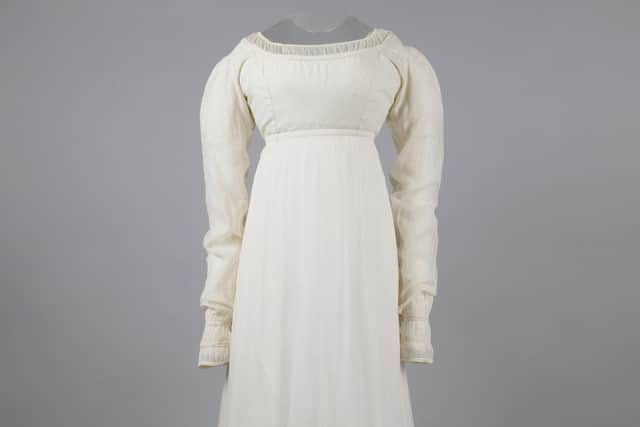
The earliest dress, circa 1810-1820, illustrates the world that the railways were born into. It belonged to Sarah Fossick, who married into the Pease family in 1825. Rachel says: “Until 1825, this was, and still is in many ways, a very rural area. They didn’t have good forms of communication, everything was carried by cart, people travelling by carriage.
“The Pease family were essential to the Stockton & Darlington Railway, mainly because they chiefly bankrolled it, because they were bankers in Darlington, and very interested in progress.”
The dress is made of fine cotton, or muslin. “It’s interesting in that it is both very plain, because the Peases were a Quaker family, but it does also follow the fashionable lines of having that very high waistline, and white was very fashionable at the time,” Rachel says.
“You will know from Jane Austen adaptations that muslin was hugely popular, because it was quite cheap and you could wash it, and that white colour was inspired by the neoclassical craze at that time. It would have been made possibly by a local dressmaker or a member of the family.”
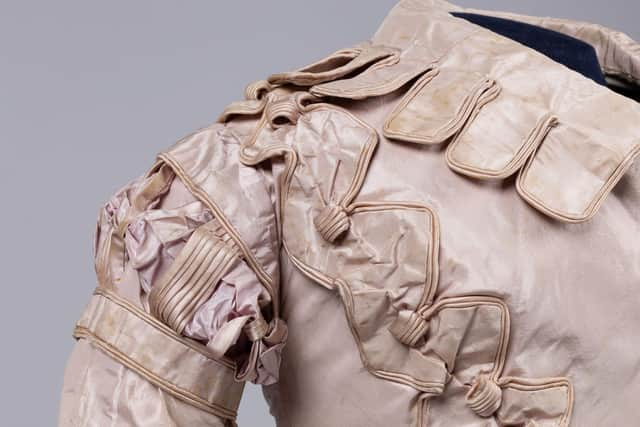
Another scene-setting piece is a pink Spencer, a little jacket for wearing outdoors, named after the second Earl Spencer, who, in the late 18th century, was wearing a coat with tails, standing before a fire,, when the tails set alight, and so he chopped them off to make a short jacket - which soon became all the rage.

There is a child’s dress dating from 1825. Rachel says: “We don't know if it’s a girl’s or a boy’s dress, because at this date little boys would wear dresses to begin with, for ease of movement and nappy changing, until they got to an age where they were formally breeched - the name of this transition from wearing a dress to going into trousers - and that could happen between the ages of four and seven, usually.
“It looks like a little dress that has been made out of fabric probably from a larger dress, which is a good example of how people would recycle.”
There is a wedding dress from 1936, owned by Eleanor Thomlinson, whose husband was a driver with the London-North Eastern Railway. They lived by the station in Barnard Castle. “She also made her own trousseau, so we’ve got pyjamas, underslip, drawers and a camisole that she made for her honeymoon.
“She was a professional dressmaker, who trained at Binns in Sunderland,” says Rachel. “It has this sheath-like style that was very fashionable at the time. It’s a type of velvet that was very popular in the 1930s, and it could be made of synthetic fibres. It was meant to look like silk velvet but would have been a cheaper alternative, which is a nice reflection of her wanting to look like a 1930s film star on a dressmaker’s budget.”
The railway enabled women like Eleanor to travel to towns and cities where they could see films and buy magazines. Rachel says: “We hope visitors leave with an appreciation of how railway innovation has influenced all aspects of life, from the past to the present.”
Another regional highlight on display is a commemorative medallion from 1893 which marks the start of construction of the Wear Valley Extension Railway whilst also recognising the role of Sir Joseph Whitwell Pease (1828–1903), who opened The Bowes Museum to the public in 1892.
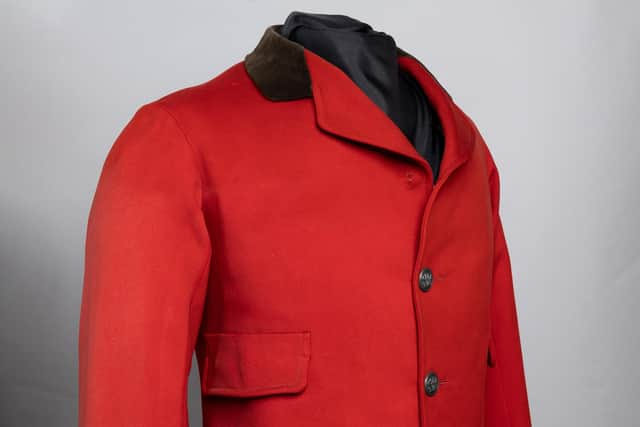
The display highlights how the railway shaped art and culture, showcasing scenic train journeys through the picturesque landscapes of Teesdale and the rise of popular seaside holidays promoted by railway companies.
The display also explores how railway travel influenced leisure and fashion, particularly the development of bathing costumes and swimwear designed for seaside holidays.
Rachel says: “Dressed for Departure captures the excitement and transformation that railways brought to society, reflected in the garments people wore, the toys they played with and the places they visited.”
The exhibition is part of the wider programme of celebrations run by the S&DR200, a nine-month international festival taking place across County Durham and Tees Valley in 2025 to celebrate the 200th anniversary of the first journey on the Stockton and Darlington Railway (S&DR).
Dressed for Departure: Fashion in the Age of Rail runs September 27, 2025 to February 1, 2026 in the Fashion & Textiles Gallery at The Bowes Museum, County Durham. See thebowesmuseum.org.uk.