
Boxing Day floods 10 years on: The Christmas catastrophe which was Yorkshire's worst peacetime disaster in modern history
Ten years ago, the worst flooding since the Second World War brought devastation to vast areas of Yorkshire. Andrew Vine looks back at the catastrophe that struck over Christmas 2015.

It began with the warning sirens blaring across Todmorden, Hebden Bridge and Mytholmroyd on Boxing Day as river levels rose alarmingly, threatening to breach flood defences.
The wail of those sirens effectively sounded the alarm not only for the three communities, but vast swathes of Yorkshire, which in the hours and days that followed were to suffer their worst peacetime disaster in modern history as flood waters swamped the county, bringing heartache and shaking residents’ faith in the safety of where they lived.
Flooding wrecked homes and businesses, caused the collapse of a historic bridge, submerged busy roads and railway lines and turned landscapes into lakes, leaving people and farm animals stranded.
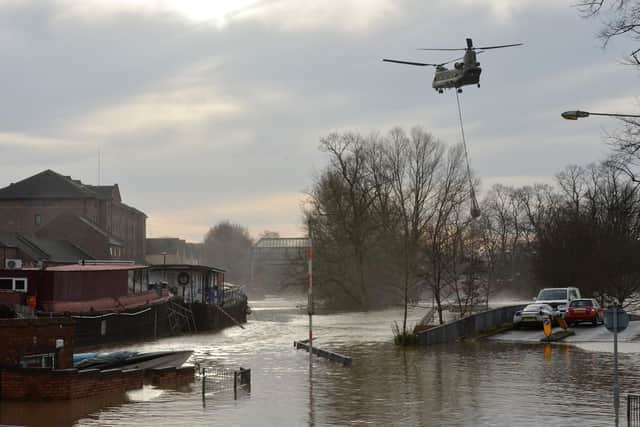

Streets became raging torrents of filthy water that swept all before it, rising up to five feet in living rooms, hallways and kitchens as residents fled, some being helped by troops deployed in Leeds, Calderdale and York to assist rescue and recovery operations.
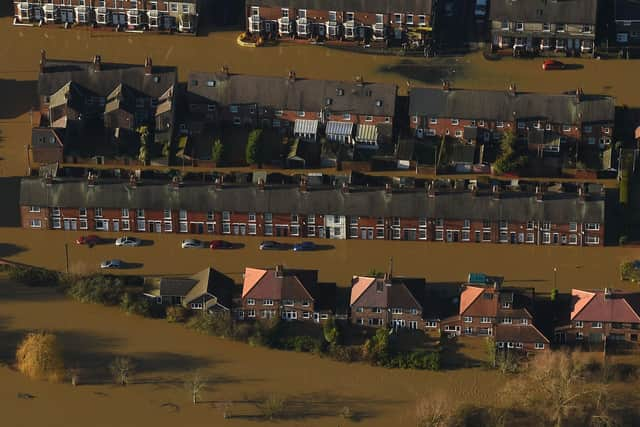
From the air, the scale of devastation was shocking. For as far as the eye could see, town and country alike in North and West Yorkshire lay under water as emergency services, engineers and council staff worked tirelessly round the clock to rescue people and restore some sense of normality to communities traumatised by a calamity on a scale none had ever witnessed.
And as the waters receded, the aftermath made the hearts of everybody who saw it sink. Wreckage and sodden furniture littered streets covered by an inches-thick layer of stinking mud.
Business owners went back into their premises to find thousands of pounds worth of stock and equipment stored in basements unsaleable or damaged beyond repair.
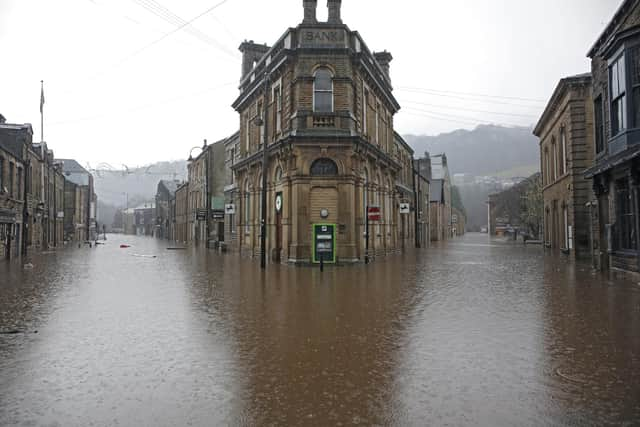
Residents evacuated for their own safety returned to the heartbreak of finding cellars flooded and the ground floors of homes they had worked hard to make their own ruined. Months of drying-out and then repairs lay ahead before some would be habitable once more.
More than 4,000 homes and 2,000 businesses were stricken, with the Environment Agency calculating the cost of that winter’s flooding across the north at £1.6bn.
Yet this worst of times brought out the best in Yorkshire’s people, resilient and defiant in the face of the most damaging floods in 70 years. Neighbours rallied round to commiserate with and comfort those whose lives had been thrown into such turmoil.
And then whole communities rolled their sleeves up to get on with the mammoth task of clearing up, shifting debris and turning out with mops, brushes and shovels to clean away the mud.
Shop owners put notices in their windows declaring themselves open for business as engineers restored power.
The aftermath also brought anger, directed at the Government for failing to invest in flood protection, dredging rivers and clearing drains, with the Prime Minister, David Cameron, being heckled when he visited York.
There was fury at an institutional north-south divide in spending on prevention which had seen Leeds denied funds for measures that would have saved homes and businesses, even as money was found for flood protection in the Thames Valley.
Nature’s onslaught on homes and livelihoods had been weeks in the making. As Yorkshire finished work to celebrate Christmas, residents of areas in West and North Yorkshire which had previously suffered flooding were worried.
They knew the signs of danger all too well. A series of storms had brought torrential rainfall across the north throughout autumn and the early weeks of winter, leaving rivers exceptionally high and the ground saturated, and more were forecast.
A pointer to what might lie ahead for Yorkshire had been seen in Lancashire and Cumbria, hit by widespread flooding in the first week of December.
Then, on Christmas Eve, Storm Eva roared in from the Atlantic, barrelling across Ireland and north-western England before lashing Yorkshire with 80mph winds and downpours that continued for hours. The Environment Agency issued 21 severe flood warnings in Yorkshire on Saturday December 26 – then the sirens sounded in Calderdale, which saw its nightmare of being flooded three years earlier happening all over again, with Todmorden soon cut off.
River levels rose relentlessly. In Leeds, the Aire reached a record peak on Saturday night of 2.95m at Crown Point – more than two metres above its usual height of 0.9m – and in North Yorkshire, rivers became lakes, leaving farmland submerged.
In the centre of York, the Ouse peaked at 5.3m above normal summer levels – just 15 cm below the top of the flood defences. In Tadcaster, aerial pictures showed the extent of the Wharfe’s inundations after bursting its banks, the waters leaving beer barrels floating in a newly formed lake in the yard of a brewery and the roof of a Sainsbury’s supermarket poking out of a flooded car park.
This was a deepening crisis developing extraordinarily quickly in multiple locations, leaving emergency services at full stretch as 999 calls lit up switchboards, many from people whose power had been cut because electricity substations had flooded.
Much of the land between Sherburn-in-Elmet and York was under water. In the village of Cawood, near Selby, the road bridge crossing the Ouse was submerged, cutting residents off, and a family was seen seeking refuge on the roof of a mobile home.
Travel became impossible. In Leeds, Kirkstall Road, one of the main routes into the city centre from the north was flooded by the Aire, and alongside the road the railway lines to Harrogate and Ilkley were under four feet of water.
York city centre was effectively closed, with visitors told to stay away. More than 600 properties were inundated and 100 more evacuated when the River Foss was allowed to flood as part of emergency measures, with residents waist-deep in water wading to safety.
Areas of the city usually protected from flooding were engulfed when the Environment Agency opened the Foss Barrier defence – an agonising choice forced on it because the control room had flooded and eight pumps capable of shifting 32,000 litres of water per second were in danger of failing, potentially putting 1,800 properties at risk.
Businesses and homes in Otley, Ilkley, Bingley, Keighley and Saltaire were all badly affected. In Baildon, near Bradford, the force of water cascading from the hills swept a double-decker bus – thankfully empty – into the Aire, tipping the vehicle on its side.
The ordeal of the flooding and its immediate aftermath lasted for days. On Monday the 28th, 1,300 properties in the Calder Valley were still without power, as were more than 150 in York.
The following day, the 18th-century Tadcaster Bridge became the symbol of Yorkshire’s suffering, when as night fell at about 5pm, it partially collapsed, the centre span crumbling into the river.
The collapse fractured gas mains and troops were drafted in to evacuate residents of nearby properties because of the risk of explosion.
Tadcaster was cut in two by the bridge’s loss, leaving motorists facing a 10-mile detour via the A64 to get from one side of town to the other. It would be 13 months, and a repair bill of £4.4m, before the bridge reopened.
Elland Bridge, a main route into Elland, near Halifax, also suffered a partial collapse of its carriageway. Linton Bridge over the Wharfe, near Wetherby, was sealed off after being damaged, and part of Copley Bridge, in Halifax, collapsed. Some routes in Calderdale, including Scout Road, at Mytholmroyd, were closed because of a landslide caused by water flowing down the hills.
Anger at the Government manifested itself in the heckling of the Prime Minister in York on the Monday. Environment Secretary Liz Truss got a more polite reception when she visited Tadcaster to pledge government funds for rebuilding the bridge.
As Yorkshire slowly returned to normal, the Government attempted to deflect the growing criticism of its record on flood defences for the north by offering a £50m emergency support package for the region.
It also announced grants of £20,000 for farmers who had suffered uninsurable losses.
The funding was widely attacked as too little, too late. What the people of Yorkshire who had seen their lives turned upside down demanded was action – and spending – to ensure it could never happen again.