
Brantingham: The stunning flowers of a Yorkshire village which feels like a fantasy novel
Descending through a steeply banked ash woodland at the southern end of the Yorkshire Wolds on a fine summer's day, the approach to Brantingham’s the north-eastern gateway feels like the setting of a fantasy novel.

It's immediately apparent why the area is ranked among the most floristically diverse in the Yorkshire Wolds.
There's an abundance of species such as common rockrose, wild thyme and salad burnett alongside clustered bellflower, felwort and lady’s bedstraw.
The name of the village is believed to derive from the Old English word for steep, referring to its position at the mouth of Brantingham Dale.
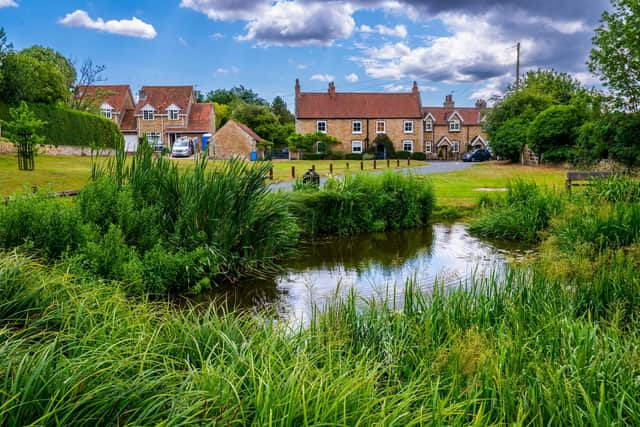

There's a sense of tranquility with the beck running along the side of the lane, and a curiosity surrounded by railings, a bench and interpretation board that demands attention.
The brick-lined basin was the venue for the spectacle of pre-shearing. The annual event saw the beck dammed with a metal bung and the basin filled with water. Before the introduction of chemical sheep dipping, farmers paid to have their sheep pushed one by one through the water, lathered by hand, dunked and rinsed.
No longer used by sheep, it has been known for children from the village to dam the stream and use the sheep wash to swim.
As a backdrop to the pastoral scene stands the 12th century All Saints’ Church. A Church of England website for the area heralds the grade II* listed building as "without doubt one of the most picturesque churches in the East Riding of Yorkshire".

Surrounded by woodland and fields, with just a single, secluded house in the vicinity, the church is at the centre of a large graveyard. While its earliest stonework is Norman, the nave's windows and tower are medieval. Two bells in the tower date from before the Reformation.
It is unusual for a church to be so detached from a village. Historians say the place of worship was once linked by poor houses to the village.
Despite being a short distance off the A63, between South Cave and Elloughton, and close to the urban sprawl of Hull, Brantingham continues to have the air of an isolated agicultual community. Numerous areas of farmed or enclosed land, including west of the village hall and land next to Crook Hill, remain.
It retains features such as a Victorian water pump, at the foot of Spout Hill. Activity from the Bronze Age period in the village has been confirmed by the discovery in 1950 of two crouched inhumation burials identified during housebuilding.
The road from there leads steeply up to a height of about 330 feet, offering a westerly view towards the Vale of York.
Groups of hikers, tackling the 79-mile Yorkshire Wolds Way National Trail, meander past the village's limestone properties with red pantile roofs. Interspersed by largely sympathetic modern housing developments, there village with a population of about 400 boasts a number of heritage assets.
Among the highlights are the 18th century Hall Farmhouse and Brantingham Hall, both on Burrill Lane. The Village Hall dates from 1933 and was gifted to the village by Arnold Reckitt, the then owner of the Brantingham Estate.
Its custodians say the facility exists "for the benefit of the residents of Brantingham and the surrounding villages with the objective of improving lives". With regular activities ranging from yoga and ballroom dancing to dog training, and as a venue for wedding receptions, parties and charity events, it is a well-used community hub.
Further to the south of the village, off Crook Hill, there's the late 17th century Brantinghamthorpe Hall, built on the site of a former Elizabethan manor, which commands an extensive view of the River Humber.
Yorkshire Gardens Trust says the surrounding parkland at Brantinghamthorpe is "a good example of a modest planned landscape of the early 19th century", but it is of particular historical significance due to remains of Victorian formal gardens laid out for visits of the Prince of Wales.
Nearby, alongside the ancient route from the Roman walled town of Petuaria (Brough) to Eboracum (York), two mosaics were discovered during quarry works in 1948. Further excavations in 1962 revealed a villa.
Nevertheless, about half of Brantingham was built in the 18th and 19th centuries to serve the hall's estate, the remainder has developed around a duck pond enclosed by reed beds alongside a village green. Both historic and modern properties overlook the green, as does a telephone box painted cream to highlight Hull's history of having an independent telephone network.
On the opposite side of the green, at the village's South Cave Road entrance, is an edifice which architectural historian Sir Nikolaus Pevsner described as "one of the most lovably awful things in the East Riding".
Built by Sir John Sherburn, the owner of Brantinghamthorpe Hall, the war memorial is constructed from fine red sandstone and polished red granite reclaimed after the demolition Hull Town Hall. One side supports a bronze plaque on which are recorded the names of 14 young men.
Across the road, The Triton Inn, once a coaching inn and staging post, has ranked among East Yorkshire’s most popular dining venues for decades. It also represents one of the Brantingham area's few commercial premises.
The imbalance between commercial and residential properties in the village partly led conservation officers, during the latest review of the village, to conclude Brantingham was transforming into a "21st century commuter village", for the affluent, with a growing collection of holiday cottages in recent years. They added sympathetic development was "inevitable for its survival".