
Bridlington Priory: The Yorkshire church which is more than 900 years old and was visited by royalty
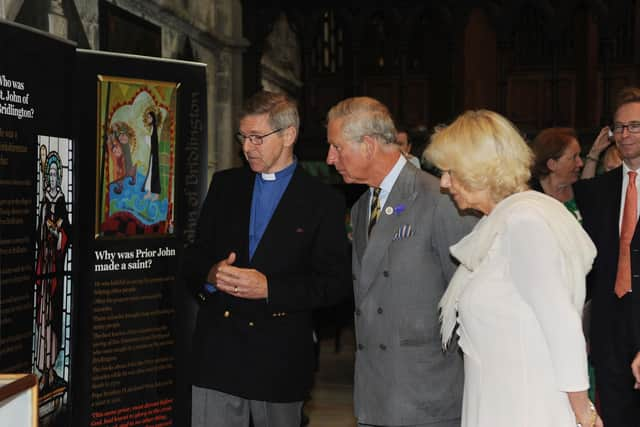
Prince Charles and Camilla joined Bridlington Priory’s 900th anniversary celebrations when they visited Yorkshire’s East Coast on July 23, 2013.
A festival called Priory 900 had been established to celebrate the anniversary of the foundation of the priory as a house of Augustinians.
The festival programme was designed “to encourage and enable the public, in Bridlington and beyond, to explore and appreciate the heritage of the Priory and its impact on and significance for the town as a whole”.
Bridlington Priory was formerly part of a monastic complex, built from the 12th century onwards.
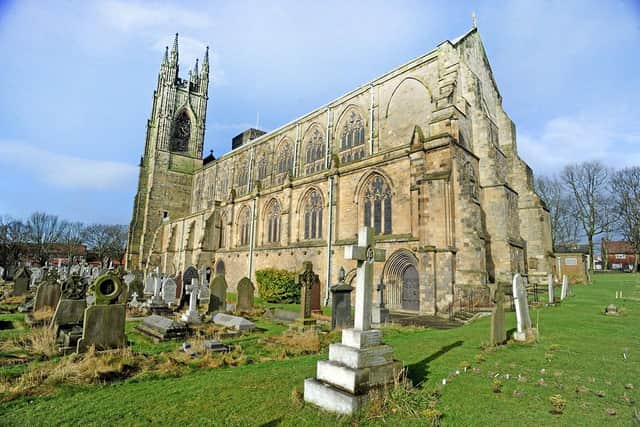

Only the nave (of the original Priory Church) and bayle (or gatehouse) now remain of the complex.
Yet, as part of its Augustinian heritage, Bridlington Priory Church today endeavours to encompass the three great monastic themes of prayer, study and hospitality.
A Saxon church was noted in the Domesday survey in 1086, and the Augustinian Priory was founded in 1113.
It is speculated that the site was chosen for the new foundation by the Priory's founder Walter de Gant, Lord of the Manor.
His father was part of the new aristocracy, established in England following the Norman conquest of 1066.
Nothing was built within the Augustinian site until early in 1200.
A complex took decades to build, though two towers either side of the western entrance were never completed before the Reformation.
The Priory Church took on a cruciform design and was much larger than most cathedrals.
Construction of the set of monastic buildings was organised by the religious order of Augustinians.
Although their origins are ambiguous, their beliefs may have been based on the writings of Augustine (AD 354-AD 430) – the bishop of Hippo Regius (modern day Annaba, Algeria).
He is viewed as one of the most important church fathers in Western Christianity for his writings in the patristic era.
The Augustinians came over to England in the 11th century soon after the Norman Conquest. Bridlington Priory was the first Augustinian Priory established in Yorkshire.

Augustinian practices fell between the two main strands of medieval religious communities. On the one hand, there were monks living in monasteries in an enclosed community who gave hospitality.
Then, there were friars such as the Franciscan friars who went out on the road giving spiritual guidance and help where needed.
The Augustinians were like a hybrid of the two. They existed in a monastery, living a cloistered life, but exercising spiritual and pastoral care within communities.
This was beneficial to Bridlington itself and in a wider area, stretching to Scarborough, down to Hornsea and over the Wolds.
Thus, the Augustinian Bridlington Priory Church Nave was always in parish use. Besides the nave, the church included transept, a large stately tower, and choir.
Amongst the adjoining monastic buildings, mainly on the south side, were the Prior's Hall, Cloister, Chapter House, Court Yard, Canon's Dormitory, Infirmary, Chapel, Treasury Library and Bakehouse.
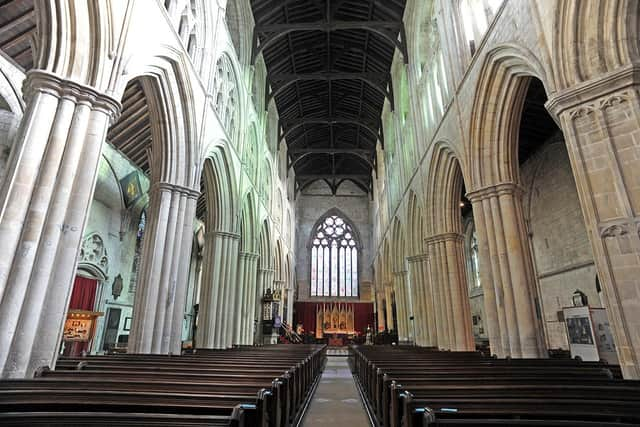
Building work within the Priory Church had started in the north west corner of the nave, and the architectural style there, and along the north side, is probably Early English.
It is markedly different than the opposite side which is more modern or maybe even cruder English Gothic.
Eventually the monastic Priory became very wealthy, acquiring lands throughout Yorkshire and Lincolnshire. The primary source of income was sheep farming.
The most noted of Bridlington Priors was John of Thwing, born about 1320. After studying at Oxford, he returned to Bridlington and was in charge of the Priory from 1362 until his death in 1379.
He was said “to shrink from vainglory as from a deadly poison”.
Twenty-two years after his death he became the last English saint to be created before the Reformation. This was commemorated in Bridlington Priory Church with the construction of the elaborate St John's Shrine within the choir (now demolished).
Thereafter, many people from far and wide made a pilgrimage to worship at St John's shrine, with the Priory reaching the height of its medieval repute.
During the 15th century the south west corner of the nave collapsed and was rebuilt in the perpendicular style, with several windows having a different appearance to those adjoining.
The last Prior before the Reformation in the 16th century was William Woode.
He became associated with the Pilgrimage of Grace – an uprising in Yorkshire in late 1536 against Henry VIII's break with the Roman Catholic church and the Dissolution of the Monasteries.
There was a fear, which turned out to be true, that Bridlington Priory, along with other large monasteries, would be swept away.
Woode was found guilty of supporting the rebels and treason. In his defence he claimed the rebels had said they would cut off his head at his own door if he did not help them.
He was hanged at Tyburn whilst the Bridlington Augustinian canons dispersed.
Most of the Bridlington monastic complex was taken down. Within the Priory Church only the nave was allowed to remain standing because it was used by Bridlington people as their parish church.
The church's tower, transept and choir were demolished and St John's shrine destroyed.
One of Henry VIII's agents, the Duke of Norfolk, tasked with destroying the priory was said to have stood in awe at the church.
Outside, all the monastic buildings were cleared with the exception of the Bayle gatehouse.
From the time of the Reformation, the remaining nave has undergone a number of restorations most notably in the latter half of the 19th century when Sir George Gilbert Scott became involved.
He added a large window to the east end and the western towers were finally completed, albeit in different styles.
The north west tower was built in the early English style while the one on the south west was taken much higher in an ornate perpendicular style.
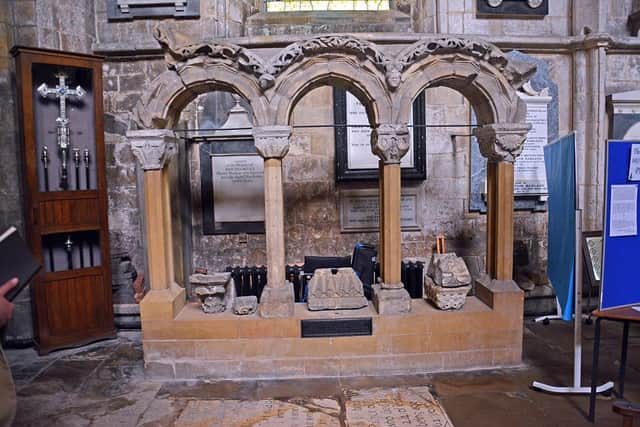
A new small shrine to Saint John may be located outside in the graveyard. It is placed roughly in the same position as it was in the former choir.
During their Bridlington Priory visit, Charles and Camilla were given a tour of the building and attended a concert, while members of the congregation and those who had helped with the 900th anniversary watched from the pews.
Priory 900 co-ordinator Penelope Weston said the event was "fantastic” and was pleased with how the day’s events unfolded.
Local stonemason Adam McTurk carved two corbels depicting the heads of Charles and Camilla which are placed on either side of the entrance to the former Prior's Lodging.
The Royal couple were congratulated on the birth of Prince George in Burton Fleming, Bugthorpe and Bridlington. On the day before their visit, Charles’s first grandchild had been born.
The pair met fishermen, charity workers and those affected by the recent flooding.