
Bringing a jewel at Wentworth Woodhouse back to life as its first holiday let

Such was the grandeur of Wentworth Woodhouse as a great stately home that it rivalled the finest in its pomp and prestige.
But for one opulent parlour, as a lady's retreat, sharing today only a small glimpse of its once feminine elegance.
Now Lady Rockingham's South Tower at Wentworth Woodhouse, taken on by the Landmark Trust, is to be restored as a holiday let.
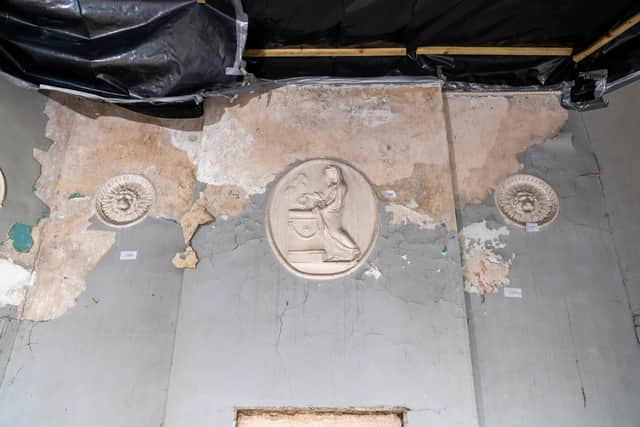
And beneath the layers of peeling paintwork and crumbling plaster are secrets to be revealed by the finest of master craftsmen.
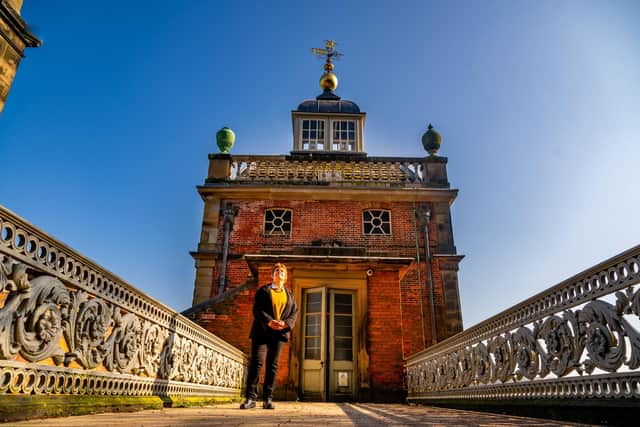

Caroline Stamford is in-house historian for the Landmark Trust, which has launched an appeal to raise a final £330,000 to restore this "exquisite" treasure box.
"It was always intended as a belvedere, a little folly, perched at the end of the house," she said. "Now, it has no ceilings. It was lost to water ingress after years of dereliction.
"The hope is to restore it, we believe we can do a full restoration," she added. "There is an irresistible urge to recreate, when the evidence is there."
Wentworth Woodhouse, one of the largest houses in Europe, was a seat of power for the north and built by 1st Marquess between 1725 and 1750.
Saving for a spell as a training college for women PE teachers, the house fell into dereliction and decay and it was bought in 2017 by the Wentworth Woodhouse Preservation Trust (WWPT) which has set about restoring it, piece by piece.
The tower roof and exteriors are repaired by WWPT, and with 70 per cent of funding for interiors secured in donations and from the HB Allen Charitable Trust.
Now under the Landmark Trust's fundraising appeal, to raise the final £330,000, work could start as soon as next summer, opening up bookings as early as next year.
This tower, with its North twin, was to be the "finishing touch" to this grand stately home. It came into its own as the private parlour of Mary the 2nd Marchioness.
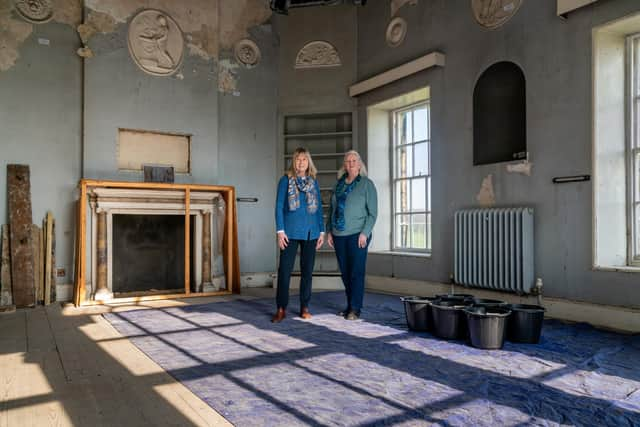
Now her Classical designs, even aged and crumbling, serve as a rare survivor of a woman's taste. And it was of her choosing, as letters to a very famous architect show.
"It's clear from letters of John Carr of York that she was in charge," said Dr Stamford. "This is a provenanced example of aristocratic ladies' tastes and education in the 18th century. She had a say in how she wanted it decorated. That makes it a really important survivor."
Experts, peeling back the paintwork, can reveal a rich teal, with the plaster plaques in a pale cream colour. Then, with old and grainy photographs printed in Country Life from 1924, teams can recreate the ceiling in detail with a master plasterer.
Each piece surviving tells its own story, said Dr Stamford, of feminine virtue and heroism.
"To have a snapshot of a woman's taste, unequivocally, is very rare," she added.
"The past enriches and informs our present lives. Everybody can book a Landmark Trust place. This allows everybody to enjoy the elegance that the very wealthy experienced."
To support the restoration appeal visit www.landmarktrust.org.uk/south-tower.