
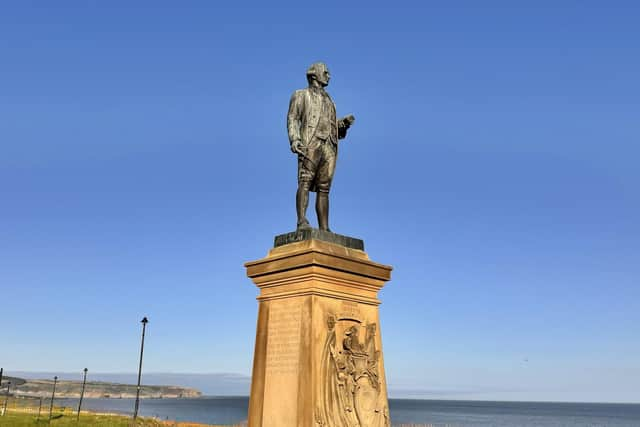
Captain Cook Statue: The Yorkshire statue honouring one of the world’s greatest explorers
In 1727 James Cook was born at Marton near Middlesbrough, then part of the North Riding, and spent his boyhood in the village of Great Ayton on the fringe of the North York Moors.
The son of a farm worker, his father’s employer paid for him to be educated by a charitable foundation and after a period of helping on the farm, at the age of 16 he was apprenticed to William Sanderson, a grocer and draper 20 miles away in the fishing village of Staithes.
Sanderson soon decided Cook was not cut out for the shop and sent the teenager down the coast to Whitby to work for friends who owned a small fleet of cargo ships.
As a merchant navy apprentice, Cook received his first proper sailing experience on vessels known as Whitby Cats, mainly used for transporting coal.

In 1755 he joined the Royal Navy and was tasked with charting the coast of Newfoundland.
He would eventually command four Whitby Cats – renamed HMS Endeavour, HMS Resolution, HMS Adventure and HMS Discovery – on his great voyages of exploration to the Pacific, New Zealand, Australia and North America.
During his final voyage he was killed during a violent confrontation with Hawaiian warriors on 14th February 1779 and buried at sea.
Later recognised as one of the world’s greatest explorers and navigators, in 1912 a bronze statue of Captain James Cook was erected on Whitby’s West Cliff, from where it overlooks the River Esk.
An identical statue of Cook was installed in Melbourne, Australia, two years later.