
Charlotte Brontë birthday: 'Her surviving clothes at Haworth Parsonage show us the woman behind Jane Eyre'
New studies of Charlotte Brontë’s clothes reveal a woman less provincial and more fashion-conscious than suspected. As the 210th anniversary of her birth approaches, Yorkshire Post Fashion Editor Stephanie Smith reports.

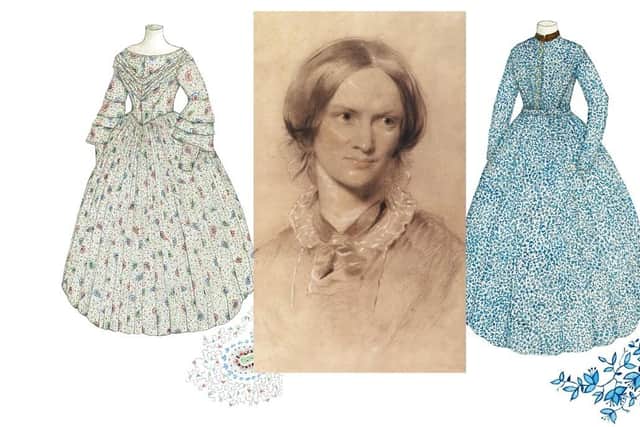
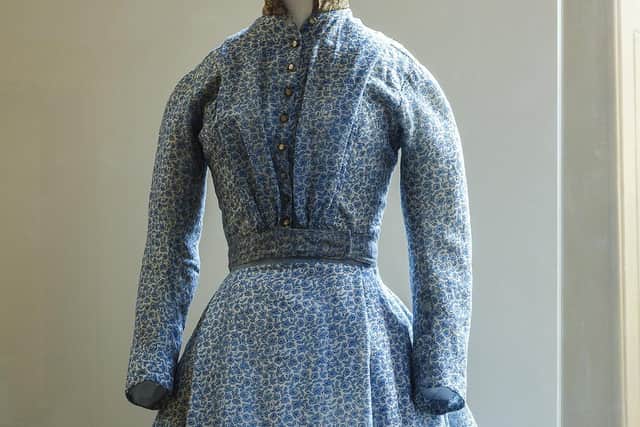
One morning in early June, 1850, Charlotte Brontë finally met her literary hero, William Makepeace Thackeray. To do so, the 4ft 8in writer - recently unmasked as Currer Bell, the author of Jane Eyre, published in 1847 - chose to wear her “power gown”, a vibrant blue-and-white floral print dress made in a fine alpaca fabric woven in her native Yorkshire.
The meeting took place in the drawing room of her publisher George Smith. Thackeray was impressed, later recalling: “New to the London world, she entered it with an independent, indomitable spirit of her own.”
From experience, Charlotte knew that appearance and favourable first impressions mattered. She had been stung by criticism when she joined the stylish young ladies of Roe Head School in Mirfield in 1931, told that she was “very ugly” by one pupil, Mary Taylor, who later described her as wearing “very old-fashioned clothes, and looking very cold and miserable”.

A surviving drawing by Charlotte, of a young woman wearing a highly fashionable, early 1930s-style puff-sleeved gown, shows how much she had noticed and been influenced by the Roe Head girls.
This is highlighted by historian and costume consultant Eleanor Houghton, whose new book, Charlotte Brontë’s Life Through Clothes, examines how surviving pieces from the author’s wardrobe give remarkable insight into her experience, her feelings and her work.
The book is illustrated by Eleanor’s own beautiful drawings which capture the detail of the dresses, shawls, bonnets, boots, combs, corsets and more.
Charlotte made her own clothes, with housekeeper Martha Brown, using fabrics from Yorkshire mills. The gown that later became known as the “Thackeray Dress” was made in a cloth called Alpaca Orleans, a blend of alpaca and cotton, woven by Sir Titus Salt who had mills in Bradford just nine miles from Haworth (Salts Mill in Saltaire opened later in 1953).

Sir Titus was a fabric pioneer, and managed to transform fine alpaca fleece into a lustrous but hardwearing fabric that quickly became a rival to silk. Printed (probably in Accrington) in a vibrant blue and white pattern of leaves and flowers, Charlotte bought the fabric around 1848 - and the blues retain their bright quality to this day.
Charlotte left most of her wardrobe to her husband, Arthur Bell Nichols, and some also to Martha. Pieces were acquired by fans down the years, but many found their way home to the Brontë Parsonage Museum at Haworth, which now looks after around 150 items.
The Thackeray dress was given to Martha’s niece, who made significant alterations, adding a brown collar and removing fabric from its full skirt.
Charlotte’s clothing reveals a woman more body and fashion-conscious than suspected. In Brussels, she bought a corset measuring just 18.5 inches around the waist. It became a staple, and later caused concern to her publisher George Smith. Eleanor Houghton writes: “Nearly forty years after her death, still impacted by what he had seen, Smith told his friend, the novelist George Gissing, that Charlotte was ‘very vain of her narrow waist … and laced herself so tight as to injure herself’.”

Pointing out that tight lacing at the time was the practice of a minority of women, Eleanor suggests that Charlotte, always conscious of her perceived lack of beauty, was “deliberately and blatantly exhibiting her femininity”. The corset might also have served as an armour as she sought strength and protection while nursing a heart broken by her unrequited love for M Heger in Brussels.
On display now at the Brontë Parsonage is a paisley print dress Charlotte wore in the 1840s, exotic and vibrant in shades of duck egg blue, mint, red and black. One Haworth resident, who recalled seeing them many times in the village, said: “I don’t know that I ever saw them in owt but print - I’ve heard it said they were pinched - but it was a nice print … They looked grand.”
Born on April 21, 1816, this Tuesday marks the 210th anniversary of Charlotte Brontë birth. The Brontë Parsonage Museum and the nearby Brontë Birthplace in Thornton are hosting special events, including performances and talks.
Eleanor has been a consultant for many TV and film historical dramas including the BBC’s To Walk Invisible, written and directed by Sally Wainwright, and Frances O’Connor’s 2023 biopic, Emily.
In 2022, in collaboration with the Brontë Parsonage Museum, she curated a large exhibition of Charlotte’s surviving wardrobe. “The museum has become a second home. The staff have been endlessly patient and helpful and always willing to clamber to the back of the Bonnell Store or to upend the library in search of a particular garment or record,” she says.
“I considered why Charlotte had chosen each piece, what it revealed of her taste, the challenges she faced, and the sartorial conventions and codes of 19th‑century society.”
She traced how and where the clothes were worn, how they were changed, and how they shaped Charlotte’s daily experience, studying them alongside letters and diaries, to uncover a rich, complex picture of Charlotte and her ever-changing world.
“The village’s surviving mills and weavers’ cottages are reminders, too, that Charlotte lived in a landscape shaped by the Industrial Revolution and by the textile economy that produced so many of the fabrics in her wardrobe.
“These gowns, bonnets, bags, and boots have presented to us a very different Charlotte Brontë,” she says. “She is a woman who is more rounded, more three-dimensional and braver, bolder, and yet somehow more vulnerable. She is less isolated and more globalised. She is more fashion-conscious and defies long-held preconceptions.
“She shows herself to be very self-critical, but also provocative and tenacious. By hearing the clothes’ testimonies, we encounter Charlotte not simply as a writer but as a real, thinking, feeling, breathing woman.
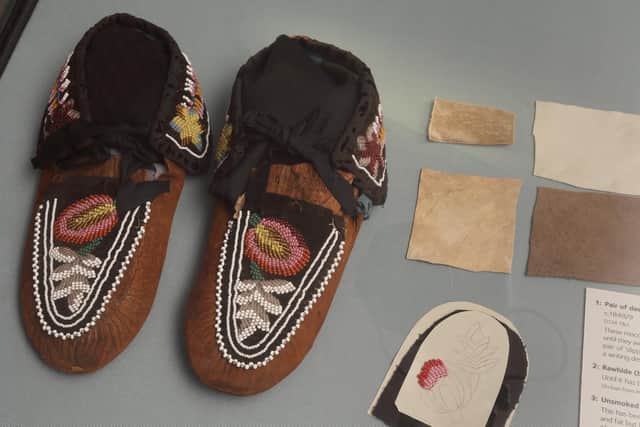
“Yet these clothes reveal more than Charlotte alone. They bring the world she inhabited vividly into view — nineteenth-century Yorkshire, with its rugged moors and sprawling villages; the networks of makers, merchants, and markets; the drive and creativity of industrial innovation; and the global routes that brought fabrics, fibres and influences from France, Peru, Mexico, Canada, and the United States to a little parsonage in the West Riding.
"They allow us to see how Charlotte navigated her social and material world, balancing expectation, personal comfort, and self-expression — and in doing so, they let us step closer to the woman behind Jane Eyre, behind Lucy Snowe, and to see beyond them to the life she really lived.
Charlotte Brontë’s Life Through Clothes by Eleanor Houghton (£25, Bloomsbury).