
Colin Ford obituary: The elder statesman of British photography who helped put Bradford on the museum map
Colin Ford CBE, who has died at 91, was described by the former James Bond producer Michael G Wilson as the elder statesman of British photography.

In just 18 months Mr Ford turned an unfinished theatre in the centre of Bradford into the National Museum of Photography, Britain’s first museum about the art and science of the photographic image.
When it opened in June 1983, he boasted: “People ask how to get here and I just say, you’ll find us.”
In the 1970s he had led a group advocating for a national museum of photography. When the Science Museum sought to deliver it, they appointed Colin to make it happen.
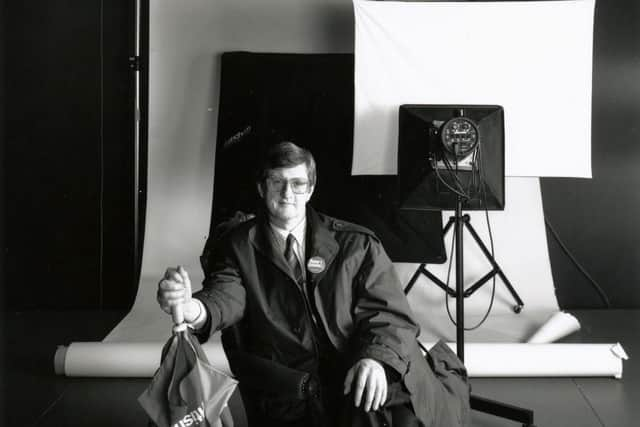

He brought energy and enthusiasm, appointing a group of similarly-minded colleagues who could deliver his vision despite the loud opposition to locating a national museum in Bradford.
One of its earliest detractors was the art historian and curator Sir Roy Strong (Mr Ford’s former boss), who wrote in the Sunday Times in 1981 “I cannot see people travelling up to Bradford to a disused skating rink to see a collection of 250 cameras.”
The museum installed Britain’s first huge Imax screen and acquired the Kodak Museum collection in 1985, using it as the basis for a new gallery about popular photography.
Other major acquisitions came from the likes of Don McCullin, Jane Bown and Fay Godwin to document Bradford and its surroundings and to lead master classes.
Colin collaborated with many contemporary photographers, including Bradford-born David Hockney, who became a personal friend.
By its fifth birthday in 1988, the museum had added film and television to its remit; it won the National Heritage Museum of the Year Award and had welcomed 3.5m visitors, making it the most visited English museum outside London.
Later, Colin converted part of the neighbouring council library into a second cinema, Pictureville, added a Cinerama screen and helped to save the nearby Bradford Playhouse and Film Theatre, with which his team ran a joint programme.
Under his 10-year directorship, the museum gave its post-industrial northern home a celebrity and lustre that levelling-up initiatives struggle to match. It helped change perceptions of what a museum could be.
Actively involved in photography until his death, Colin called himself a Jack of all trades and master of none, but the second part was patently untrue.
He was a great populariser in each of his jobs, helped by a skill for public speaking (mostly without notes), unquenchable optimism, the ability to learn rapidly on the job, stubborn determination, and a boundless flair for showmanship.
He was educated at Enfield Grammar and began in theatre after a MA in English language and literature at University College, Oxford, where his major interest was directing the University Players and Dramatic Society.
He found early work as a studio manager for Halas and Batchelor, the Anglo-Hungarian animation partnership that made Animal Farm; and at 24, he rescued Kidderminster Playhouse from financial disaster as manager/producer, claiming to be Britain’s youngest such job-holder.
After 150 productions he moved to the Western Theatre Ballet and two years later he was visiting lecturer in English and drama at California State University, relishing life with his first wife Margaret at its Long Beach campus.
He became deputy curator of the British Film Institute in 1965, bringing him into contact with Roy Strong, then director of the National Portrait Gallery.
A few years later, Strong raised funds for a specialist photographic curator and Colin became the gallery’s first Keeper of Photography.
In 1970 he initiated and co-directed the world’s largest cinema exhibition, with personal appearances by such directors as Ken Loach, John Schlesinger and Richard Attenborough.
His scholarship on the 19th century portrait photographer Julia Margaret Cameron – a subject which occupied much of his later career – began in 1975, when he raised £52,000 to secure some of her work for the National Portrait Gallery. It later followed him to Bradford, where it is still housed.
As vice-chairman of the Julia Margaret Cameron Trust, he led the public campaign to save her Isle of Wight home from destruction and in 2003 authored a catalogue of her photographs, supported by the J Paul Getty Museum in Los Angeles.
He left the Bradford museum in 1993 to become director of the National Museum of Wales.
Left unsaid was a frustration, which remained until his death, that he had not realised his early ambition for an independent national museum of photography.
He was devastated by its name change in 2006 to the National Media Museum and then in 2016 by the transfer of 400,000 items from Bradford to London.
Some 40,000 people, including David Hockney, signed a local petition in protest. Colin felt that his life’s work had been dismantled.
In the 1980s and 90s Colin was a regular broadcaster and later host of the BBC arts programme Kaleidoscope.
He was an opera and music lover and was passionate about musical theatre and symphonic music. A member of the Garrick Club, he curated exhibitions of photography there until early last year.
Colin was involved with the European Society for the History of Photography from its inception in 1977; he served on the Advisory Board of History of Photography journal from 1989 to 2009, and amongst many other board memberships, chaired the Peel Entertainment Group, a global entertainment specialist and talent agency for 16 years.
He published around 20 books and major catalogues and contributed to numerous publications. He received the Honorary Fellowship of the Royal Photographic Society in 1999 and an honorary degree from Bradford University. He was made CBE in 1993.
He is survived by his wife, Sue Grayson Ford MBE; a son and two grandchildren; and his brother.