
Colonel William Dundas Cannons, Bradford: The story behind the two cannons which are 'gate guardians' at Roberts Park
Low Moor Ironworks in Bradford is recorded as having manufactured 1,932 sixty-eight pounder cannons from 1846 following a design originally created by Colonel William Dundas, the government’s Inspector of Artillery between 1839 and 1852.
Two of them now stand on either side of the bandstand in Roberts Park, Saltaire, a green space originally created for the benefit of workers at Sir Titus Salt’s famous Salts Mill.
The weapons were never fired in anger at an enemy, however, but retained as “gate guardians” at the foundry’s entrance.
At that time Low Moor was Yorkshire’s largest ironworks and exhibited its products at the 1851 Great Exhibition in Crystal Palace.
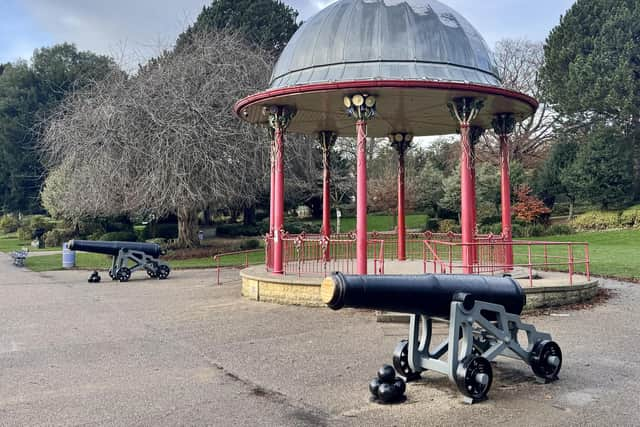

After the foundry closed in the 1950s the cannons were put on display in Rotherham for a time before returning to Bradford Industrial Museum in the 1970s.
Each one weights four and a half tons and is capable of firing 68lb cannonballs over a distance of two miles in just 15 seconds. Eight of these cannonballs are on display with the cannons.
Their primary use was as armaments on naval ships of the era, but they were also used by coastal garrisons.
Now fully restored and provided with period replica cast-iron gun carriages, the cannons were located in the park as part of a restoration project begun in 2009.
They replaced two thirty-two pounder cannons purchased by Sir Titus as adornments to the park when it first opened on the 25th July 1871.
Smaller cannons of that type also armed British warships in the 19th century. Muzzle loaded, each 2 1/2 ton gun was capable of launching cannonballs weighing upwards of 32lb.
According to an information board in Roberts Park, it is believed that one cannon saw service in the famous Battle of Trafalgar, which established Britain’s naval dominance over France in 1804.