
Crowle: The peculiar history of Yorkshire town where a man sold his wife for £40
A collection of fascinating if not bizarre pieces of information pepper the history of Crowle on the Yorkshire/North Lincolnshire border in the northern part of the Isle of Axholme.
The town benefitted from canal and railway developments in the 19th and early 20th centuries.
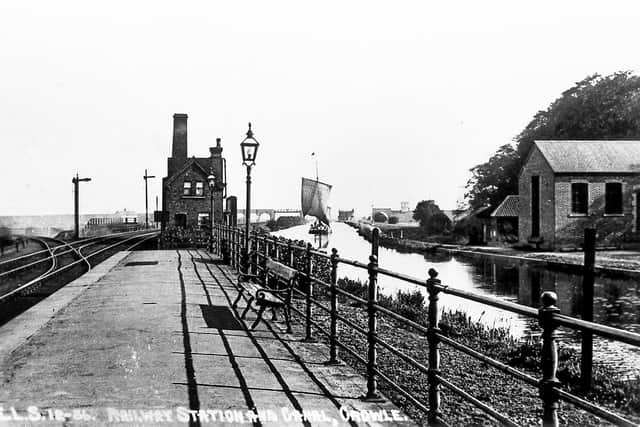
From 1802, the area was on the route of the newly opened Stainforth & Keadby Canal which connected the River Trent, Lincolnshire, with the River Don Navigation near Stainforth, South Yorkshire.
The intention of the canal was to improve transportation between the two points. This was in addition to providing a more practical way of moving goods especially heavy loads other than by road.

During the early 1830s, Crowle’s inhabitants numbered 1889, 40 years later the figure had increased to 3122.
Crowle was connected to the country’s railway system from September 13, 1859.
The Sheffield Independent reported four days later under the headline Opening of the Thorne & Keadby Branch of the South Yorkshire Railway: ‘The first train was fixed to depart on Tuesday last the 13th instant, from Keadby, at 7.40am; to reach Crowle at 7.50 and Thorne at 8.10; thus making the journey in half-an-hour, being at the rate of 20 miles an hour…’
On axhome-fhs.org it is stated that with the coming of the railway, Crowle became the centre of traffic for the Isle of Axholme.
The foundation stone for Crowle Market Hall was laid in 1869 by Thomas Harsley Carnochan.
The building’s design was provided by William Hull of Northampton and the funding was provided by local businessmen.
The construction work was undertaken by William Cowling and completed in 1870.
Over the years it has been used for a variety of purposes: as a Young Men’s Institute, a cinema, a dance hall and restaurant.
More recently North Lincolnshire Council turned the old hall into a community hub for local residents.
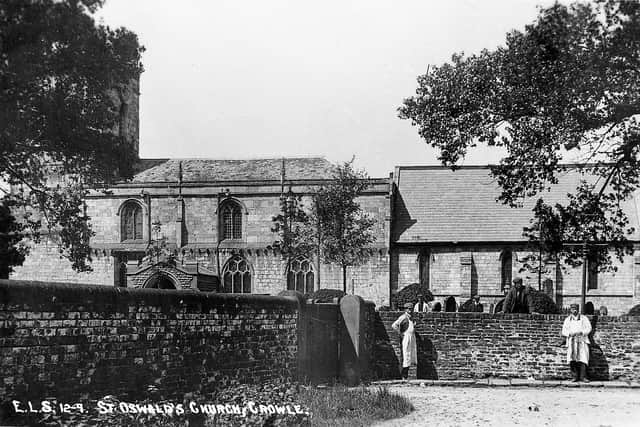
Crowle church is dedicated to Saint Oswald, the Christian King of Northumbria. A church was known to be extant at Crowle at the time the Domesday survey of 1086.
It was thought to have been a wooden structure with a rush roof.
The crowle.org website states the original stone church was built around 1100AD and notes the subsequent addition of a bell tower, clerestory and north aisle, entrance. Also, the windows were remodelled in the 15th century.

A newspaper article from August 6, 1884 says that on the previous day the Parish Church, Crowle was reopened after restoration.
A committee had been formed, bazaars were held and subscriptions solicited; rich and poor, churchmen and Nonconformists heartily responded to the call.
A.S. Ellis of Westminster, London, was engaged as architect. Wm Johnson of Doncaster was selected as Clerk of the Works.
The contracts were let to W. Clarke of Crowle, F. Grant of Epworth and a Mr Harrison of Crowle.
Earlier, in 1856, the chancel had been restored and the latest work was extended to the nave and aisle.
The article continued: ‘The chancel has been raised two steps above the level of the nave, the Sacrarium has been tiled in mosaic work, with Minton’s, and the whole church reseated with pitch pine.’
The sermon and consecration service the previous day were taken by the Bishop of Nottingham, in the absence of the Bishop of Lincoln owing to his severe illness. St Oswald’s was restored at an estimated cost of £1,500, of which a sum of about £1,000 had been raised previous to the reopening.
On looking through newspapers for Crowle information, two matrimonial stories caught my attention.
The Leeds Times of June 9, 1866 said that after their wedding the bride and bridegroom adjourned to the vestry, and when the usual formalities had been concluded, the Clerk asked for the fees.
The pair replied that they only had ninepence which they were willing to offer along with a contribution of three pence from the best man.
The clerk turned the key in the vestry door and coolly told them they would not be allowed to leave until the debt was paid.
The bride’s sister put half a crown through the window and then toured the area collecting a sufficient sum to ransom the imprisoned pair.
The newspaper added: ‘This paid, they were set free to celebrate their wedding festivities in their own way’.
A second story about Crowle from January 1877 was splashed across numerous newspapers throughout the country.
William Liggott, a pork butcher, sold his wife for £40 to Chapman Pridd, landlord of the Fishmongers’ Arms.
The articles of sale were drawn up at a solicitor’s office, the money paid and the wife handed over.
One article concluded: ‘Both parties appeared highly pleased with their bargain. Pridd had only been a widower for a few months.’
In April 1878, it was reported that at Medge Hall near Crowle, the Crowle Charing Company had fitted up an experimental furnace and ovens for producing peat charcoal.
It was intended to be used ‘as a disinfectant and agent for fixing ammonia in stables, cowhouses, and other parts of homesteads and domestic offices.’
The New Trent Brewery situated near the railway was founded at a cost of £7,810 in 1878 by Thomas Dymond and George Robinson. It had a railway siding and boasted 16 pubs including the Darby & Joan, and Fishmongers’ Arms in Crowle, but went into administration during 1951.
In 1892 James Fox & Sons of Barnsley bought from the Executors of Thomas Tune the Isle of Axholme & Marshland Brewery, Brewery Road, Crowle, along with other properties, for £21,750. The business may have been founded in 1856 by Peter Tune.
James Fox & Sons was registered as a private company in 1917. The Barnsley Brewery took control of Fox’s brewery and 40 licensed premises in 1949. The brewery was demolished in 1988.
Another railway station was established in Crowle following the opening of the Isle of Axholme Joint Railway (IoAJR) by 1905. It stretched from Haxey to Reedness junction with links to Goole and Fockerby.
A spur was extended to Hatfield Moor in 1909.
There were some engineering difficulties to be overcome, and the gradients were as severe as one in 50.
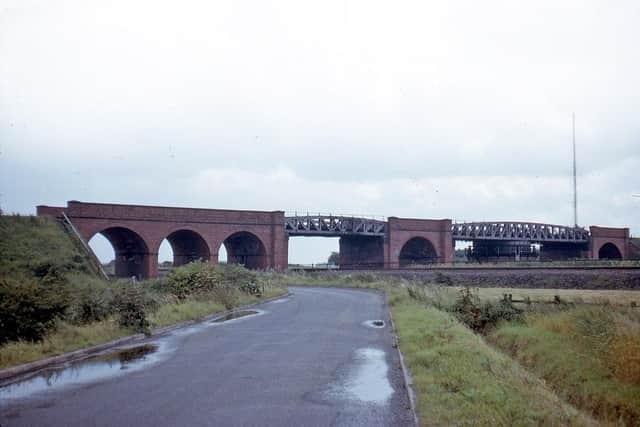
The great engineering feat was the erection of the viaduct and swing bridge near Crowle Wharf where in order to give a clear height to the railway bridge of 20 feet the viaduct was approached by embankments on either side.
The distance between the two abutments was 330 feet.
Three brick spans of 25 and 22 feet, crossed the North Soak Drain and the roadway, and the Great Central Railway running parallel to the canal was crossed by an open web truss girder bridge resting on brick piers.
The canal had to be crossed by a centre pivot swing bridge of 104 feet width, and the bridge was erected by the Cleveland Bridge & Engineering Co., of Darlington.
The cost of the bridge and abutments was £20,000. It was powered by a 20hp Crossley diesel oil engine, though could be turned by hand in the event of engine malfunction.
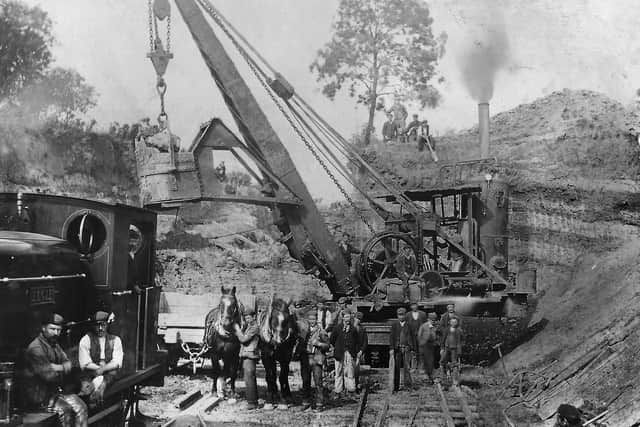
During the construction of the Crowle swing bridge in October 1904 a large steam crane, fixed close to the parapet of the bridge overbalanced and fell crashing into the Soak dyke below. Luckily, no one was injured.
Passenger operations on the IoAJR were disappointing and had ceased by July 15, 1933, unable to compete with motorised buses.
Thereafter, occasional rail tours were operated along the line. The last one was organised by the North Axholme Secondary School on April 1, 1965.
Over the years the Crowle area was home to a number of peat companies: British Moss Litter Company, dating from 1896; Fisons from 1963; Ken Crow Products.; Richgro Peat; Fernmoor UK Ltd and Scotts.
Crowle and Thorne Moors eventually became part of the Humberhead National Nature Reserve and peat extraction ceased around 2007.
Preserving and celebrating the rich industrial heritage of the peat industry is the Crowle Peatland Railway Society which also operates a heritage railway.