
Dowager Lady Saye and Sele obituary: Custodian of Tudor castle where Shakespeare In Love and The Crown were shot
The Dowager Lady Saye and Sele, who has died at 90, was keeper of the Tudor castle on the edge of the Cotswolds that Alan Bennett described as “the most beautiful of houses” and which he chose as the location for the film adaptation of his play, The Madness of King George.

Broughton Castle, the moated manor house on an artificial island two miles outside Banbury that was her family home, was also her life’s work.
For 650 years the home of the Fiennes family, the castle is often cited as the supreme surviving example of medieval England.
However, when Marriette Saye and her late husband Nathaniel, 21st Baron Saye and Sele, moved in with their children in 1968 its usefulness seemed to be at an end.
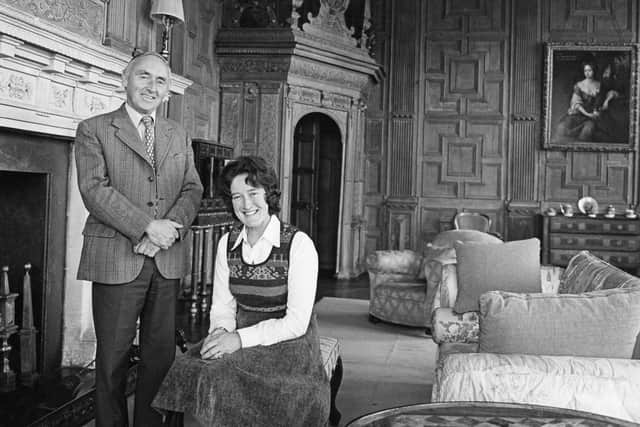

Too big and draughty to heat, it appeared little more than a picturesque relic. It was Marriette’s mission to turn it around.
Born in London in February 1936, her father was Major-General Sir Guy Salisbury-Jones, a soldier who fought in the First World War and later served in Palestine, Egypt, Greece, South Africa and France before joining the Royal Household as Marshal of the Diplomatic Corps.
The young Marriette followed in tow.
She came back to England in 1946 to attend Heathfield School in Ascot, where she discovered JS Bach and Shakespeare, both lifelong passions.
When her parents bought a house in Hambledon, Hampshire she was immersed in the English countryside, riding horses and roaming with her rough-haired dachshund while her father planted vines on the chalky, south-facing slopes below the house.
His work established Hambledon as the first commercial vineyard in the UK and the birthplace of English wine.
Marriette left there at 16 and ‘came out’ as a debutante in 1953, using as her base her parents’ grace-and-favour flat in St James’s Palace.
After a brief period as a secretary she went to Switzerland, where she met Nat Fiennes in a cable-car above the Alpine village of Zermatt. They met again at a ball in Windsor and married in December 1958 at St Margaret’s Westminster.
His forebears could be traced back to the Norman Conquest. An ancestor, Geoffrey de Say, was one of 25 barons who signed the Magna Carta.
Mariette had five children, one of whom, Richard, developed epilepsy as a boy and spent most of his adult life in residential care. He died aged 41 and another son, Thomas, died in an accident shortly before his third birthday.
Mariette’s youngest son, the writer and psychotherapist William Fiennes, was born in 1970, not long after she and Nat had moved into Broughton Castle.
In the early 1980s they embarked upon renovating the main structure of their castle, with a 12-year programme supported by English Heritage.
As the crumbling stonework, rotting window lead and timbers riddled with deathwatch beetles were gradually replaced, the castle started to become familiar to film and TV viewers.
Parts of Shakespeare In Love, Wolf Hall and The Crown were filmed there, as well as Alan Bennett’s work, and in 2021 the discovery on the estate of one of the largest Roman villas in Britain prompted a visit by Channel 4’s Time Team.
Mariette and Nat were also largely responsible for restoring Broughton’s magnificent garden. In the book England’s 1000 Best Houses, it was one of just 20 awarded the maximum of five stars.
Mariette served as Deputy Lieutenant for Oxfordshire and was president or patron of many groups and charities, as well as caring for her husband in his final years.
He died in 2024, aged 103, and she is survived by her sons Martin and William and her daughter, the artist Susannah Fiennes.