
Dr Ivan Hall obituary: The architectural historian who helped save some of Yorkshire's most beautiful buildings
Dr Ivan Hall, who has died at 93, was a well-known architectural historian who had a huge impact on conserving the historic centres of Beverley and Hull.

He was also an expert on the 18th century Yorkshire architect John Carr, who designed Harewood House near Leeds.
Hall was born in Manchester in 1933 and his passion for architecture was already evident when, having won a scholarship to Manchester Grammar School, he skipped his first sports day to visit Carr’s Tatton Park in Cheshire, whose owner, Lord Egerton, made him a member of the Georgian Society at the age of just 12.
Ivan studied at Manchester University’s School and gained an MA on Greek Revival Britain and a PhD on the Classical Architecture of Manchester.
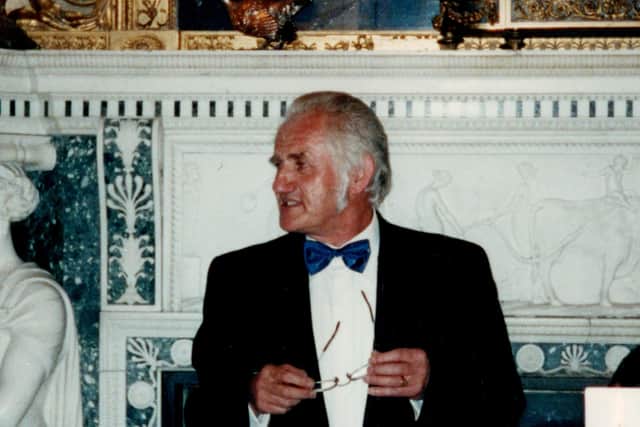

His first job was as a lecturer at Hull University and he settled with his new wife Elisabeth (née Liebeschuetz) in nearby Beverley.
The 18 years he spent there during the 1960s, 70s and early 80s saw him challenge the prevailing wisdom that old buildings should be swept away in favour of modern utilitarian convenience.
Conservation was a dirty word.
In Beverley and Hull, Ivan led the fight for the preservation of many historic buildings, sometimes even whole streets.
He believed that they could be sensibly re-purposed and that to maintain the historic integrity of a town, not only the outstanding examples of architecture needed to be preserved, but also those historic buildings that provided their setting.
One of his tactics was to use his meticulous research on buildings to get them listed, making them more difficult to demolish.
In Beverley, he was involved in preserving houses in the majority of the historic streets: Ladygate, Saturday Market, Highgate, Railway Street, Flemingate, Keldgate, Newbegin, Hengate, Walkergate, Lairgate, Toll Gavel and Beverley Friary.
Challenged by the council to put his money where his mouth was, he bought a dilapidated medieval building in Ladygate, earmarked to make way for an expanded bus station, and restored it.
The building is still performing its original purpose as a retail shop today.
He was less successful in Hull, where many buildings – catalogued in his book on the city’s Georgian past – were demolished.
The fact that the Historic Quarter survives even in part is due in large part to his dedication.
His last legal case in the early 1980s, famous but ultimately unsuccessful, saw Ivan and two other university lecturers try to save the open space on the South side of Beverley Minster from development.
The case went all the way to the House of Lords and the defeat left them with a huge legal bill. Generous supporters contributed but it was a major blow and a factor in his leaving Beverley.
He went next to Historic England as an historic buildings officer in the City of London, where he proved himself to be no Luddite, prepared to back good modern design.
He retired after 10 years and moved back to Yorkshire to embark upon the restoration of an uninhabitable Grade 1-listed Queen Anne house near Bedale.
Alongside his conservation activity, he wrote numerous books and articles and was a principal contributor to the Victorian History of Yorkshire.
He lectured at the Architectural Association, the Royal Institute of British Architects, and the Royal Institute of Chartered Surveyors, together with the schools of architecture in Hull and Cambridge and universities in North and South America.
He also established himself as the leading expert on John Carr, visiting almost every one of his structures and carrying out extensive archival research.
A collection of his writings on Carr was published in 2023, with a launch party at York Racecourse, whose grandstand Carr designed.
Elisabeth died in 1995 and Ivan is survived by his two daughters and a son.