
Goole: How sleepy village was transformed into port town almost 200 years ago
Goole came alive in 1826 with the establishment of a port and the creation of a new town.
Five years earlier, the area was a scattering of buildings and with a population of 450.
A new canal stretching about 19 miles in length from Ferrybridge to Goole was made by the Aire & Calder Navigation and this along with other works at the port were formally opened on Thursday July 20.
Two locks communicated with the Ouse, one intended for barges and the other for ships creating a direct and speedy communication with the centre of Yorkshire and the manufacturing and commercial districts.


The workmen employed in the project, amounting to upwards of 500, were entertained in the evening with refreshments. The houses for Resident Agent, Dock Master, and other officers were completed.
One account added that the new town is built on the north of the harbour.
The Banks’ Arms Hotel was already built. On the north of it was to be a spacious market place 220 yards square.
Several streets were staked out in parallel lines, branching from the Ouse. The houses in three or four of the streets were already built and many of them occupied.
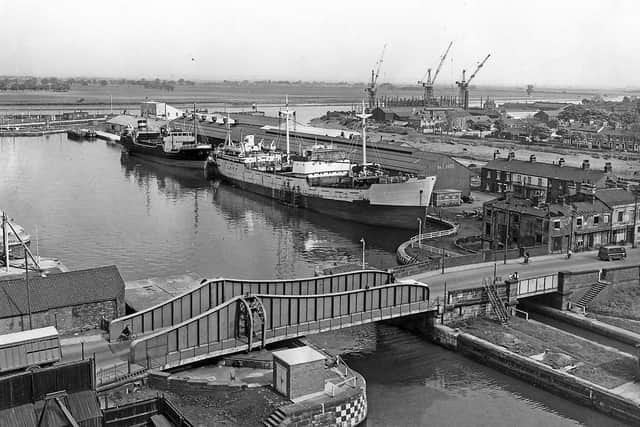
The contractors for the undertaking were Joliffe & Banks under the superintendence of G. Leather. The architects of the buildings were Woodhead & Hurst of Doncaster.
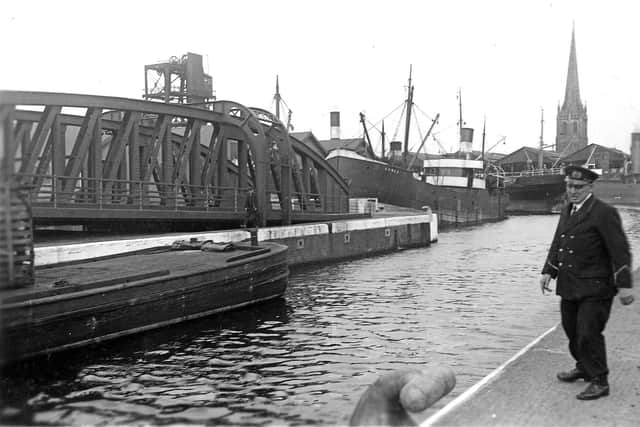
With Goole established as a port, steam ships began to connect with the area.
The Goole and London Steam Company said in August 1834 that the City of Glasgow steam ship was sailing regularly between Stanton’s Wharf London, and Goole, leaving the former place every Thursday morning, at 7 o’clock, and Goole every Monday to suit the tide.
This steamer left London on her first trip down, on Thursday morning 31st July, arrived at Goole between three and four o’clock on Friday afternoon, and passengers were at Leeds and Wakefield the same night.
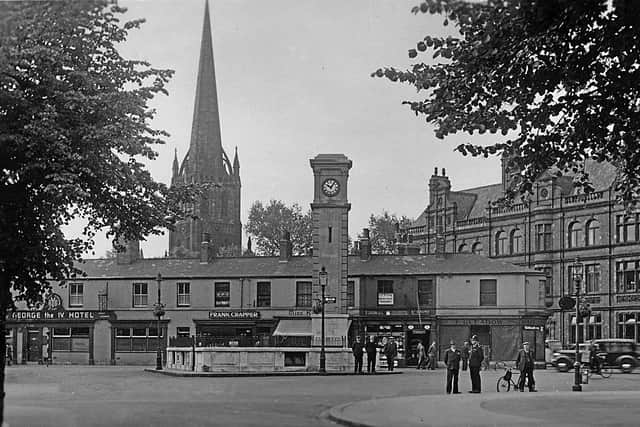
Other steam packet conveyances ran between Goole, Newcastle, Edinburgh, Lancashire and the West Riding.
Builders were invited to tender for the new Goole church in 1843. Plans had been drawn by Hurst & Moffatt of Leeds.
Named the church of St John the Evangelist, it was consecrated on Tuesday May 2, 1848 by the Archbishop of York.
The style of the church is perpendicular, the plan being a cross with tower and spire rising from the intersection.
The opening of the Wakefield, Pontefract, & Goole Railway – important as a link to connect the manufacturing districts of Yorkshire and Lancashire with the port of Goole, as well as to accommodate the district through which it passed – took place on Wednesday March 29, 1848.
The estimated cost of making the railway extending some 281/2 miles was £365,000.
The first Goole station opened on April 1, 1848 and survived according to Quick (2001) until October 1, 1879. By this time another station had welcomed passengers on August 2, 1869 and still survives.
Wednesday January 8, 1873, saw the completion of the new hospital and infirmary at the Goole Union Workhouse and was celebrated by a dinner.
The buildings, erected at a cost exceeding £5,000, were built to the designs of Bradford architects Lockwood & Mawson.
A new Roman Catholic Church, dedicated to St Thomas of Canterbury, welcomed people on Sunday September 23, 1877.
Cardinal Manning preached the opening sermon, accompanied by the Bishop of Beverley.
By 1850, Goole’s population was 4,722 and at the turn of the century it was 16,576 and 20,332 in 1911.
In June 1887, a report said that the port of Goole for its size was one of the most thriving shipping towns along the East coast and its importance was annually increasing.
It owed to the Aire and Calder Steam Navigation much of its prosperity, that company having for many years expended large sums of money in the formation of docks and warehouses, in the erection of appliances for facilitating both the loading and discharge of cargoes, and also to a very large extent upon lighters and steam ships.
The trade of the port was of a general character, and was carried on both steam and sailing vessels, vessels of 1,000 tons being easily admitted within the docks.
A good trade was done with London and various continental ports while a few cargoes were brought in direct from the East Indies and the United States.
The apparatus for shipping coal was impressive and formed a distinctive feature of the docks.
The new Mission Hall, which was to be the centre of mission work amongst the bargemen and dock labourers at Goole, was opened at Doyle Street on January 29, 1891 by the Lord Bishop of Beverley. There was a crowded congregation.
An event which marked an interesting stage in the progress of civic enterprise and popular culture in Goole took place on Monday March 13, 1905 when Alderman C.G. Milnes Gaskell (Chairman of the West Riding County Council) welcomed readers at the new public Free Library.
The building owed its existence to two acts of generosity, Andrew Carnegie having given £3,000 for its construction, and Ralph Creyke donating the necessary land.
Ratepayers had readily adopted the Public Libraries Act and accepted the levy of a penny rate, which yielded £250 per annum.
The building was erected by J. Walker of Goole on plans designed by H.B. Thorpe of the same place. The library started with 2,300 books.
Goole’s entertainment industry developed steadily in the early 20th century.
An account from December 17, 1912 mentioned the Goole Amateur Thespian Society had recently delighted a very large audience in the new Coliseum Theatre with the first of a week’s performance of the opera ‘Dorothy’.
A report in The Era said that the Carlton Picture Palace, Goole, was reopened on Wednesday February 25, 1914 having been practically rebuilt.
It was now a substantial brick building with stone facings and could accommodate 1,000 patrons.
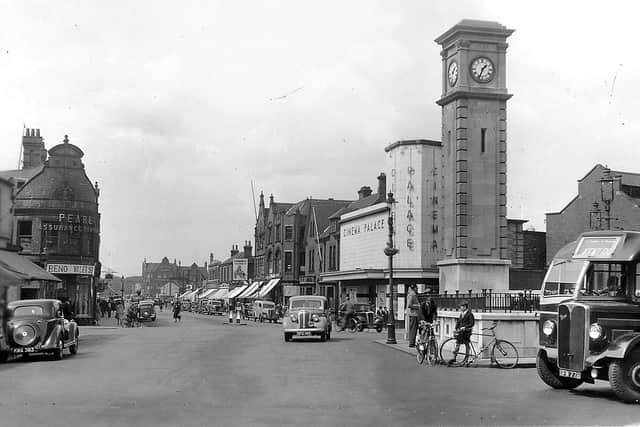
To celebrate the port’s centenary, a new clock tower was erected in the Market Place.
A tender from Potts & Sons of Leeds for a turret clock, fitted with four bronze dials and Grimethorpe three-legged gravity escapement, costing £112, was accepted during October 1927 by the General Purposes Committee. It was working by December of that year.
The new Boothferry Bridge across the Ouse, near Goole, which had cost £116,467 and taken four years to build, was ready for traffic to use from July 18, 1929.
The importance of the bridge was indicated by the statement that ‘hitherto there had been no road structure over the river between Spurn Head and Selby, a distance of 68 miles’.
By joining the East and West Ridings, the bridge was expected to prove an inestimable local boon. The structure was designed by Mott, Hay and Anderson.
When the Poet-Laureate, Dr Day Lewis officially opened Goole’s new £72,000 public library in Carlisle Street on November 20, 1968, he said every library should be a centre of culture and civilisation, a place where people could sustain and enlarge their concept of the human spirit.
He described libraries ‘as generators of human knowledge and a powerhouse of imagination’. The Poet-Laureate argued there was no substitute for books.
Cinema, radio, television and other forms of entertainment and communication were all ‘spectator sports’. But, a good book was a challenge to the imagination, the writer creating the reader re-creating.
An immeasurable benefit to Goole’s industry, docks and inhabitants was provided when connected to the M62 motorway, which had been started in 1970.
The final section, including the Ouse Bridge near Goole, was finished in 1976.
With the whole of the route completed on this side of the Pennines, it provided North Humberside with a long-awaited major road to and from the west.
One commentator said: ‘Centuries of not-so-splendid isolation are at an end’.