
Goole: The weird and wonderful objects marking Yorkshire town's bicentenary

The East Yorkshire town of Goole has much to celebrate this summer as it marks 200 years since its foundation.
To mark the bicentenary, its museum is using 200 weird and wonderful objects from its collections to tell the town’s history, including its industrial milestones and community spirit.
Until 1826, Goole was little more than a tiny rural village.
Then the Aire and Calder Navigation Company cut a canal from the Yorkshire coalfields to the River Ouse to export coal and built the town’s docks, workers' houses, and the famous Lowther Hotel.

One man, William Eden Cass – who stares out from a Victorian photograph at the museum with his mutton chops and his pet terrier – played a major role after becoming one of Goole’s first settlers.
Cass, who had been a ship’s surgeon in the Arctic, took on many roles in the town – medical officer, police surgeon, officer of health through two outbreaks of cholera, and midwife.
One of his descendents donated a tea set, hand-painted with birds of paradise, to the museum.
"Goole was built from scratch in 1826,” says the museum’s curator Dr Alex Ombler, ahead of today’s opening of Goole 200: A History of Goole in 200 Objects.
“The original town was called the Goole Triangle – a triangular network of four or five streets with very nice Regency-era terrace housing all built by the Aire and Calder Navigation Company.”
Elsewhere in the museum is a 1970s three-piece Burton’s wedding suit. The firm had a huge manufacturing plant that was a major source of employment in the town for seven decades.
Opened by the Princess Royal in 1949, the factory employed around 500 people, most of whom were local women.
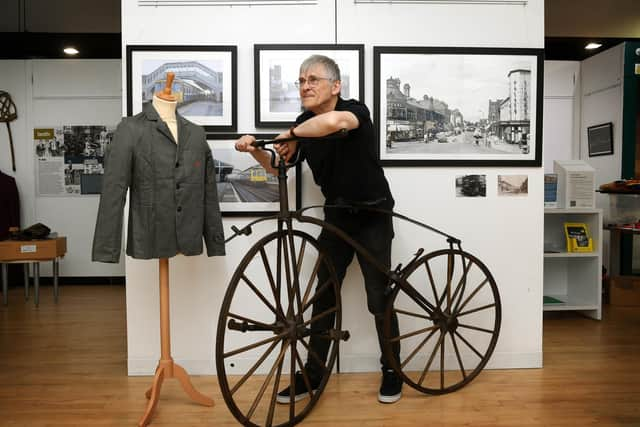
"It was like one big family,” said Dr Ombler. “Most of the men worked at the shipyard. Everybody rode on bikes and all the women from Burton’s rode one way and all the men from the shipyard rode the other way.
"People would avoid going out at 5pm. They used to call Goole China Town or Little Holland because of the bikes, bridges and waterways.”
The town will celebrate with a Big Bicentenary Weekend on July 18 and 19, featuring street theatre, film screenings, and community festivals, marking the date the first ships came through its docks.
An exhibition of works by artist Reuben Chappell (1870–1940) is set to attract international attention when it opens in July. The ‘master of the masts’ was a pierhead painter who would canvas the docks for commissions and sketch incoming ships for their captains and crew.
Because he was so prolific, creating an estimated 12,000 paintings, his works were carried by the crews back to their home ports and are now widely distributed in various European countries.