
Harworth: The pit at the tip of Yorkshire that was nearly a German outpost
Until the early 20th century Harworth, on the tip of the South Yorkshire/North Nottinghamshire border, was just a small and little heard of village with an ancient church.
The earliest parts of the All Saints’ Church fabric date to the 12th century according to the southwellchurches website.
It continues with other facts: ‘The church in Harworth was part of the chapelry of Blyth Priory, a Benedictine Priory founded in 1088 by Lord Roger de Builli.
In 1869 the church was largely rebuilt by the Mansfield architect, C.J. Neale, except for the Medieval tower.


On July 17, 1914 the remains of Lord and Lady Galway were removed from the family vault and transferred to a new family burial ground near Serlby Hall. Around 2012 the roof was rebuilt.’
In 1914, a German syndicate’s search for coal – of the steam variety – directed its attention to Harworth.
Leading the venture was Herr Hugo Stinnes, a great Westphalian mining magnate who had his own line of steamships for carrying English coal to his native Fatherland.
The mining royalties had been secured by the syndicate and according to the London Evening News the entire contract for sinking, freezing the water-bearing strata, tubbing the shafts and supplying the equipment had been placed with a company in Essen.
The company had perfected a new way of freezing which it was claimed had not been tried in England before.
In March 1914, it was envisaged that several hundred German workmen would be imported and the sinking of a shaft was to begin within a few weeks.
The new enterprise attracted widespread comment, for it aroused interest for mine owners, railway companies, engineers, and social reformers, as well as financiers.
A leading authority said this was a significant development. Germany wanted more and more coal from us and her leading men were trying to obtain some of the English sources of supply into their own hands.

It was added that at Harworth they had secured ‘a very good thing.’
In the previous year, nearly 400,000 tons of coal was exported to Germany from Hull alone and many of the Yorkshire collieries supplied large buyers on the continent.
No German invasion on the scale promised at Harworth had been witnessed anywhere in the country.
Regret was expressed in some quarters that the lessees went to Germany for a firm to sink the new pit when there were plenty of capable mining engineering firms in England.

It was however, regarded as a simple business proposition, and the fact that German capital was being supplied was accepted as sufficient explanation that a German firm should be employed.
Various companies interested in the development of the South Yorkshire Coalfield were invited to share in the Harworth business though declined.
Thus, the German coal owners were approached and were ready to engage in the project to increase their interest in the English mining industry.
By July 1914, an announcement said that Harworth was being rapidly developed by the Northern Union Mining Company (NUMC) and ‘will soon be a large and flourishing mining centre.’
The NUMC was largely financed by German capital though there was a British interest.
The chairman of the company was Russell Ferguson of London and Glasgow and the registered office was in London.

An Englishman was appointed as consulting mining engineer and the manager of the colliery was born in England.
But, Herr Hugo Stinnes was the potent force behind the undertaking.
Leases, which Arnold Lupton had secured a little earlier from Lord Galway of Serlby Hall and other landowners, were transferred to the company whose holding was approximately 20,000 acres.
It was estimated that between 3,000 and 4,000 miners might be employed and the NUMC chairman stated their intention was to provide ‘something of a garden city for the colliers.’
This would be on the Port Sunlight and Bournville lines.
Predictably, the project came to a grinding halt with the outbreak of the First World War on July 28, 1914.
One newspaper from August 8, 1914 reported there was great excitement at Retford on the previous day.
This occurred when the Notts Sherwood Rangers received instructions to proceed to the new Harworth colliery and collect German Reservists who were engaged in sinking the pit.
It continued: ‘Two motor charabancs were requisitioned, and these proceeded to [Harworth], and returning to Retford deposited 16 men at the police station, where they were detained.’
They were all young and able-bodied men, including two who had been German army officers.
During April 1917, came the announcement that the Harworth German pit options, leases and properties had been purchased by Barber, Walker, and Co. of Eastwood, Notts and of Bentley, Doncaster.
During September 1921, sinking operations began at Harworth. At the end of October 1923, a rich bed of coal known as the Barnsley seam was reached.
This was reportedly struck at 929 yards below the surface. About 200 workmen’s houses were in the course of construction while a contract for a new railway was let to a Scottish firm.
The Leeds Mercury of October 31, 1923 said that geographically the pit is just over the South Yorkshire border into North Notts.
But, the greater portion of the area it would work was in South Yorkshire and it ‘really ranks as an important addition to the famous South Yorkshire coalfield.’
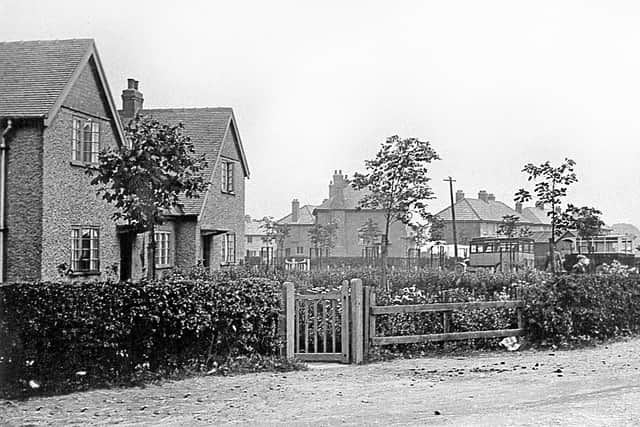
Miners came from Cumberland, Staffordshire and Durham as well as other areas to work at Harworth pit and settled in the new colliery housing provided at Harworth, Bircotes and Langold.
Hugo Stinnes who once had great ambitions for the Harworth enterprise died in April 1924.
There were riots in Harworth over the weekend of April 24/25, 1937 as striking members of the Miners’ Federation of Great Britain (MFGB) clashed with the more moderate ‘Spencer Union’ members.
This led to arrests, convictions and imprisonment – ranging from nine months to two years – for riot for 11 miners and a miners’ wife, Margaret Haymer.
Amongst the convicted miners was Mick Kane chairman of the local branch of the Notts Miners’ Association.
He was described as ‘the leader of the riot’ and received the longest sentence of two years with hard labour.
By July 1937, Harworth members of both unions agreed to merge and form the Nottinghamshire and District Miners’ Federated Union.
Widespread protests ensued about the convictions until the Home Secretary Sir Samuel Hoare granted remissions in certain cases. He said this was ‘solely as a contribution to the cause of industrial peace.’
Mick Kane was not released from Lincoln prison until August 25, 1938. He was welcomed home in Harworth to much celebration.
A late addition to the colliery site was the huge No. 1 Winding Tower completed in 1989 and it became a familiar local landmark.
Harworth colliery was mothballed in 2006, though eight years later a statement said it would not reopen.
Much of the site had been cleared at this point and the No 1 Winding Tower was scheduled for demolition Sunday April 10, 2016.
Planning permission to redevelop the site was granted and many houses now occupy the area that nearly became a German industrial outpost.