
'Heroines in the truest sense of the word' - The women who were secret agents in the Second World War
Historian Dr Kate Vigurs tells Laura Reid about how she brought to light the extraordinary stories of female agents operating during the Second World War.

In 1940, during the Second World War, then Prime Minister Winston Churchill ordered a secret British organisation to “set Europe ablaze”.
That underground army was the Special Operations Executive (SOE) – and its agents were tasked with helping resistance movements and carrying out sabotage behind enemy lines.
The women of the SOE often risked their lives working as couriers and wireless operators. Their stories are told in a book published earlier this year by historian Dr Kate Vigurs and this week, she will be in Harrogate to talk about these “wartime heroines...often unrecognised and sometimes forgotten”.
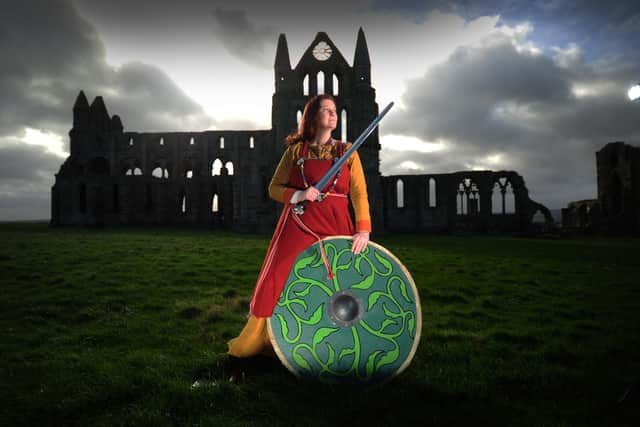

“These are ordinary people doing extraordinary things,” she says. “When you talk about these women’s origins, you can almost empathise. You can go oh yeah okay she worked in a shop or she was an air stewardess – normal day-to-day jobs even now… for me, these stories are so relevant because of that.
“But also, they just really deserve to be told…These are heroines in the truest sense of the word. And I'd love people to look at them, have them inspire them, and then aspire to be as heroic as they can be.”
Dr Vigurs jokes that she “fell down a very deep rabbit hole” after becoming interested in the SOE whilst working at Royal Armouries Museum in Leeds early in her career. At the time, she was writing a script for a museum performance on resistance efforts during the war and soon found herself fascinated by the reality of life for women operating undercover.
An interest in history – and the military – had been present throughout childhood for Dr Vigurs, who was born in Silsden, West Yorkshire, with a father in the forces. But a love of music and theatre prompted her to study for a degree in drama instead. It was whilst working at the Royal Armouries a year after graduating that her passion for history was reignited and she discovered “this amazing way that you can tell stories from history, through performance, through horses, through swords”.
Since then Dr Vigurs has undertaken a PhD at the University of Leeds focused on the women of the SOE, as well as setting up History’s Maid, a historical interpretation company that brings history to life and has seen her produce work for organisations including English Heritage, Imperial War Museums and York’s Jorvik Centre. She is also a frequent contributor for TV, radio, podcasting and the press and previously wrote Mission France: The True History of the Women of SOE.
Her most recent book, Mission Europe: The Secret History of the Women of SOE, tells the stories of the lesser-known women who worked across the Continent, from the Netherlands to Belgium and Poland to Denmark, as well as France. Dr Vigurs also explores the lives of Jewish agents recruited in Mandate Palestine for missions in Eastern Europe.
With the support of a grant from the Gerry Holdsworth Special Forces Charity, Dr Vigurs was able to travel to the countries she has written about to access archival material. She documents the women’s work, including requesting information, supplies, firearms and agents from the UK, and physically taking messages between different networks and countries.
Perhaps one of the most remarkable tales is of a woman who was an explosives instructor, who worked on enemy sabotage in the run up to the D-Day invasion. In France, she taught men of the resistance to blow up railways. “In the run-up to D-Day, that's absolutely critical,” Dr Vigurs explains, “because the Allies have been misfeeding the Germans information that D-Day will be Calais. So they're starting to amass troops in the wrong place. And a month before D-Day, she goes out, she blows up this railway line to show how it can be done. And because of that, 960 railway lines are blown up the night before D-Day, which means when the Germans try to mobilise by rail, they can't, and everything is much, much slower.”
With an existence that was cloaked in secrecy, largely dangerous and at times, very lonely, the women required incredible courage and bravery to survive, with the risk of being caught weighing heavy 24 hours a day. Dr Vigurs paints a picture: “Imagine you're in an aircraft. You're over enemy occupied territory. It's dark. You're about to parachute jump in. You don't know if it's going to be the Gestapo (Nazi Germany’s police force) or friendly resistance who pick you up. You don't know what's going to happen next.
"You are wearing civilian clothes, acting as if you have always been there when in actuality you might have only learned the area by studying maps and things like that. And then you are on edge the entire time. You're living under a cover story. You are basically playing a character...
"As a wireless operator, every time you set up that wireless and put out your aerial, the Nazis could move in on you, they could close in on you…I always think that bit must have been terrifying because if you didn't have a lookout, how would you know? How would you know who’s listening or who’s around? It's very much living on your nerves.”
A handful of women from Dr Vigurs’ book will be highlighted in her talk in Harrogate tomorrow. “What I try to do with Mission Europe is share real stories of heroism,” she says, “but I do also pick out a couple of the bad eggs who maybe turned double agent or maybe let this go to their heads. So, I'm taking people's emotions backwards and forwards. The aim really is just to get these women's stories out there...I felt it was time that their stories were told and their roles were celebrated.”
- Dr Kate Vigurs is at Raworths Harrogate Literature Festival on Saturday, October 18, at 11.30am, at The Crown Hotel. For tickets, visit harrogateinternationalfestivals.com