
Historic postcards show ancient buildings, trams and a king in Yorkshire
Ancient buildings, recent developments and significant events were the subjects favoured by postcard photographers during the first three decades of the 20th century.
This was certainly true when they turned their attention to Rotherham.
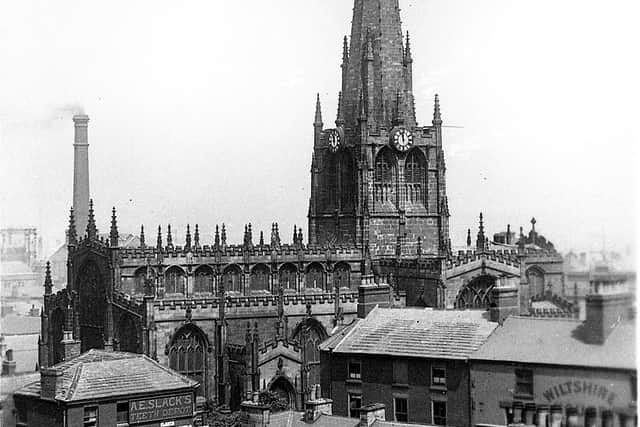
The town’s All Saints Parish Church, also known as Rotherham Minster, was a popular subject for photographers. Nikolaus Pevsner in Yorkshire The West Riding (1959) states: ‘[All Saints] church is one of the largest and stateliest parish churches in Yorkshire…’
The Minster’s website mentions that the church has been at the heart of Rotherham town centre for over 1,000 years. Three churches have stood on the site.

The building acquired its present form when monks “reordered the Norman church in the 14th and 15th centuries in the Perpendicular style of architecture”.
During 1873, under the direction of Sir George Gilbert Scott, a number of alterations and repairs were made: the galleries were removed; the stonework cleaned and repaired; the pulpit was moved to the north side of the nave and the chancel was reordered. Rotherham Minster is now a Grade I-listed building.
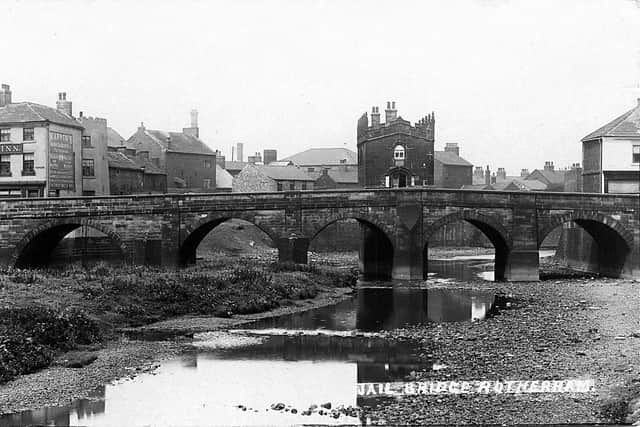
Another ancient building featured in postcards is the Chapel of Our Lady on Rotherham Bridge.
This came into being around 1483 when the bridge was erected. This is proved by a will of a local teacher called John Bokying, dated 1483, in which it is stated: '3s.4d. to the fabric of the chapel to be built on Rotherham Bridge.'
Following closure in 1547, the building passed into the ownership of the Feoffees of the Common lands of Rotherham – in effect Rotherham's first town council.
Thereafter, the chapel found a variety of uses. It became an alms house in 1595; was in ruins by 1681; converted to a prison in 1778, and rented as a dwelling house in 1826. In 1888, the old chapel became a tobacconist and newsagents.
During the early 20th century, many residents wanted the chapel to be restored to its original use.
They found a supporter in Sir Charles Stoddart who bought the building in 1913. He died before any restoration work could take place but it was eventually organised by the vicar and churchwardens of All Saints Church and completed by 1924.
Additional restoration work, carried out in 1975, saw the installation of a splendid new east window.
In the Victorian era, the North Midland Railway opened the first link between Yorkshire and London – to Rotherham (passing over the Sheffield & Rotherham line) on May 11, 1840 – and from Rotherham to Leeds on July 1.
The NMR's Rotherham station opened as Masbrough Rotherham on the south side of Midland Road.
It was built by Joel Buxton of Sheffield to the designs of Francis Thompson, an architect well-known for his railway work. Postcards of the station were taken from the platform or from the Coronation Bridge.
Rotherham’s cinemas were amongst the modern buildings that appeared in postcards. One photographer could not resist including the Electric Pavilion, alongside the Hippodrome situated opposite.
The Electric Pavilion was housed in a former Zion Chapel dating from 1860 and, with seating for approximately 600, began screening films on July 15, 1911.
In the 1920s the proprietor was Cinema (Rotherham) and Electra Ltd. During this period the name was changed to Electra Picture Palace. The final film before closure on April 26, 1930 was Free Lips and the building was eventually demolished.
The Cinema House, Doncaster Gate, began trading on March 9, 1914.
It was unique, being designed in the Moorish Revival-style complete with four Russian-style domes, two octagonal and two square ones. It seated 900 in the stalls and small balcony. Closure came on June 1, 1963. The last films were Just My Luck and War Arrow.
Reopening as a bingo club, its exterior features were lost in a modernisation scheme and, after serious damage by fire in 2004, the premises were cleared in 2009.
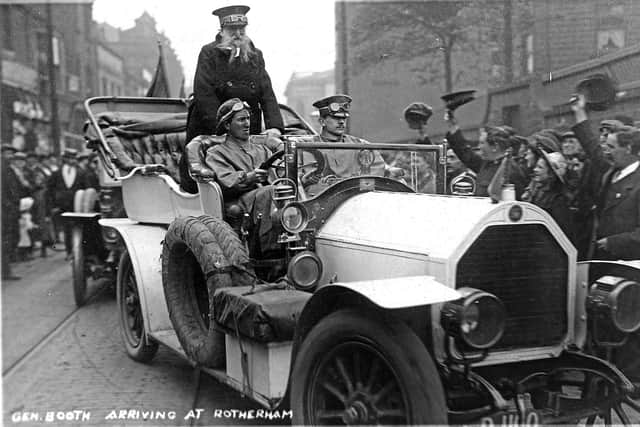
Visits to Rotherham by prominent people were featured in postcards. William Booth was an English Methodist preacher who along with his wife founded the Salvation Army and he became its first General.
During 1909, he embarked on a motor tour of the United Kingdom, including Rotherham. Almost every day, he addressed meetings at two or three places.
George V came to the throne at a time of social unease within the country.
Thus, he decided to take a tour of industrial South and West Yorkshire to observe people under their working conditions and to gain a first-hand knowledge of how the vast body of workers earned a living.
Decorations, except simple bunting, were discouraged, the object being that no expense should be placed on any community.
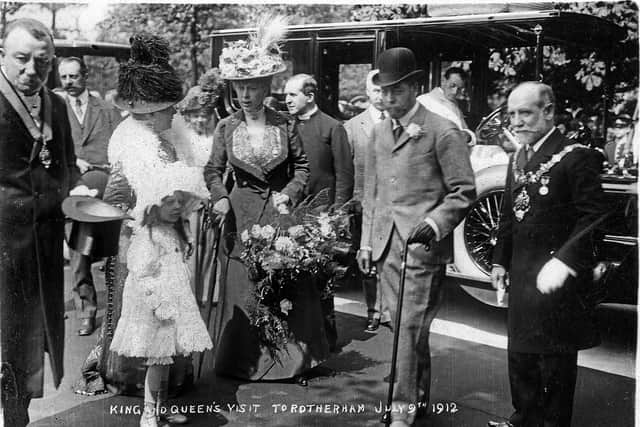
A large crowd witnessed the departure of the King and Queen from London and they arrived in Doncaster at 3.55pm on July 8 1912. The Royal couple took tea at Conisbrough Castle and moved on to Wentworth Woodhouse where they were staying for the duration of the Yorkshire tour.
The following day, they visited Rotherham and met 16-year-old John Wroe, of Kimberworth.
At the age of seven, John had lost both his legs. Sometime later the King supplied him with some artificial limbs. John was brought to the King who shook hands with him. It was said: "The little lad broke down when the Queen spoke to him.”
A review of some 8,000 children also took place in the town’s Clifton Park.
At Silverwood colliery the King and Queen inspected the surface arrangements and a by-product plant.
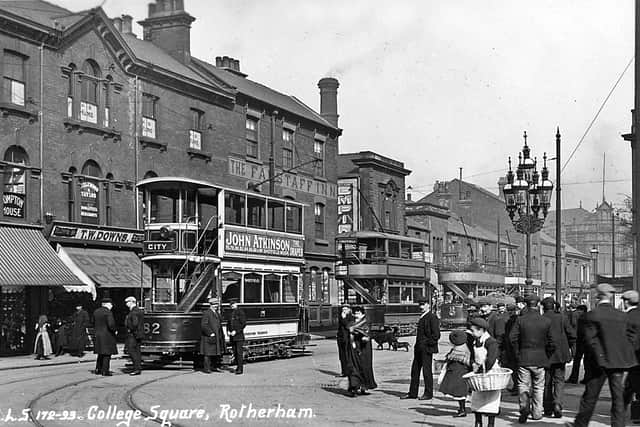
Views showing many aspects of new electric tramways appeared in thousands of postcards throughout the country.
On Saturday January 31, 1903, Rotherham was added to the list of municipalities boasting their own electric tramways.
Two sections of the Corporation's comprehensive scheme were opened by Alderman Winter J.P., the chairman of the Electric Light and Tramways Committee.
The Rotherham system was to the standard gauge of 4ft 81/2in.
McCartney, McElroy & Co. undertook work on the overhead equipment and permanent way for £7,102 and £55,429 respectively. The tram rails were supplied by Walter Scott Ltd of Leeds, the points and crossings from Sheffield's Hadfield's.
The town's first 12 cars, weighing eight-and-a half-tons, were double deck, open top and included 56 seats (22 downstairs and 34 upstairs).
The livery was chocolate and yellow but the former was later changed to maroon. A tram’s nominal speed on the level was 10 miles an hour.
After much wrangling between Rotherham and Sheffield Corporations, a through service connecting both places came into operation on September 11, 1905. Postcards show both Sheffield and Rotherham trams in the latter’s town centre.
Trams continued to run to Templeborough until 1949, the year the Rotherham tram system closed.