
Hooton Pagnell: The Yorkshire village that has proved a family affair
Some Yorkshire villages have seen little change over the years. This is often said of Hooton Pagnell situated between Doncaster and South Elmsall.
Yet, there are still some developments to mention and individuals to feature. All have played a part in the area’s continuing history.
Hooton Pagnell is the old seat of the Norman family of Paynel (sometimes Paganel or Paganell), lords of Leeds, and it received a Royal Charter in 1254.
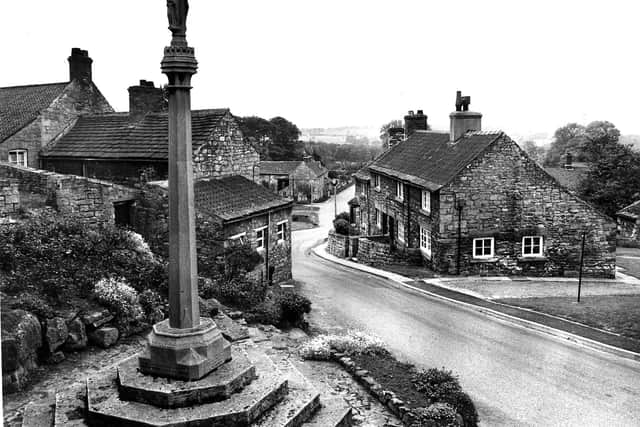
This entitled the village to hold a market and an annual fair. The remains of a butter cross still survive today.

From 1704, the Hooton Pagnell estate has been occupied in turn by the Warde, Warde-Aldam and Warde-Norbury families.
At the end of January 1803, St. Andrew Warde gave 50 poor families of Hooton Pagnell 373 yards of cloth, and 41st of beef. Baines’ West Riding Directory of 1822 mentions the village contained a population of 326.
Amongst these were: a wheelwright, cooper, butcher, surgeon, stone mason, victualler, and blacksmith. An alarming newspaper notice relating to the village appeared on April 9, 1825. It read: ‘Joseph Wood, charged with feloniously stealing two sheep, from a field at Hooton Pagnell…Guilty, Judgement of death recorded.’
A Falcon Inn existed at the centre of the village from at least 1822, but it appears to have ceased trading around 1877.
Sarah Julia Warde (b. 1857) inherited the Hooton Pagnell estate in 1868. Ten years later, she married William Aldam of nearby Frickley Hall. Becoming Mrs Warde-Aldam, she was an influential figure at Hooton Pagnell for a number of years.
A reading room was opened in Hooton Pagnell in November 1880 with newspapers and games provided by Mr and Mrs Warde-Aldam.
An article at the time informed: ‘To defray the working expenses low priced tickets are being sold, and from the numbers that avail themselves of the opportunity of spending their evenings in a well warmed and lighted room, it is anticipated that good success will attend the institution.’
In August 1886, milk dealer Wm Scott, aged 21, was indicted for stealing a cow, valued at £9 10s from Hooton Pagnell. He was found guilty and sentenced to 12 months’ hard labour. In the same month the Archbishop of York (Dr Thomson) reopened the village’s All Saints Church, which had been restored at a cost of nearly £4,000.
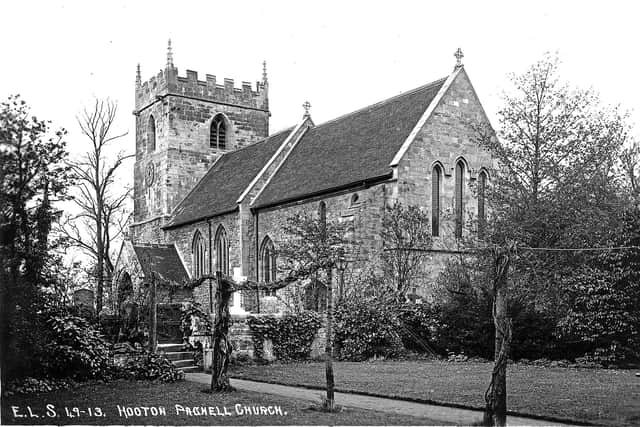
The nationalchurchestrust website states: ‘Hooton Pagnell was recorded in the Domesday Survey, although there is no mention of a church, we know one existed as in 1089 Ralph [Paynel] granted the church to the Priory of Holy Trinity in York.’
The 1886 restoration work included the church roof being repaired, new windows inserted throughout, and new seating installed. Mrs Warde-Aldam, the patroness of the living, provided funds for the restoration.
Leading her own moral crusade with the estate tenants in 1894, Mrs Warde-Aldam wrote them a letter outlining certain rules: ‘That any member of the family of any of my tenants having an illegitimate child of children born to them or being proved to be the father of such child or children in the parish of Hooton Pagnell shall at once receive notice to quit.’
In 1895 Mr and Mrs Warde-Aldam presented a clock to Hooton Pagnell church. It was built by Smith & Sons of Derby who also provided five new bells.

They were added to the three existing bells to make a peel of eight in total. The cost was around £600. The lych-gate at the entrance to the church was presented by Mrs Warde-Aldam in addition to land for a cemetery
According to landedfamilies.blogspot.com, Hooton Pagnell Hall is 14th century in origin, but since that time it has undergone a number of alterations.
A drawing shows that in Elizabethan times the Hall was given five gables. During the 18th century, architect William Lindley was involved with work at the hall.
The website continues: ‘The entrance side of the house was re-Gothicised with crenellations in 1894-1904 by Mrs Warde-Aldam, but the architect of these changes is unknown…She was also responsible for the minimalist Gothic gateway building.’
This was built to the designs of Granville Streatfield and Frank Atwell and was finished around 1920.
From 1900, the Hooton Pagnell vicar Revd Frederick Samuel Willoughby began a training scheme to prepare men of limited means to enter theological college.
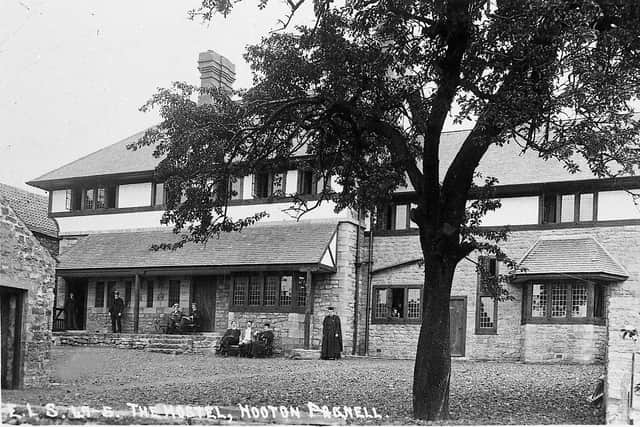
They were housed in the vicarage and other properties in the village. He named this enterprise ‘St Chad’s Hostel,’ and it was supported by Mrs Warde-Aldam. Then, with her support, a purpose-built hostel was completed in the village during the summer of 1904.
An article from the time said: ‘The building is in the Tudor style, half timbered and has been erected by the workmen on the estate…The cost will be about £2,000…Mrs Warde-Aldam opened the building…’
During July 1915, a report said that through the kindness of Mrs Warde-Aldam, Hooton Pagnell Hall was being used as a convalescent home for wounded soldiers.
A staff of about ten sisters and nurses was maintained. As the war continued and the number of wounded increased, it was apparent more space was required.
The Commandant, Mrs Warde-Aldam, utilised St Chad’s Hostel. Thus, the accommodation was increased to 100 beds. Over 1,200 patients were treated, and for her involvement with the hospital, Mrs Warde-Aldam was awarded the MBE.
St Chad’s Hostel opened once more after the War but due to financial problems it finally closed in 1921.
A war shrine was erected on the village green opposite to the Market Cross during June 1917. Just under two years later, on Tuesday March 11, 1919, the Hooton Pagnell Auxiliary Military Hospital closed.
A war memorial, erected by public subscription, was unveiled on Tuesday April 17, 1923, in the centre of the village. At the ceremony, the vicar (the Rev. Kearney) read the names of the Hooton Pagnell men of the village who fell in the war.
Following the death of Mrs Warde-Aldam her son, Lt. Col William St. Andrew Warde-Aldam took over. During January 1953, he was among 31 British passengers rescued from a liner which sank ‘off Portuguese East Africa.’
His daughter Mary Betty Warde-Aldam inherited her father’s estate. She married Harold George Norbury and they changed their surname to Warde-Norbury.
Hooton Pagnell was designated a conservation area on June 22, 1970. Within the conservation area it was mentioned that there were 29 listed structures, including the Grade 1 listed Church of All Saints and Grade II* listed Hall.
Betty Warde Norbury died in 1978 and was succeeded by her son, Antony Warde-Norbury, Chairman of Joshua Tetley & Son Limited. Clifford Lackey mentions in Quality pays…The story of Joshua Tetley & Son (1985) that in 1977, Tony Warde-Norbury launched the company’s idea of providing family rooms within public houses.
After extensive alterations Hooton Pagnell Club, housed in the former St Chad’s Hostel was reopened in 1983. It had been in existence since 1954. President of the club, Tony Warde-Norbury, performed the opening ceremony by pulling the first pint.
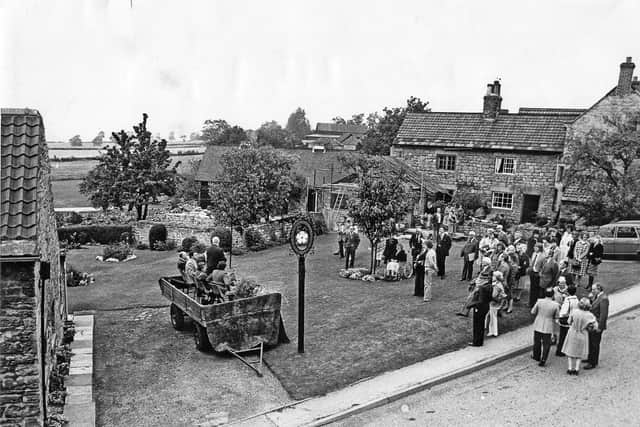
In the past, Hootton Pagnell has won the best kept village award three times: 1973, 1979 and 1985.
A photograph from September 1973 shows Baroness Bacon after she had presented an award to Hooton Pagnell for Best Kept Village.
An announcement from July 1985 said that Hooton Pagnell had come top in Yorkshire Rural Council’s Best Kept Village competition.
The judges said in their report: ‘No village can be perfect in all respects but the overall impression of cleanliness, care for houses, buildings and gardens and the various other features was outstanding and left no doubt that Hotton Pagnell was the best-kept village in South Yorkshire in 1985.’
The population of Hooton Pagnell in the 2011 census was 201.
Thanks to Mark Warde-Norbury for help with this piece.