
How a new book by a Yorkshire archeologist lifts the lid on Britain's Forgotten Vikings
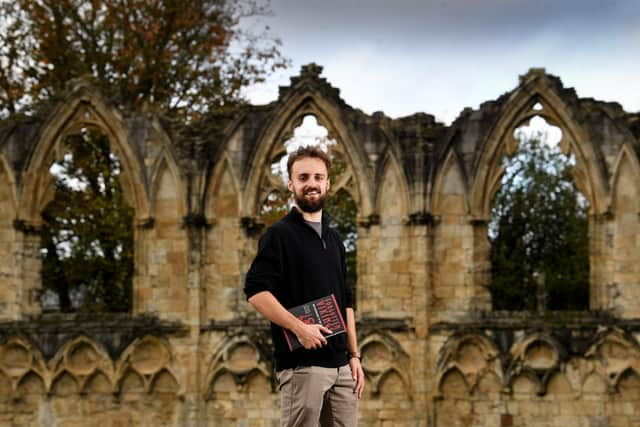
Medieval archaeologist from York, Alex Harvey, has written a book focusing on what he calls the Forgotten Vikings. Here he gives an insight into his findings for Yorkshire. Pictures by Simon Hulme.
The Viking Age (793 -1066) was a transformative period of English history, which saw roaming raiders and traders impact the country in a variety of ways, from sporadic coastal attacks to influential economic expansions.
By the end of the eighth century, England as we know it was made up of several fissiparous kingdoms, such as Northumbria, Mercia, and Wessex, which were often locked in combat with one another and between themselves.
When William the Conqueror touched down at Bulverhythe near Hastings, in that fateful September of 1066, the English soil he laid eyes upon was, for better or worse, united.

It was through the Viking Age that England was forged, out of the shells of former kingdoms that fractured, fragmented, and faded into obscurity through the depredations of Scandinavian, Baltic, and Frisian invaders.
For Yorkshire, the Viking impact is well-attested through our dialect, language, place-names, and can be seen most visibly in places like the JORVIK Centre and the Yorkshire Museum.
The ‘Vikings’ (a catch-all term that homogenises a broad spectrum of individuals and identities) gave us important artistic and linguistic contributions, like the swirly vine-like motifs of the Gosforth Cross, and the word ‘egg’. The word ‘Yorkshire’, itself, has tangled roots in the Old Norse language, from Eurvicscire, first attested in the year 1086, but undoubtedly hailing from an earlier century.
Yorkshire was - and is - a shire built around the city of York; York’s name has an even more diverse linguistic history. Before the Romans created their Ouse-side fortress, the marsh was probably recognised in the landscape as a ‘place of yew-trees’, called Eborācon.
This became the Latin Eboracum, and through linguistic shifts in the fifth and sixth centuries, morphed into the Old English Eoferwic and the Old Welsh Caer Ebrauc.
To cut a long saga short, the Yorkshire that the Vikings attacked from the ninth century onwards was a realm centred around York but also filled with its own small locally-bound petty kingdoms. This is an angle not always considered by analyses of the Viking impact.
The kingdom of Northumbria, for instance, was actually a kingdom of two halves; Bernicia north of Whitby and Deira based around Driffield, York, and the Vale of Pickering.
These two divisions were already engaged in a bloody civil war before any Viking armies arrived at the gates of York, and these weren’t the only partitions within Early Medieval Yorkshire. Elmet, a small Celtic-speaking territory east of Leeds is still remembered in village names today, and an eighth-century historian mentioned it alongside ‘the country of Loidis’ (Leeds) as two separate locations.
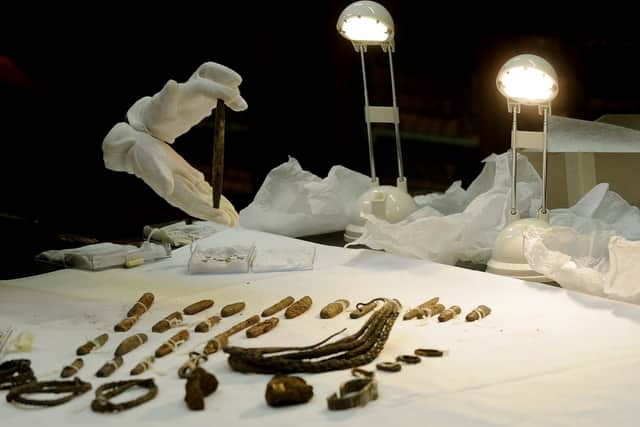
Archaeologists and surveyors have also hypothesised the existence of a third territory centred around Harrogate, Wetherby, and Spofforth, based on the presence of earthworks, barrow mounds, and historical references to powerful itinerant landowners.
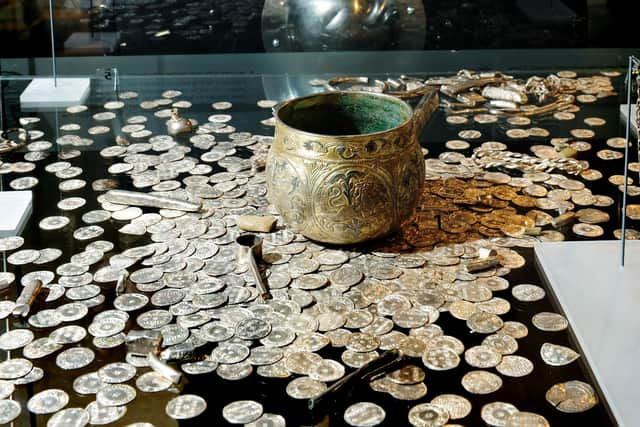
The Vale of York Hoard, discovered near Harrogate in 2007, reflects the career-spoils of a retiring Viking warlord, much like the Bedale and Cuerdale Hoards found nearby. These mass deposits of looted, bartered, and hard-won wealth were equivalent to insurance deposits; a large sum of booty deposited for safe-keeping in the new territory of a land-claimer.
In 876, The Anglo-Saxon Chronicle describes leaders of the viking army ‘sharing out the land of Northumbria to settle and plough’, and these hoards more or less date to that period. This is roughly the period that the term ‘Danelaw’ started to be used to describe lands north of English-speaking Wessex and Mercia; Yorkshire was firmly ‘Danish’ by this estimation, and Northumbria was no more.
In my opinion, we are not necessarily looking at the dissolution of old kingdoms and the creation of new territories, but simply the reemergence of these earlier pre-Viking Age regional divisions.
Elmet, Loidis, Craven and Dunutingas (both based around the Yorkshire Dales and the edges of Cumbria), and Deira, were all collectively different areas of the ‘Danelaw’, possibly even ruled over by different, competing kings.
Coins from York paint a more detailed story, revealing the changing rulers of the city and its hinterlands between the ‘fall’ of Northumbria in 867 through to the death of the last Danish king in 954. Between 895 - 905, coins from York display the names of monarchs like Knutr and Sigfrodr.
We know nothing about these individuals beyond that they were possibly Christian, and certainly powerful within parts of Yorkshire. All of this is inherently speculative but to research Viking Age Yorkshire requires a healthy amount of guesswork built upon a foundation of knowledge about pre-Viking Age Yorkshire.
To understand the formation, fragmentation, and longevity of the ‘Danelaw’ as a vague territorial entity is to dissect the squabbling kingdoms that existed before it in the same geographic area.
All this is made even more complicated when we consider the role of St. Cuthbert’s posthumous worshippers in the tenth century, who carved out their own political and geographic territory near County Durham, known as the land of ‘the holy folk’.
Literary and poetic traditions about this ephemeral territory paint the holy folk’s land as diametrically opposed to the ‘Danelaw’.
Whilst fictitious, the traditions paint an atmosphere of identity erosion within the ‘Danelaw’. Viking Age Yorkshire was awash with competing identities and regional affectations; the ‘Viking’ element became obscured as new settlers, former raiders and traders, found themselves landlocked and inter-marrying with Christians and farmers.
Whether you find yourself in the Yorkshire Dales, along the streets of York, or near Leeds, it is worth remembering that ‘Yorkshire’ is not and never has been a monolithic entity.
It is carved out of the bones of Northumbria, which was itself a composite of countless smaller and less memorable kingdoms.
The term ‘Danelaw’ neatly summarises these divisions but can only ever be a band-aid for discussing a very complicated, fascinating, and bloody period of English history.
www.amberley-books.com/forgotten-vikings