
How umbrella production boosted Yorkshire town
The manufacture of Paragon umbrella frames by Samual Fox in Stocksbridge from the mid-19th century led to the production of more significant items and the transformation of the small area – located in the picturesque valley of the Little Don River.
Samuel Fox was born on June 7, 1815 at Bradwell in Derbyshire – the son of a weaver’s shuttle maker. Following an apprenticeship as a wire drawer, he went into partnership with a Rivelin wire manufacturer.
This was short lived and he moved in 1842 to the sparsely populated Stocksbridge. There, a business was established on a site occupied by a 1794 cotton mill, a joiner’s shop, and a small blacking grinding manufactory. He set about redeveloping the site and converting it into a wire manufactory. At first, he devoted his attention to wire drawing and the production of hackle and gill pins used in wood combing operations. Water power was used initially but this gradually switched to steam power.
The 1841 census notes only a few people in Stocksbridge but there was a rapid growth throughout the century.
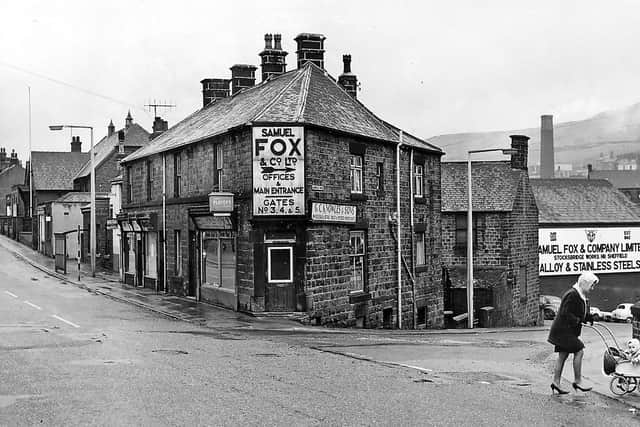

Fox invented what became known as Fox’s Paragon frame for umbrellas. Previously, umbrella ribs had been made of whalebone or solid steel. The whale bone was unreliable and the steel was heavy. It occurred to Fox to groove the rib, and thus by its hollowness secure elasticity and lightness. He earned a fortune before other manufacturers knew what he was doing. The production of steel umbrella frames gave work for many, especially women and children who could work half time.
The Paragon umbrella frame was patented in 1852 and Fox began the production of crinoline wire soon after. By 1860 he had established a works at Amiens, France to manufacture the umbrella frames.
Fox also turned his attention in other directions, including the manufacture of quarter and half inch rods for cables, telegraph wires and the making of wire ropes for use in coal pits. A Bessemer plant was put down and the firm began to supply rails and tyres etc.
In 1871 the firm was converted into a limited liability company.
Fox erected more than 300 houses at Stocksbridge and the vicinity, accommodating his workmen and their families. A benevolent fund was established at the works for the benefit of the old and infirm on the establishment.
As the Fox business expanded, new amenities were required for local residents. A site was bought for new Co-op stores in April 1861, the plans being drawn by Joseph Hayward probably in September of the same year.
The building was occupied in 1863. According to the History of the Stocksbridge Band of Hope Industrial Co-operative Society Limited 1860 to 1910, the New Stores as they were known provided accommodation for the butcher, draper and grocer. There were store rooms and a committee room on the second floor and a Co-operative Hall in the third storey which ran the full length of the business premises. The Stocksbridge Band of Hope Industrial Co-operative Society had been formed in 1862 having held meetings in the Friendship pub.
Fox built the Works School in 1867 and two years later the Stocksbridge National School was erected.
A branch line to link Samuel Fox’s steelworks with the mainline network at Deepcar was authorised by an Act of Parliament in 1874 and opened in 1877. It enabled Fox to transport his goods more easily instead of by road. Passenger services were available for steelworkers and local school children from April 1877. The 1881 census showed that Fox was head of a household of six servants.
He died on February 25, 1887 and, as a memorial to him, the St Matthias Church was planned. His son, William Henry Fox laid the foundation stone on March 8, 1889. Completed at a cost of around £4,200 with space for 550 worshippers, the building was consecrated on Saturday November 1, 1890 by the Bishop of Beverley (for the Archbishop of York). In his sermon, the Bishop said that Samuel Fox had been ‘a good man, strict and upright in all his doings.’ Significant developments in many areas took place at Stocksbridge throughout the 20th century.
The Friendship Hotel on Manchester Road underwent alterations during 1903 and these were undertaken whilst Thomas (Tom) Edward Batty was the licensee. A stone carved panel is above the doorway with the date 1903 and the initials ‘TEB’. This is besides a ‘handshake‘, the symbol of the Stocksbridge Band of Hope Industrial Co-operative Society Ltd. Amongst the former brewers owning the premises were Whitmarsh, Watson & Co. Ltd; Duncan Gilmour & Co. Ltd; and Truswell’s Brewery Co. Ltd. After the First World War, Samuel Fox & Co. joined Steel, Peech and Tozer to form the United Steel companies.
Early movie shows were seen in the former Stocksbridge Public Hall under the title of the Electric Theatre from September 1911 and they lasted until the venue’s demise in February 1922. This was maybe due to the opening of the purpose-built Stocksbridge Palace which welcomed patrons from May 12, 1921. Built by the Stocksbridge Palace Company at a cost £30,000, the accommodation included a café and seating for 1,000 – 700 in the stalls and 300 in the circle. The first film was ‘Kismet’ and a BTH sound system was installed for the cinema’s first talkie ‘Let Us Be Gay’ on Bank Holiday Monday August 4, 1931.
Building developments included a new town hall, 1928; the Council School, 1929; and houses that formed the Glebelands council estate, 1937. In the Second World War, Fox’s steel works was kept busy as part of the war effort. Star Cinemas of Leeds took control of the Palace cinema in 1942 and films were screened until closure in July 1966. Thereafter it became a bingo hall.
Stocksbridge’s population was assessed by a Ministry of Health report in 1953 as being 10,220. The Stocksbridge Junior School was opened on May 11, 1963. Over the next few decades, the Samuel Fox industrial site continued to witness significant changes. By 1967 the firm became part of the British Steel Corporation, then part of United Engineering Steel in 1986, British Steel Engineering Steels 1995, Corus Engineering Steels 1999; Tata Steels 2006; and the Liberty Steel Group 2017.
In the late 20th century there was a need to take traffic away from the towns of Stocksbridge and Deepcar and so the Stocksbridge By-Pass was opened on Friday May 13, 1988. It linked the M1 motorway to the Woodhead Pass and was constructed by Alfred McAlpie to the designs of the Scott Wilson Group. Fox Valley, a £50 million retail and leisure development, was officially opened on part of the former Stocksbridge industrial stretch by actress Dame Joanna Lumley OBE on June 16, 2016. It was named in honour of Samual Fox.
An article in The Star from July 10, 2018 announced that the St Matthias church, with its splendid stained-glass windows, was to close that month. This was after a dwindling congregation, reported to be as few as 15 worshippers, left the building unsustainable. A plan was put forward to convert the building into flats though presently there is an ambitious yet exciting plan to bring the church back to life.