
Hull Maritime Museum's past, present and future as it prepares to reopen
Hull Maritime Museum has been closed since January 2020 but is now less than a month away from finally reopening.
So what better time than now to look back at the Grade II* listed building and museum’s history?
It has been subject to to an extensive multimillion pound refurbishment as part of the wider Yorkshire Maritime City project, aimed at revitalising the city’s maritime heritage offering. Its doors at Queen Victoria Square will open again to the public on Saturday, August 8.
Here, we give a lowdown of its history, accessing our archives, and a summary of what the refurbishment has involved.
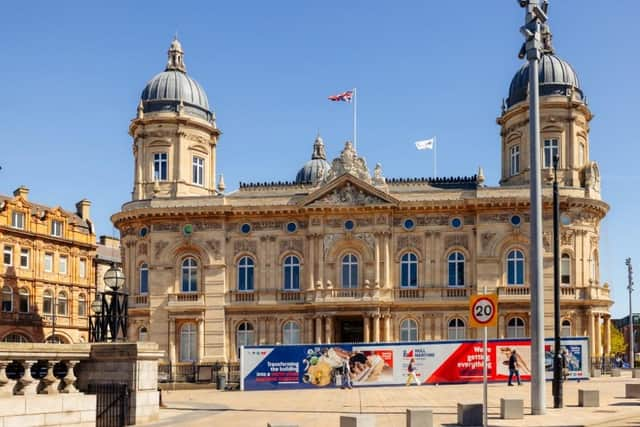

Dockside beginnings
What is today the home of the museum was built in 1871 as Hull’s Dock Offices. It was at the heart of the city’s bustling maritime trade and brought about because the Hull Dock Company needed larger offices. A design competition was held for the building, with architect Christopher Wray winning.
£90,000 was spent on its construction, much higher than an original estimate of £15,000 – some things do not change. Based on the Bank of England’s basic inflation calculator, this would be at a cost of £9.4m today.
It was well over a century after the building’s creation, and even after it first got listed in 1970 for its historic architectural value, that the building became converted into what is now Hull Maritime Museum. The city council bought the building in 1973 and the museum gradually opened up in phases between 1975 and 1980.
It was known back then as the Town Docks Museum. The museum itself had previously existed over at Pickering Park since 1912 as the Museum of Fisheries and Shipping.
Exhibitions through the ages
In its 45 year stint at Queen Victoria Square before its refurbishment closure, Hull Maritime Museum was not just known for its more longstanding exhibits, like Eric the Polar Bear and an iconic 40ft North Atlantic Right Whale skeleton. Its curatorial team have put on a range of temporary exhibitions.
These have tended to shine a light on Hull’s maritime heritage. For example, the city’s connection to the tragedy of the Titanic featured in a 2002 exhibition. There was particular focus on Hull-born fourth officer Joseph Boxhall.
He played a significant role in the evacuation as it sank, being one of the last officers to leave the liner and taking charge of a lifeboat. Following museum contact with his descendants, personal items like his telescope and pocket compass featured in the display. A Hull Daily Mail report from September 2002 states the Titanic exhibition drew in 11,000 visitors that August, twice as many as the museum usually got back then.
Two years later, the museum hosted an exhibition on the Dogger Bank Incident, or ‘Russian Outrage’, to mark a hundred years since the Imperial Russian Navy mistakenly fired on Hull trawlers in the North Sea during the Russo-Japanese War. Two British fishermen died and one vessel was sunk as as result.
Hull Maritime Museum has not only focused on the city’s maritime heritage with temporary exhibitions. It has also tapped into the wider cultural sector, such as hosting between October 2002 and March 2003 life-size and scale models of dinosaurs featured in the BBC hit TV series, Walking with Dinosaurs. It filled seven museum rooms and was described by then-head of museums in Hull as the first time they had “staged such an ambitious natural history exhibition”.
More recently, in 2016 it hosted the touring Animotion exhibition, funded by Arts Council England that explored interactivity and visitor participation via animation. Then-reporter James Campbell can be seen below testing out an exhibit.
City of Culture, Kraken and future reopening
The museum played its part the next year when Hull was the UK City of Culture. It got a record number of visitors through its doors and the building featured then and in years since as a spectacular backdrop for lights and animation displays in Queen Victoria Square. In 2019, plans were submitted to revamp Hull’s maritime attractions and build on City of Culture success.
Central to the Hull: Yorkshire’s Maritime City project has been refurbishment of the museum to open up more of its architecture and greatly expand its public space. It closed in January 2020, with initial work on improving accessibility at its Queen Victoria Square entrance.
The next year, a mammoth ten-week operation took place as the museum’s 50,000 objects were carefully relocated. Building works have included not only internal but external changes. The building’s south-facing clock on its tower, which dates back to 1871, got an extensive clean and a new automatic winding system installed. For the previous 150 years, it operated on a winding system that had to be manually wound every seven days.
When the museum reopens next month, its second floor will be opened up to the public and its collections much more digitised. One of the building’s domes will also be accessible, offering visitors stunning panoramic views of Hull.
The beloved North Atlantic Right Whale will also return, but with the opportunity for visitors to crawl inside the ribcage through a tunnel, and there will be around 50 per cent more objects on public display.
The refurbishment closure was originally intended to last until 2023, but there have been complications on the way.
In 2019, the museum’s refurbishment was costed at approximately £11m, but has ended up costing around £20.4m. As part of the wider Maritime City project, National Lottery and council funding has gone towards it.
Its doors may have been closed since January 2020, but the building has continued to play its part in the city’s cultural life since then.
Perhaps none more memorably than when the Hull Kraken ‘awoke’ from it in August 2021. This was a first major event in the build-up to the Hull: Yorkshire’s Maritime City project.
Its reopening has attracted global attention. National Geographic listed Hull as one of the top 25 places in the world to visit in 2026, with the reopening of Hull Maritime Museum specifically mentioned.