
'I explored the underground tunnels of Sheffield’s Megatron - it was a morning unlike any other'
The Sheaf & Porter Rivers Trust is running a series of underground tours taking explorers beneath Sheffield to the Megatron culvert. Christopher Hallam reports.
It was a morning unlike many I’ve experienced before.
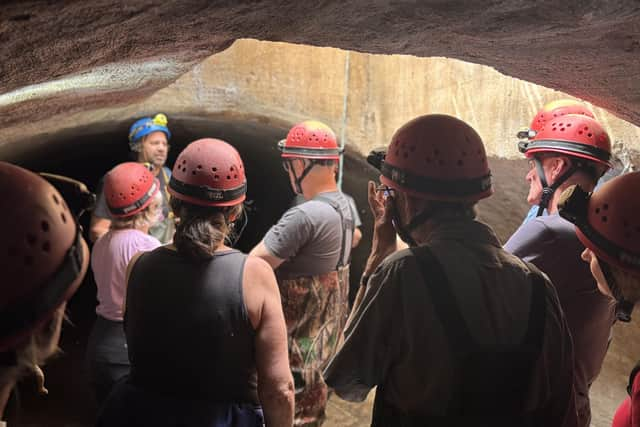
As I put on my newly-bought waders, I ignored the odd glances from passers-by before meeting the group of volunteers who will be spending 16 weeks of their summer taking explorers on twice-daily tours of the Sheffield’s underground – where they will venture into the depths of the Megatron.
For those of you not quite familiar with the aforementioned moniker, the Megatron culvert is a large labyrinth of tunnels hidden beneath Sheffield Railway Station, dating back to the mid-1800s.
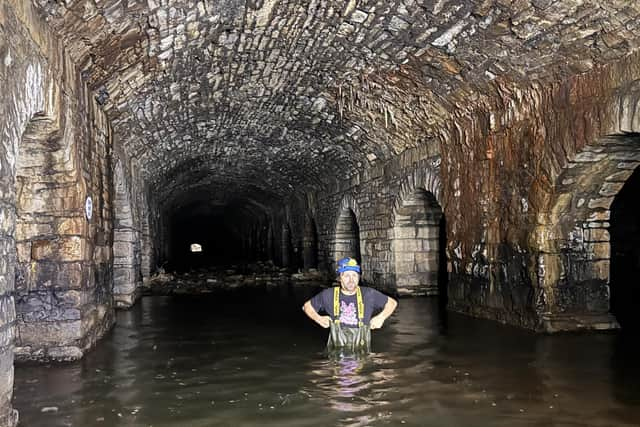

The Victorian-engineered subterranean drainage system boasts an impressive network of cathedral-like brick archways and interconnecting darkened tunnels.
It was originally built in an effort to channel the huge flow of water from the rivers Sheaf (from which Sheffield got its name), Porter and the Don, and contain the overflow following a storm.
The Sheaf & Porter Rivers Trust, which is working to uncover, celebrate and restore Sheffield’s historic waterways and restore the wildlife habitats within them, is running a series of underground tours taking explorers as far as the legendary Megatron culvert.
Each tour is manned by a number of volunteers who have given up their time to share their passion for the ecology of the city’s waterways.
And money generated from the outings funds things such as river clean-ups and the production of plans for river improvements as well as the installation of ‘light wells’ to cast some light onto these hidden rivers.
After a volunteer briefing at Matilda Street Pocket Park, previously covered by a timber yard, we drop down into what feels like a stream but is actually the River Porter.
There we make our way around to our first test – a knees-bent crouched scramble through the Porter Culvert underneath the car park of BBC Sheffield, the Sheffield Archives and Red Tape Studios.
Just ten-minutes in, I am relieved to have had the foresight to buy some waders, especially after seeing the varying water depths. No doubt they’ll come in handy during the city’s occasional floods also. I’d definitely recommend wearing proper sturdy footwear. People have done it in trainers. But you don’t know exactly what’s hidden in the water’s depths, so suit up accordingly.
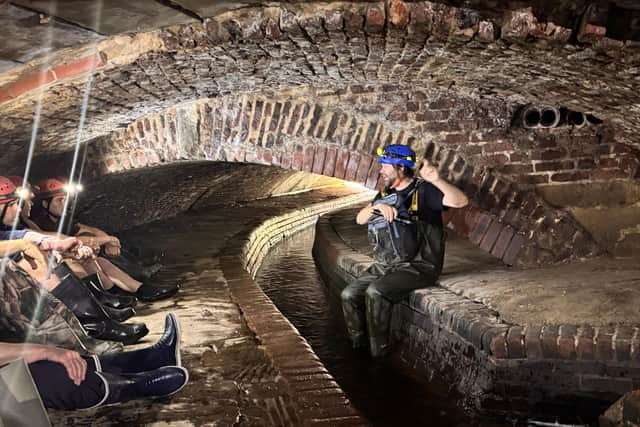
We make our way through the Sheaf & Porter Confluence, which leads us beneath Sheffield Station and the location of the first (of hopefully numerous) ‘lightwells’, casting natural light into the tunnels for the first time in 150-years. It’s a huge moment for the trust, which has painstakingly spent years trying to change the ecology and attitude towards the city’s many river systems.
Stepping and wading through the waterways is a great experience and one requiring slight agility in between avoiding the slippery algae build-up on rocks, wall-walking through water around broken weirs and crouching through some tight gaps.
The Trust chair, Simon Ogden, is on hand throughout to impart numerous nuggets of historical insight and to learn about and see elements of the city’s industrial past is fascinating.
We spot a number of aged grindstones, crucible caps, some tools and randomly, a creepy floating baby-doll – which is now positioned on an outwardly jutting stone in one of the tunnel walls.
Stalactites have begun to form in some of the tunnels below Sheffield Station, left untouched, but the team sometimes enter the tunnels to scrape and remove stalagmites – preventing these from growing upwards.
At Broad Street West, the culvert transforms into a large single arch. You can see here just how the area acquired the name ‘Megatron’ by urban explorers – who playfully competed with rival Manchester-based explorers who had named a culvert there ‘Optimus Prime’, after the comic and movie series Transformers. Spoiler: Sheffield’s is bigger… and better.
The first section is built from huge stone blocks, which previously accommodated the old wholesale market. This is followed by a shorter stretch of blue brick under Exchange Street – the chamber’s highest point. It was built around 1890 to serve as a ramp for electric trams travelling from Rotherham to central Sheffield.
Wildlife is beginning to thrive in the waterways once more. The River Porter is home to trout and a variety of birds (spot the Heron) - and a number of invertebrates are returning too.
There are even bats in some of the tunnels; the Daubenton's bat (a water bat) has been seen roosting in the dark ceilings and brickwork of the Megatron culverts.
The tour is great fun, but also comes with a continual health and safety warning depending on conditions. At points, parts of the water can reach chest height, and if there has been rainfall this will have an impact on the current and depth.
Conditions can change rapidly, so it’s helpful to have the support of the experienced caving guides from Howl Bushcraft and the trust, who impart their knowledge, opinions and share their passion with humour and refreshing honesty.
As we begin making our way back above ground, I realise that what was essentially a less than two-miles water walk was an informative and tiring one. But my, what an invigorating and exciting experience.
The Sheaf and Porter River Trust Megatron Tour has sold out for July, but ticket releases for August, and September will be announced later on its Facebook page at www.facebook.com/SheafAndPorterRiversTrust
For more information, and to book your place on a tour, visit www.sheafportertrust.org/guided-tours