
"I used to make guitars, but now I make high end furniture," Sam Parkin of Last Leaf Furniture in York
Number Ten Bootham is a higgledy-piggledy old building in York. It has, in recent years, been home to a children’s bookshop, an art gallery and a gentleman’s tailors. Now a song by Tom Waits has moved in.
Furniture maker Sam Parkin has always loved the song Last Leaf, with its line in russet defiance: “I’m the last leaf on the tree/The autumn took the rest, but they won’t take me…”
That’s why the hardwood furniture he makes is stamped with the name Last Leaf. He loves wood, a useful passion in his line of work, and could talk about it all day.
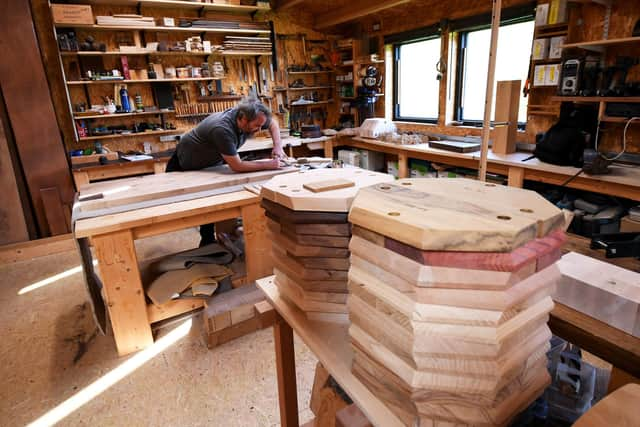
When Sam, 42, isn’t talking about wood, he saws and hammers and chisels it in a workshop behind his home in Flaxton, doing everything himself, mostly by hand and with minimal use of technology.
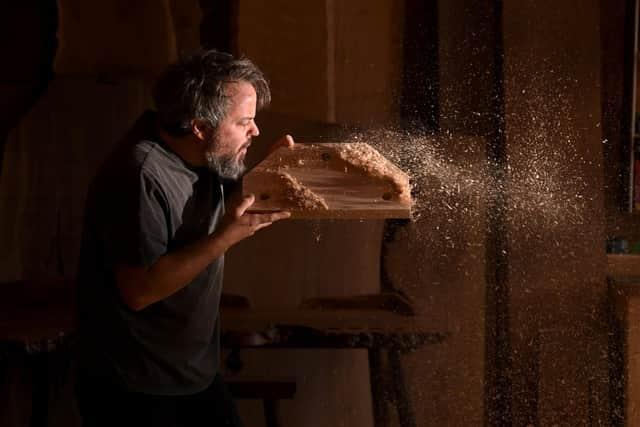

He has just moved into Bootham to open a shop and gallery.
To understand how Sam arrived where he is, you have to start with the guitar.
Sam, who was born in Leeds and grew up in Rawcliffe in York, studied to be a luthier at London Metropolitan University.
“I did guitar making,” he says. “I love making stuff, and I love music, so it was a natural thing. When we turned up, one of the first things one of the lecturers said was, ‘You will not make a living’.”
Sam laughs at this memory. He often chuckles. He is bright-eyed and hirsute, with thick greying hair and beard.
Guitar making, he says, involves many useful skills.
“I knew from day one I was going to go into furniture. With building guitars, everything has to be precise, which is fine; I enjoy that. But there’s little room for creativity because guitarists are generally purists; they want what they saw their hero playing in 1962, and for good reasons, because it’s a huge part of the sound.”
Sam plays the guitar himself and still has the instruments he made – but prefers his old Martin.
“I can’t bring myself to play anything else because it’s so nice.”
He and his partner, Amy, moved to the West Country for a while. After three house purchases fell through, they were visiting York when they spotted a house in Flaxton, a bungalow on a corner plot.
“We thought you could build an amazing workshop here.”
And that was the beginning of Last Leaf.
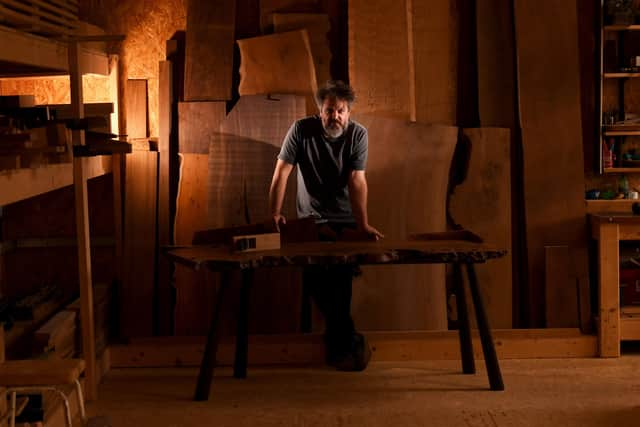
The workshop is modern and spacious, although the house where he lives with Amy and their two young children “is still terrible”.
After his degree he worked for furniture maker Treske in Thirsk, then met a builder who said he’d build the workshop for cost if Sam worked for him.
“I did that for two years, doing green oak framing. It was really good fun.”
Before Sam had a chance to establish himself fully, the workshop flooded. That happened after he and Amy had visited A&E when their then-five-week-old baby was ill.
“We were there till 4am. I drove us all back home in a massive rainstorm and got everyone into bed. Then at 6am…”
Here he makes two loud raps on an old wooden pillar in the shop.
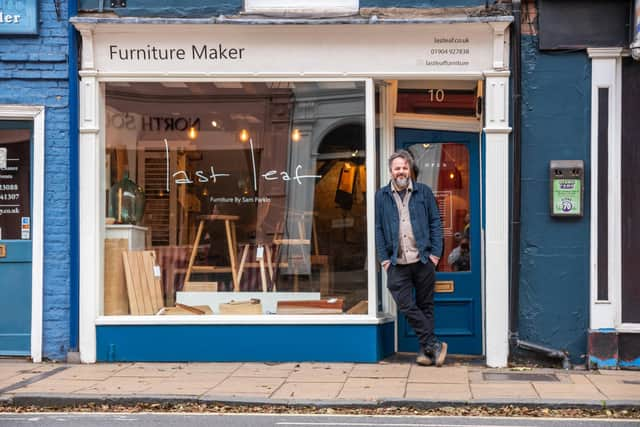
“The neighbour was at the door saying there was a flood,” he recalls. “There’s a culvert under the road opposite, and it wasn’t big enough; it was blocked.
“The workshop was six inches under when he woke me up, and it was about an inch from coming in the house.”
To conjure a mental image of Sam that morning, picture him in pyjamas and steel-capped wellies, after two hours’ sleep, using a spade to dig a channel from the verge of the road.
He saved the house, but the damage to the workshop was done.
They wrote off the year, living on savings and credit, while Sam restored the warehouse before returning to furniture making.
Until now, Sam has mostly drummed up business through exhibitions. A month-long show at Lotte Inch’s gallery, where he now has his shop, led to three years’ worth of commissions and gave him the idea for his own gallery.
Sam makes heirloom furniture, pieces that will last a lifetime and be handed down to the next generation.
As we talk, Sam sits on the narrow stairs, above one of the shop counters, a piece of wood with the bark and bend of the tree it came from still visible.
“This is burr from horse chestnut,” he says. “It’s really hard to come across. I make one-off bespoke commissions.
“What I really enjoy is making one thing once. You can play with an idea or design that keeps coming back.
“I love doing tables. They’re going to be treasured. And things happen around a table three times a day; they’re used. It’s fun to make an ornate, fancy piece of furniture, but they’re not things that need to exist. Desks, tables, and coffee tables are brilliant to make. And with tables you can be more free, as sculptural as you want.”
A large and elaborate table can take a while to make. One he sold to someone in Bootham took two and a half months.
“It was a sculpture with a plank of wood on top – a very nice plank of wood. Some dining tables I can make in as little as eight or nine days.”
Sam visits a client to see the space and discuss what ideas they have. Then he comes up with two or three designs and suggestions for materials. Naturally, the longer it takes to make, the more the table costs.
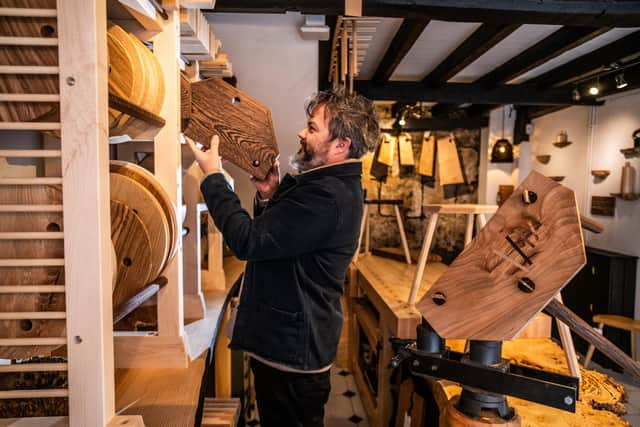
Upstairs in the gallery, a beautiful round tabletop decorated with marquetry stands vertically on a sturdy easel. Piano keys and offcuts from a guitar fingerboard are among the tiny pieces embedded so skilfully that at first you don’t realise you are looking at anything other than wood.
The inlaying took two weeks.
“I started and just kept going. I had to stop myself in the end.”
Downstairs the shop has a small workshop. There, Sam will make to order three-legged stools using a wedged tenon joint. He produced a dozen for a show once, and they all went, and this is now a useful sideline.
“I’m very much going to be working on commissions most of the time, but I’ll be making these, too. The tops are all made in the workshop to a certain level, and then all the legs and components will be here. You can come in and order one, and they’ll be ready ten days later.”
One question makes Sam squirm. Has he been learning on the job, or is it something else?
“I always hate saying this, as I never know how to say it without sounding like an idiot. Can I just say it comes naturally? I can just do it. I don’t know why; it’s how my brain works. I design in my head a lot.
“If things are complex or use expensive materials, I will draw by hand. It’s a slow process, and by the time you’ve done that, you know what you’re making and how you’re going to do it. All my work uses specialist timbers, and that goes back to the guitars.”
For more information on Sam’s furniture, visit lastleaf.co.uk or visit Last Leaf Furniture at 10 Bootham, York.