
Incredible journey of huge Neolithic stones across Yorkshire uncovered
It was a building task which would test the skills of construction teams today, let alone those of thousands of years ago.

Researchers have shed new light on a series of prehistoric stones in Yorkshire, revealing the 25-tonne structures were hauled 11 miles across land by Neolithic builders.
The Neolithic age spanned 12,000 years ago to around 2,000 years BC.
Geological analysis showed Neolithic communities bypassed more local stone sources to bring the giant megaliths, known as Devil’s Arrow stones, from Brimham Rocks, North Yorkshire, settling a long-running debate over whether human effort or ice-age glaciers moved the giants.
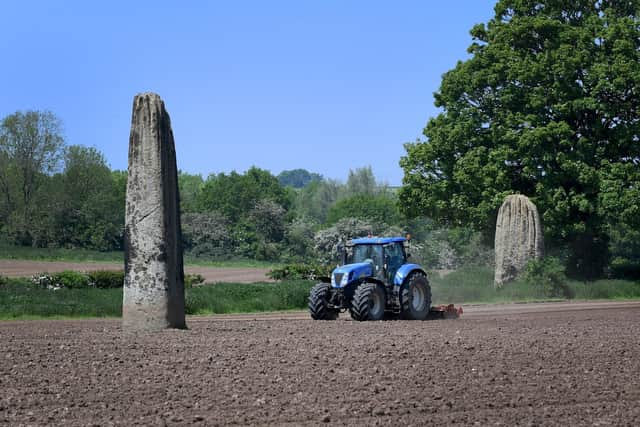

Researchers at the University of York and Curtin University in Australia also confirmed that a missing stone is "hiding in plain sight" in the nearby village of Aldborough, in the form of a cross, proving 19th-century theories and local legends to be true.
At almost seven metres (23ft) tall, the three surviving pillars near Boroughbridge form the tallest standing stone row in Britain, and taller than the stones at Stonehenge.
The southern stone is the second-tallest megalith in the country after the Rudston Monolith, while the central stone ranks as the third-tallest.
The team used Isotopic "fingerprinting" to match the stones to Brimham Rocks, 11 miles – or 18km – west, proving builders deliberately sought out a specific, distant landscape rather than using nearby sources.
Dr Jim Leary, from the University of York’s Department of Archaeology, said: “Sites in southern England and Scotland receive considerable attention, but monuments like the Devil's Arrows have remained comparatively understudied despite their significance.
"We have now proved that Neolithic communities moved several 25-tonne stones 18km across Yorkshire, transforming a familiar site into an epic quest to create a sacred landscape.”
Tudor antiquarian John Leland recorded a fourth standing stone in the mid-16th century, but decades later it was said to be missing.
In 1687, it was recorded that locals had broken up a fallen stone, using part of it to construct Peg Bridge over the River Tutt and taking the top segment to Aldborough manor.
In the 19th century, antiquarian J.R. Walbran proposed that another fallen monolith had been recycled into the Battle Cross – a 5.5-metre monument crafted in the 15th century to commemorate the 1322 Battle of Boroughbridge.
The new study's mineral fingerprinting has now confirmed Walbran's theory, proving the medieval cross that remains standing in Aldborough today is indeed a carved segment of a long-lost Arrow.
The Devil's Arrows stand on Triassic Sherwood Sandstone, but the monoliths themselves are made of Pennine Basin Millstone Grit - a coarse-grained sandstone deposited over 300 million years ago.