
'It's history in your hands' - The new wave of metal detectorists finding joy in old treasures
Metal detecting used to be the preserve of predominantly older men who enjoyed foraging for coins and discarded buttons with the potential of discovering hidden treasure.

But the rise of younger detectorists on social media and television programmes that feature mudlarkers searching the foreshore of the River Thames have transformed that perception.
One of the new converts is Daniel Hartley, 24. By day, he is a project manager in Bradford but at weekends he is a detectorist.
In two years of searching he has found numerous items including a silver penny which may be more than 750 years old and a seal which intriguingly contains the name of the man who used it in the 14th century.


Daniel, of Norristhorpe, Liversedge, said he took up the hobby as he always had an interest in history.
He started with a cheap metal detector but has now moved up to a £1,600 machine which he says is much more sophisticated.
He said one of his most interesting pieces was a silver penny from Edward I era – or Edward Longshanks, as he was known because he was so tall.
“This was minted in London between 1272 and 1307, likely in the midst of the Scottish wars of independence.
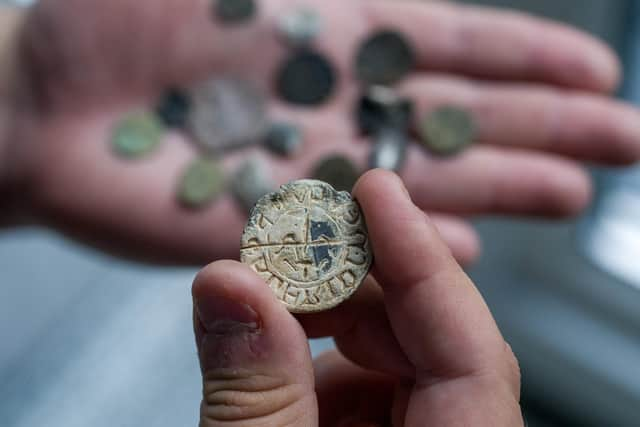
Daniel said: “Silver pennies like this would have been carried through the areas of Windy Bank and Hartshead (West Yorkshire) by traders, travellers and locals on their way to local landmarks such as the Walton cross, St Peter’s Church at Hartshead, the well at Ladywell and the Kirklees Hall estate, with all these places being fundamental to the functioning medieval community.
“Coins like these often sink in the soil over the centuries but can be saved by frequent ploughing that brings deep soil back to the surface carrying these lost artefacts with them.”
He also found a medieval seal belonging to Geoffrey of Newcomb from the 14th century in Lincolnshire. Not much is known of the man but the seal contains his name which at least makes him real.
“There is no feeling like it to pick up an item for the first time in some 700 years or so,” he said.
“It might not be worth more than £50 or £100 but that’s not the point. It’s history in your hands and we have brought Geoffrey back to life in a way.”
Daniel is partly inspired by television programmes such as a series on the History Channel which followed charismatic presenters like Johnny Vaughan and expert mudlarker Steve "Mud God" Brooker exploring the Thames foreshore to discover items connected to London's history.
In the 18th and 19th centuries, poor Londoners sold scraps they found on the foreshore to earn money. They became known as mudlarks.
Now mudlarks use their keen eyes, metal detectors and trowels in the hunt for objects, and they play an important role in preserving the city’s past.
And Mackenzie Crook and Toby Jones further popularised the hobby in the BBC series Detectorists.