
Kellingley colliery: Remembering a time when Yorkshire was the coal king of Europe
A Yorkshire Post and Leeds Intelligencer headline from September 4, 1954, shouted: ‘New colliery planned near Pontefract’.
An article explained that a modern all-electric colliery, intending to produce 1,500,000 tons of coal a year, was planned at Kellingley, near Pontefract.
The County Planning Department had sent details to Knottingley Urban Council of an application by the Castleford Area of the National Coal Board (NCB) to establish the new colliery. The site covered around 177 acres.
W.H. Sales, chairman of the North Eastern division of the NCB, said at Knottingley on May 12, 1959 that the board must fight back to enable the coal industry to regain its place in the nation’s markets. He was laying the foundation stone of the new multi-million-pound Kellingley colliery.


A report said the work had started about 18 months earlier on the project and claimed it was the first new pit to be sunk in Yorkshire since 1927. Sales pointed out that since Vesting Day some £103 millions had been spent on Yorkshire pits ‘an indication of the confidence that is placed in the Yorkshire Coalfield.’
A British record for shaft sinking was achieved during January 1961 at Kellingley when 339 feet was completed. The previous record was 319 feet at Parkside colliery in the North-Western Division in 1959.
On a visit to Kellingley in August 1961, NCB chairman Lord Robens, spoke about the coal industry’s future with the Common Market: ‘If and when the United Kingdom joins the Common Market, we shall have tremendous opportunities for selling coal in Europe, provided that we are competitive, and I have no reason to believe we shall not be competitive.’
On Wednesday May 5, 1965, Kellingley colliery, dubbed ‘Big K’, was officially opened. Many distinguished NCB and NUM personalities were present for the event.
One report said: ‘From the present force of 750, manpower is due to grow to 1,700, and as the four-mile “take” of Kellingley has workable reserves of 172 million tons, a life of well over 100 years seems ensured.’
Another said that above ground, a great deal of trouble had been taken to preserve the local scene, ‘Kellingley’s surface buildings look more like a modern factory than the conventional idea of a pit.’
An open day over August Bank holiday 1974 turned Kellingley colliery into a tourist attraction. As well as offering side-stalls and sports events, visitors were able descend 2,000 feet to see the underground workings.
November 1977 saw Kellingley miners smash the county coalfield’s six-year-old record for a single week’s production. They produced 44,136 tons of saleable coal.
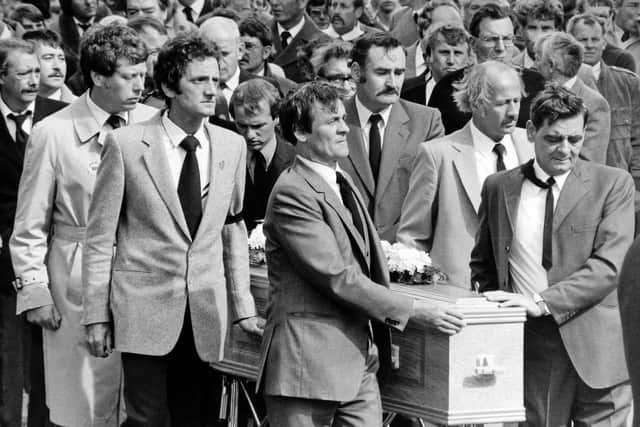
In June 1984 around 8,000 miners followed the funeral cortege of Kellingley miner Joe Green, the second of their colleagues to die on the picket lines during the 1984/5 strike.
Joe of Knottingley near Pontefract died in an accident with a lorry while picketing Ferrybridge Power Station.
Miners from all over the country took part in the procession from Pontefract racecourse to the town’s crematorium. They were led by the Kellingley colliery band. Following up were NUM President, Arthur Scargill, Jack Taylor and MPs Geoff Lofthouse and Bill O’Brien.
Joe’s coffin was escorted into the crematorium by Scots piper, Gordon Queen, who played Scots Lament. Family, friends and union officials packed the crematorium and the service was relayed outside by a p.a. system. Arthur Scargill described Joe as a ‘fantastic lad.’

In September 1984, police organised a 24-hour guard on the home of a Goole miner who returned to work at Kellingley. He had become the target of a hate campaign and was one of two miners to run the gauntlet of thousands of angry pickets outside the pit.
An NUM official said: ‘He and his mate are only getting into Kellingley because of the police. The two men will probably be “sent to Coventry” when everyone returns to work.’
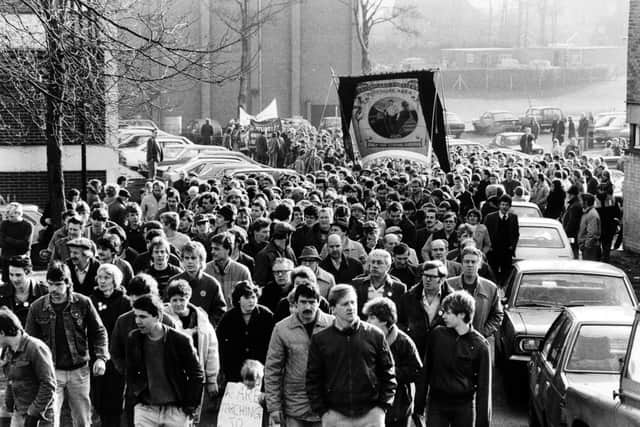
On 5 March 1985 miners were led back to Kellingley with banners flying, in a symbolic return, by union officials. It took 40 minutes to complete the walk of several miles from the social club to the pit gates and the men were accompanied by supporters, their wives and children.
An almost carnival atmosphere prevailed for much of the march but, as the procession passed the homes of strike-breakers, and a knot of police, there was vicious chanting.
The House of Commons Select Committee on Energy visited the coal face at Kellingley in February 1986 to learn some ‘pit talk.’
The committee was about to launch one of its periodical examinations of the coal industry and chairman, Ian Lloyd (Con. Havant) said: ‘We have come to familiarise members of the committee who know little about the coal industry apart from what they have read…Our brief is the future of the industry and the terms of reference have been cast as widely as possible so that we can look at everything which affects the future of coal in the United Kingdom’.

Other committee members included Pontefract Labour M.P. Geoffrey Lofthouse, Dr Michael Clark (Con. Rochford), James Pawsey (Con. Rugby and Kenilworth) and Peter Rost (Con. Erewash).
Miners at Kellingley were the Coal Kings of Europe again after recapturing their crown with an output record of 70,262 tonnes during a week in September 1988.
Kellingley’s new British and Euro best was almost 2,000 tonnes up on the previous record of 68,362 tonnes set by Wistow in December of the previous year.
Colliery manager Roy Cocker said: ‘The title is now back where it belongs – at Kellingley. We have been knocking on the door for several weeks, averaging 55 to 60,000 tonnes a week, so it is no flash in the pan.’
In January 1992, British Coal said that Kellingley was to face ‘a substantial reduction’ in manpower because of poor development rates.
It was stated the pit employed hundreds of mineworkers and was alleged to be in the top 10 of the country’s high-cost pits.
Six years later, Peter Mandelson visited Kellingley at the request of Pontefract MP, Yvette Cooper, one of the Labour MPs fighting to save pits, to see for himself what the industry was all about.
Afterwards he said: ‘I saw great men working with great technology...I had a warm welcome and it is a privilege to see such a committed workforce.’
A memorial to all those who had been killed at Kellingley was unveiled on September 30, 2010. It was carried out by widows – Sue and Carole – whose husbands had died during the previous two years.
Don Cook was killed by a rock fall on September 30, 2008. Ian Cameron died on October 18, 2009 when equipment fell on him.
NUM members raised funds in a number of ways – bike rides, a coast-to-coast walk, a charity rugby match, and an auction – to contribute towards the costs.
Kellingley NUM delegate, Keith Hartshorne, commented that this was more appropriate than a tree or a bench for those who had lost their lives. The memorial was created by renowned sculptor, Graham Ibbeson, who had produced sculptures of Dickie Bird and Fred Trueman.
The Kellingley work included a pit face, a miner, and two coal tubs.
According to Kellingley’s NUM Branch Secretary. Keith Poulson, the union tried to find a record of all the men killed at Kellingley but this had not been possible, adding: ‘With the pit being sold first to one company, then another, there doesn’t seem to be a record of the men killed or their names. We tried the Health and Safety Executive as well.’
Kellingley colliery closed on December 18, 2015, marking the end of deep-pit coal mining in Britain.