
Kippax: How historic Yorkshire town got its unusual name
The Kippax place name is derived from an Anglo-Saxon first name, ‘Cippa’, and the old English term for Ash tree, ‘aesc’.
In the Domesday Book (1086), the settlement was recorded as ‘Chipesch’ and by the 12th century had evolved to ‘Kippeys’. Later, ‘Kypask’ and ‘Kypax’ were recorded.
Following the introduction of the Poll Tax in the late 14th century, variations of Kippax – ‘Kepas’, ‘de Kepax’, ‘de Kypax’ – started to be adopted as surnames.
There are several instances of these in the Poll Tax records of Yorkshire and Lancashire, whilst the name also appears in church registers for births, marriages and christenings.

The West Yorkshire Archaeological Advisory service’s Dave Weldrake says Kippax Castle was established by the de Lacys to act as an administrative centre, the activity continuing until the late 12th century.
There is speculation that the castle may have been dismantled at this time or shortly afterwards.
Weldrake suggests it was likely that the Keep was originally a wooden structure and was never rebuilt in stone.
He adds: ‘The most visible survival of the castle today is a circular earthwork known locally as “Cheney Basil”.’
The churchnearyou website boldly states that St Mary’s at Kippax is the most dramatic example of the Yorkshire group of Norman churches characterised by their herringbone pattern masonry.
The Kippax church dates from the 11th century but claims are made that the use of the site for worship extends pre-Domesday.
During the building’s restoration in the 1870s a roman coffin was found beneath the nave.
Also, in the mid-1870s, a local antiquarian found two fragments of an Anglian cross shaft built into the threshold of the high-level doorway in the tower’s west wall.
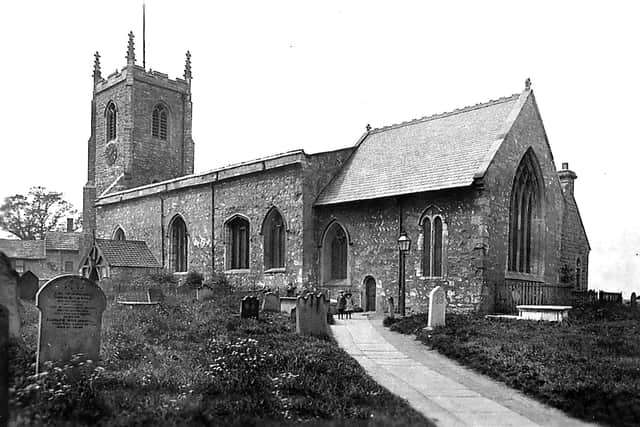
St Mary’s tower underwent restoration in the early 1890s, the work organised by York architect G.H. Fowler Jones.
The Yorkshire Gardens Trust says that from the time of Norman Conquest Kippax Park was originally part of the de Lacy family estates, before passing to the Duchy of Lancaster in 1322 and Thomas Bland in 1595.
The Bland family hailed from Leeming in North Yorkshire and were landowners in Kippax, Allerton Bywater and Castleford. They were granted the Bland Baronetcy in 1642. Several Bland members served as MPs.
Sir Thomas Bland erected Kippax House on the site of a former hunting lodge. Later, large additions were made to the building.
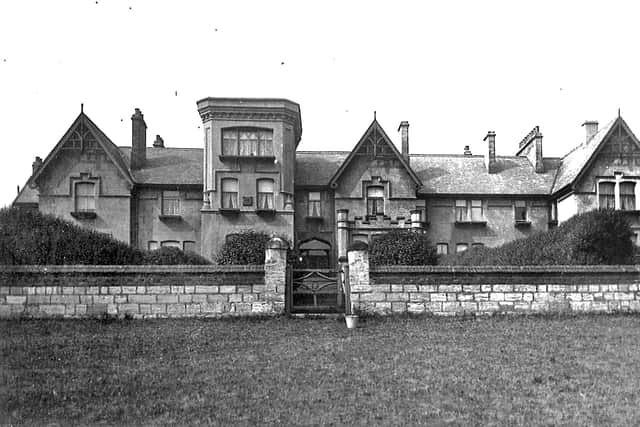
Pevsner (1967) puts forward James Paine’s name as the architect responsible for much of the work. The house’s frontage eventually having a staggering number bays.
Yet, Peter Leach in his erudite book on Paine (1988) does not to confirm the submission.
The Bland family intermarried with the Davison family and it led to the ‘Davison Bland’ line. These family members played a prominent role in the area’s history for a number of centuries.
References relate that coal was mined at Kippax from the 14th century. Several coal pits are noted on an OS map surveyed 1845 to 1847 and published in 1850.
The allertonbywater parish council website mentions that prior to 1858 coal was extracted from shallow ‘bell pits.’
A main colliery situated near Owl Wood – between Kippax and Allerton Bywater – was sunk in 1858 by Jospeh Locke & Co. to mine the Haigh Moor seam. Joseph Locke was a legendary civil engineer and railway pioneer who is most notable for building the Grand Junction Railway.

The first sod of the Leeds Pontefract & Castleford Railway was turned on Saturday April 17, 1875 by T.D. Bland III of Kippax Park.
The new line running to the west of the village was originally promoted by influential land and coal owners in the district.
After the opening of the railway in 1878, and now operated by the North Eastern Railway Company, coal was sent via this rail link.
The colliery brought an expansion in house building at Kippax to accommodate miners and their families.
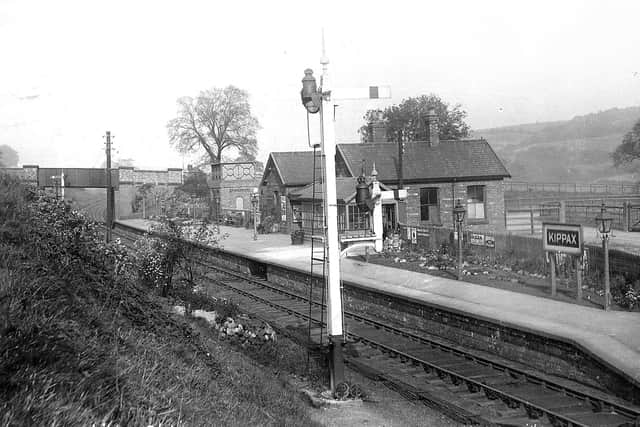
According to Michael Quick (2009), Kippax railway station opened August 12, 1878. The facility had one platform and a goods shed.
The chief traffic from the station was aggregates, a local quarry having a siding just to the north of the station.
John Davison Bland inherited Kippax Hall and estates in 1885. He was educated at Eton and Christ Church, Oxford.
During the Victorian period a large property becoming known as Kippax Old Hall was erected just off the High Street for Edgar Breffitt owner of the Calder Glass Works in Castleford.
The 20th century saw considerable change and developments in Kippax. A notice from May 1903 mentioned the Kippax colliery ‘which has been working for 40 years has been closed Over 100 hands are affected’.
During October 1907, the results of the annual competitions promoted by the North Eastern Railway Company for the best kept wayside station on their system were announced.
In the Leeds district, Kippax secured a special certificate.
A small company trading as the Yellow Bus Service was established by the Watson family in 1924.
With vehicles painted in yellow and maroon, a service was run from Leeds to Ledston Luck, via Cross Gates, Garforth and Kippax.
In time further services were added and the company became known as the Kippax & District Motor Co.
From June 1, 1956 the firm – according to the local transport history website – came under the control of the Wallace Arnold Group. But, ‘it continued to be operated as a subsidiary under the Kippax a & District fleet name.
The final journey of the ‘Yellow Bus Service’ in Leeds occurred on Sunday March 31, 1968.
John Davison Bland died aged 76 in 1928 at Torquay without a direct heir. Kippax Park was inherited by the daughters of his cousin Frederick Millbank Davison Bland.
John Davison Bland left unsettled property of gross value £633,890 and bequests to several organisations and Leeds charities.
Newspapers reported in October 1929 that high prices were paid for the sale of furnishings and effects at Kippax Park. They included five Chippendale mahogany chairs ‘in the Chinese taste, with concave seats’.
Thereafter, Kippax Park House went into decline and was eventually demolished. Open cast mining took place over Kippax Park from 1953 to 1962. Michael Quick states that Kippax station closed in 1951.
The site has been cleared though the trackbed is converted to a cycleway. At the end of October 1958, the Kippax Park estate of nearly 2,350 acres was sold by private treaty.
It was quoted as consisting of ’13 farms, two smallholdings, Peckfield Colliery, a number of cottages and approximately 120 houses.’
‘Alderman Breffitt’s Kippax Old Hall is in ruins and a dangerous eyesore’ the Yorkshire Evening Post claimed in February 1988 and the building was subsequently cleared.
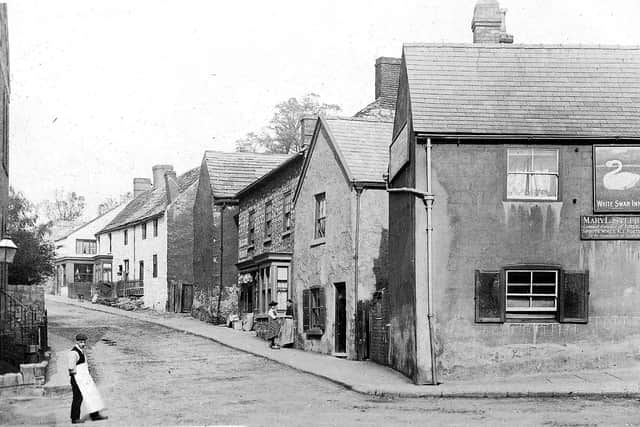
A popular Kippax pub for many years has been the White Swan at the Cross Hills junction.
It has been known as Kate Mason’s after a popular former landlady. Kippax, once a mining community has become a dormitory town, the closeness of several motorways providing easy access to numerous workplace destinations.
Thanks to Susan Stepan at Leeds Libraries and Professor Dr Paul Buckland for help with this piece.